Astralive has closed a seed round and a seed-plus round, both in the tens of millions of RMB. The company is a spin-out of Tsinghua University’s computer science department, and what it sells is unusual: it does not build robots and it does not train foundation models.
The seed round was led by Shunxi Fund, which carries Beijing state capital. The seed-plus was led by Lingyun Guang, with Zhongguancun Capital and First Capital participating. Patient state money on one side and an industrial strategic buyer on the other is an unusual combination for a company this young, and it is the clearest signal in the deal.
The bottleneck nobody photographs
Language models had the internet. Robot models have no equivalent. There is no natural corpus of manipulation, so every hand pose, grip force and slip correction has to be recorded deliberately. Xinhua reported from the 2026 World Robot Conference that the industry still lacks data on hand joint motion and applied force at the scale needed to make dexterous hands work in ordinary settings.
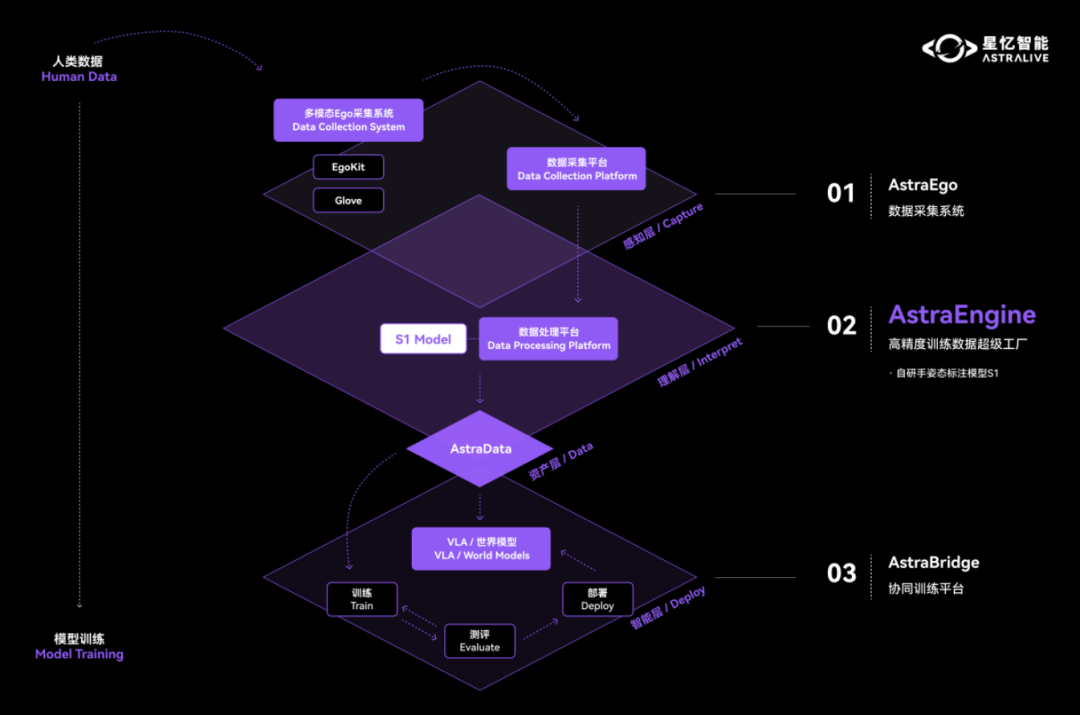
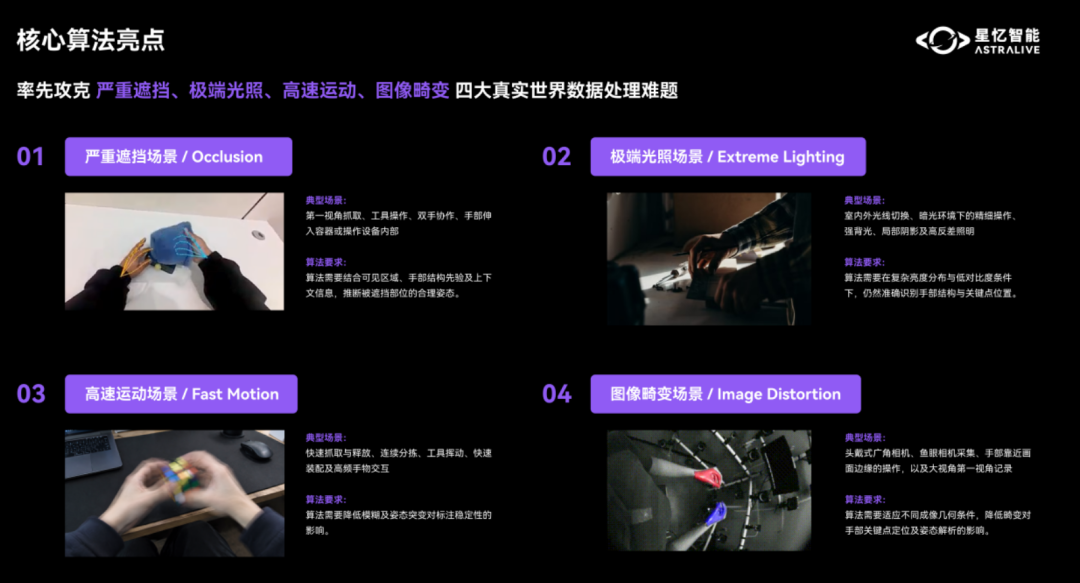
Astralive attacks the hardest slice of that gap. Its EgoKit system puts a headset and a tactile glove on a human and records fine manipulation in first person. Its HBR engine then processes the footage against four specific failure modes: severe occlusion, image distortion, fast motion and extreme lighting. The output is hand pose and multimodal fusion at millimetre resolution, with automated labelling.
The company’s internal line is that a demonstration with a tremor, a drift or a timing error does not teach a model a skill, it teaches the error. That is why the rig uses a black glove: it makes gesture recognition reliable in the worn state so that vision, touch and pose fuse into something trainable.
Who is behind it
Founder and chief executive Song Zhiheng ran the full-size bipedal humanoid product line at AgiBot before this, and was an early employee at MegaRobo before that. Years of shipping products left him with a blunt read of the market: the scenes that sell the most units are still showrooms, stage performances, research labs and data collection, none of which produce a repeatable productivity loop.
His conclusion was that robot intelligence is fed, not reasoned. In 2026 he and co-founders from Tsinghua and Beihang set out to industrialise the digitisation of human manipulation, supplying high-precision action data to model builders the way a utility supplies water.
Lingyun Guang’s involvement goes beyond money. Its wholly owned subsidiary Yuanke Shijie has a deep strategic agreement with Astralive to build a closed loop from capture through annotation and quality assessment to delivered training data. Lingyun Guang has also invested in Zhipu, and the pattern is consistent: industrial capital buying access to a scarce technical layer rather than a story.
The scaling argument
Nvidia Research published its EgoScale framework in 2026, using more than 20,000 hours of action-annotated first-person human video, and observed a relationship between data volume and model performance that is close to log-linear. Meta and 1X have shifted toward human first-person capture as well. When the strongest labs converge on one data format, the suppliers of that format stop being a niche.
China’s version of the bet is that a Tsinghua-trained team can match or beat the capture fidelity of the American work. Song’s framing of the moat is unusually clean for this sector: the body can be bought, the algorithm can be forked from open source, but high-precision action data with real-machine feedback has no market to buy it from.
His forecast is three years to reach factories and five to reach homes. Whether that holds depends less on any single humanoid launch than on whether the data layer gets built first.
Editor’s note: This is an adapted translation of the original OFweek report. It has been trimmed and restructured for readability for an international business audience. The full original (in Chinese) is at https://robot.ofweek.com/2026-10/ART-8321205-12003-30708459.html.