Zero-Form Robotics closed a Series A on 29 September, its sixth round in nineteen months. Investors included Wuxi Guolian Xizhou Fund, Tsingke Industry Investment, Cowin Capital and Hefei Industry Investment. The company was registered in January 2025 in Baohe district, Hefei, and its founding team came out of Tsinghua’s AI and robotics laboratory.

Founder and chief executive Min Yuheng holds a Tsinghua master’s in artificial intelligence. The early cheques came from local state vehicles, the Baohe Venture Capital arm and the Hefei seed fund, which is how a prototype becomes a product in Anhui. Later rounds brought in automotive component makers and industrial investors, and that shift matters more than the headline amount: industrial capital brings supplier introductions and customer doors, not just cash.
The hardware, briefly
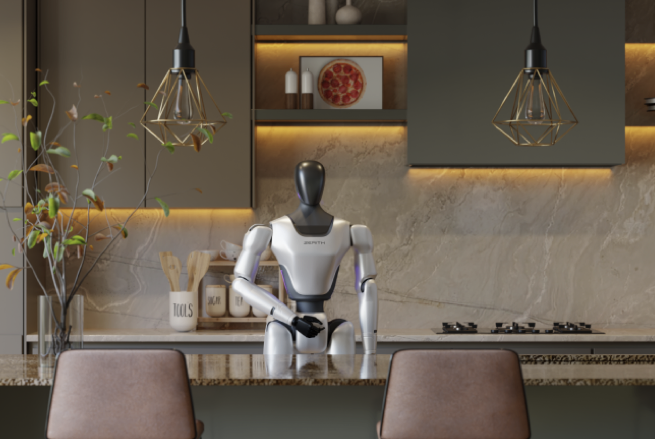
The ZERITH Z1 biped runs 27 degrees of freedom with peak joint torque of 150Nm and a payload-to-weight ratio above 70 per cent. The control stack fuses rigid-body and floating-base dynamics, which is the standard way of saying it can handle slopes, steps and uneven ground while doing grasp, carry and interaction work. A second product, the wheeled H1, pairs a wheeled chassis with a humanoid upper body and an arm reach of about 80 centimetres.
Why B-end first is the boring correct answer
The company deliberately skipped the home. It targets business service, exhibition and education, where the buyer has a budget line, the environment is semi-structured and the failure mode is an underwhelming demo rather than a broken vase. Unit margins are thin, but the data is real, and real interaction data is the only currency that compounds in this industry.
Hefei is doing its part. Baohe district now hosts more than 100 robotics supply chain companies, has opened robot experience stores, and offers shopping districts, parks and exhibition halls as test sites under what the local government calls a scenario partner model. That is a city acting as a customer of first resort, which is a cheaper subsidy than cash and harder for a rival region to copy.
The counterweight is the sector’s own arithmetic. Several hundred Chinese companies can now assemble a walking prototype, because the reducers, servo motors and controllers are all purchasable. Differentiation then depends on delivery, yield and whether a customer pays twice. Nineteen months and six rounds buys time, not a moat.
Editor’s note: This is an adapted translation of the original OFweek report. It has been trimmed and restructured for readability for an international business audience. The full original (in Chinese) is at https://robot.ofweek.com/2026-09/ART-898890-12003-30705229.html.