Open a cupboard, find the blocks hidden inside, then stack them into a bridge. A child manages it. For a robot the task splits into capabilities that live in different models: vision and language following to find the blocks, contact-rich interaction to open the door, geometric planning and fine control to build the span. Vision-language-action models, world-action models, reinforcement learning policies and task-and-motion planners each do one part well, and none of them talk to each other.
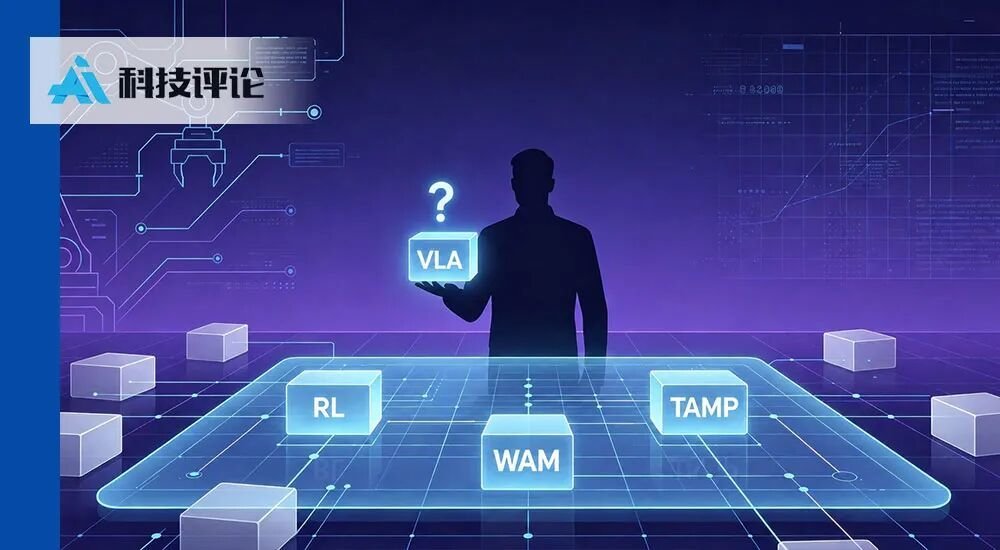
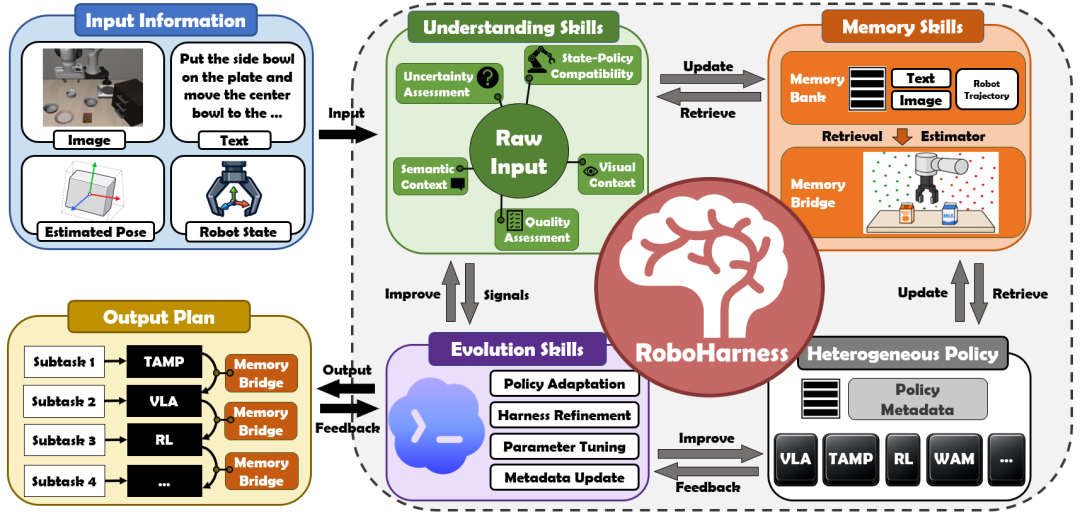
A paper called RoboHarness takes the problem seriously. Rather than waiting for one model to be good at everything, it wraps each independently developed control system, VLA, WAM, RL policy and TAMP, as an agentic skill and puts a coding agent in charge of deciding which one goes to work. The design has one hard constraint: nothing underneath is retrained. No shared architecture, no shared action space, no shared data.
The routing problem is quantitative
The obvious objection is that a language model cannot know which policy fits. It can read the instruction, but it cannot estimate from a raw image how close the current scene sits to a policy’s training distribution, or how reliable the sensor data is right now. So the system adds three classes of helper skills.
Understanding skills convert raw input into measurable signals, including embedding similarity between the scene and each policy’s training data, pose stability over a time window, and whether lighting and image quality clear a threshold. Those numbers, not the sentence, decide the routing. Memory skills retrieve prior executions and, through a module called Memory Bridge, handle the mismatch between policies. Evolution skills update policy metadata and orchestration logic from online feedback, so the system learns instead of re-deciding from scratch every time.
The handover is the hard part
Two independently trained policies inhabit different data worlds. The state where a TAMP planner stops is precisely the state a VLA may never have started from. Memory Bridge addresses the seam in three steps: retrieve the top matching successful trajectories for the incoming sub-task, fit the target policy’s preferred handover state range by online regression, then sample and score candidate states to generate a transition trajectory before handing over control.
The ablation is the most useful number in the paper. Remove Memory Bridge and task progress barely moves, which means routing is still broadly correct, but full success collapses from 86.0 per cent to 60.4 per cent. Most of the failures are tasks that reached the last step and died at the handover.
Two lineages, converging
RoboHarness sits on a specific branch of the family tree. Tsinghua’s Yu Chao team published Harness VLA in July, which froze a VLA for contact-rich manipulation and added a harness layer to decide when to invoke it, how to reset and how to retry, lifting success on the LIBERO-Pro perturbation benchmark from 50 per cent to 82.4 per cent. That fixes the stability of one specialist. RoboHarness handles what happens when the task exceeds any single model’s boundary.
The geographic split is real. West coast groups such as Stanford and Berkeley push learning and scaling, betting on end-to-end models and data volume. The American northeast and Canada, MIT, Toronto, MILA, keep faith with hierarchical planning and structured decision-making. Physical Intelligence’s pi series represents the scaling route, Gemini Robotics the layered one, and Nvidia has been shipping robot agentic systems with more hierarchy in them. Over the past few months the two routes have started borrowing from each other, with controllability and skill composition moving up the agenda inside the scaling camp.
The limits are stated plainly. RoboHarness can only orchestrate policies that already exist, and Memory Bridge needs execution history to be reliable. Orchestration is not intelligence. It is the discipline of admitting that until one model dominates, the system that routes work will beat the model that tries to do it all.
Editor’s note: This is an adapted translation of the original Leiphone report. It has been trimmed and restructured for readability for an international business audience. The full original (in Chinese) is at https://www.leiphone.com/category/ai/vE6z6buPMecczPrc.html.