The punch landed on the back of his head and the streamer went down. He got up, kept broadcasting, and a few minutes later the same machine kicked through a glass display case and collapsed, twitching, on the floor.
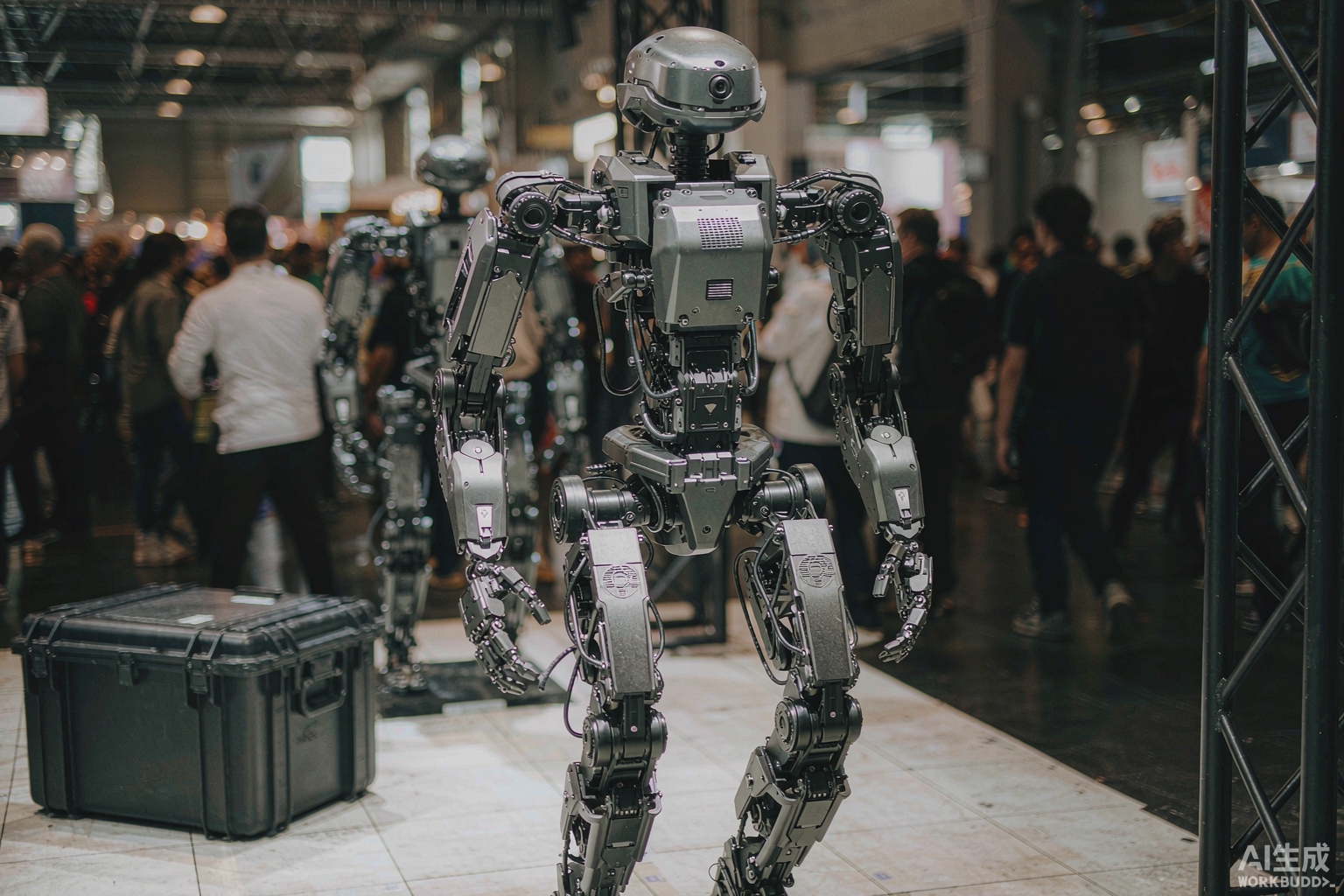
The streamer is Westcol, broadcasting on the Colombian platform Kick. The machine is called T800, and he had paid USD 100,000 for it. He had wanted a dance demonstration. Music started, the robot swung its arms, and the arm connected with the person standing in front of it. Answering his chat afterwards, he said it was not an autonomous attack and the machine was not trying to kill him. It was following pre-programmed instructions with insufficient spatial awareness to register the person and the case beside it.
He did not name the model at the time. Several outlets, including HK01, Kuaikeji and Star Island, reported it as a Unitree G1. It was not a Unitree G1. It was an EngineAI T800, from a Shenzhen company that builds humanoids explicitly for combat sports.
Two machines that look nothing alike
The confusion is worth unpacking, because the two products are not similar. Unitree’s G1 stands about 1.3 metres and weighs 35 kilograms, with an arm payload of about 2 kilograms and 90 newton metres of peak knee torque. It launched at RMB 99,000 and now starts at RMB 85,000 including tax. It trots above 2 metres per second, dances, does drunken boxing forms, side flips and wall-assisted backflips. It is small, quick and hard to break, and it gets up by itself after being knocked over. Almost every performance robot in a shopping mall or a Spring Festival gala is this machine.
The T800 is a different category. It stands 1.73 metres, weighs 75 kilograms, carries 29 degrees of freedom, produces 450 newton metres of peak torque and 14,000 watts of instantaneous power, and starts at RMB 180,000. Founder Zhao Tongyang’s design order was physical strength first, everything else after. The T800 can throw spinning kicks, flying kicks and combinations, and its peak output exceeds that of an elite human athlete. Its selling point is that it can fight.
There is footage that settles the difference. On 18 September 2026, a company called REK staged what it billed as the world’s first human versus robot cage match in San Francisco. The human was an internet personality named Lapena, 5 foot 6 and 205 pounds, in helmet, gloves and knee pads. Round one was an entry-level machine that he kicked over without difficulty. Round two was a T800 dressed as a RoboCop-style figure, which kicked him across the cage into the wall.
The T800 is also physically capable of the damage reported in Colombia. The G1, at 1.3 metres, would struggle to reach the back of a standing adult’s head at all.
Why Unitree keeps getting blamed
For this specific incident, the misattribution is unfair. But the reason it happened is not random. In Chinese public reporting, the brand that appears most often in robot injury stories is the small, agile one, not the large, powerful one.
The record includes a five-year-old girl in Xiangyang, Hubei, hit in the face by a Unitree robot during a kindergarten visit in November 2025, losing several milk teeth and needing three stitches. In February 2026 a G1 in a Chengdu mall left its programmed path and knocked over an elderly man in the front row. On 1 June 2026, a G1 performing at a Xinjiang scenic site kicked a boy in the abdomen.
Unitree’s exposure explains most of it. According to the 2025 humanoid market report published by China Electronics News, Unitree shipped more than 5,500 humanoids in 2025, a 32.4 per cent global share and the largest in the world. Its prospectus shows that in the first three quarters of 2025, 73.6 per cent of humanoid revenue came from research and education, 17.39 per cent from commercial consumer sales, and only 9.01 per cent from industry applications. In other words, the overwhelming majority of Unitree humanoids went to universities, research institutes, science museums, malls and tourist sites. Large installed base, dense public venues, short human-robot distance. The probability that an incident is witnessed, filmed and circulated rises with all three.
Shipment volume alone is not the full explanation, because competitors also operate in public. Third-party data from SAG shows AgiBot shipped about 8,400 units in the first half of 2026, overtaking Unitree for the global lead, with close to nine tenths going to commercial service, entertainment and research. If incident frequency tracked volume alone, the brands in the headlines would be spread more evenly.
The bigger factor is the brand identity Unitree built. Its Spring Festival gala performance in 2026, with backflips and martial arts forms, sold the idea of a machine with exceptional dynamic control. Buyers who want that buy it to perform in malls and scenic spots, where crowds are dense, distances are short and there is no physical separation, while the machine itself needs a large volume of space to move through. Change the relative position of a person and a robot in that setting and the risk curve steepens quickly.
The industry ships performers, not workers
The pattern is not a Unitree problem. In the first half of 2026, global humanoid shipments exceeded 22,000 units. Entertainment and commercial performance plus education and data collection accounted for more than 60 per cent. Guidance and retail reception took about 19 per cent. Genuine deployment into intelligent manufacturing and warehouse logistics came to under 20 per cent.
Which means that for now, most humanoids have one job: performing in front of people. The first place humanoids get deployed at scale is precisely the place where they need to be handled most carefully.
The technical gap is the reason. Li Binbin, a senior engineer at the China Electronics Standardisation Institute, describes the sector’s core problem as strong bodies and weak brains. Systems that look capable in a laboratory still cannot cope with unexpected situations in the real world. A humanoid cannot yet perceive, decide and constrain its own force and position in real time. In a public space it cannot sense an imminent collision, so it cannot avoid or stop.
As of October 2026, China has no nationwide mandatory safety standard aimed specifically at public humanoid performance. The five elements most likely to cause an incident, namely separation distance, physical barriers, operator qualification, emergency stop mechanisms and incident reporting, are all unregulated.
The standard written so far covers a different problem. In October, China published its first standard for window-cleaning robots, a category already deployed in millions of homes, because that is where the damage was measurable.
Robots entering public life will need to learn to be constrained first. Until then, every viral clip of a machine falling into a crowd is doing the work that a standard has not been written to do.
Editor’s note: This is an adapted translation of the original OFweek report. It has been trimmed and restructured for readability for an international business audience. The full original (in Chinese) is at https://robot.ofweek.com/2026-10/ART-898890-12003-30708039.html.