The quadruped robot market is splitting into two businesses that share a body plan and almost nothing else.
On one side, consumer-grade robot dogs keep getting cheaper and are moving into universities, developers and ordinary households. On the other, industrial quadrupeds are turning up in substations, factories, mines, chemical parks and fire scenes with increasing regularity.
The numbers from IDC’s latest Global Quadruped Robot Market Shares, 1H26 report make the split explicit. In the first half of 2026 the global market exceeded USD 400 million, up 95.4 per cent year on year, on shipments above 49,000 units, up 92.5 per cent.
Education and research plus home consumer use contributed about 60 per cent of shipments and took less than a third of the revenue. Government, industrial manufacturing and utilities accounted for under 40 per cent of shipments and more than two thirds of market revenue.
The places that buy the most units are not the places that pay the most per unit. Quadrupeds have begun to scale, and the market has separated into volume and value.
Two businesses, one product category
For several years quadrupeds were in a proof phase, demonstrating that they could run, jump and cross obstacles. Those capabilities are now table stakes, and the market has divided along what customers actually want to buy.
The first business is selling more units. Consumer and education products rely on standardisation, volume manufacturing and falling costs to lower the entry threshold. Unitree is the clearest example, using standard products, supply chain efficiency and global channels to build scale, and it holds the largest share of the market. IDC puts 2025 full-year global shipments at about 58,000 units and revenue above USD 490 million, more than double 2024 on both measures, with consumer and research demand driving the cost curve down.
The second business is going deeper. In power, firefighting, chemicals, mining and industrial manufacturing, customers are not buying a robot. They are buying the ability to take a human out of a task. Their questions are whether the machine can run around the clock and whether it holds up in a hazardous environment.
IDC shows industry applications at more than USD 270 million in the first half, up 125.1 per cent, on deployments above 19,000 units and unit growth of 260.5 per cent. That is far faster than the market as a whole. Deep Robotics has built its position in power inspection, industrial inspection and emergency response. MicVLC has gone narrower still, focusing on wheeled-legged special-purpose platforms and high-risk industrial sites.
The value of the same robot therefore differs completely between a consumer and an industrial buyer. The more standardised the machine, the more likely the hardware price falls. The deeper it goes into a complex site, the more the whole solution is worth. A report from EO Intelligence on commercialisation puts consumer products at RMB 5,000 to RMB 30,000, industry products at RMB 100,000 to RMB 300,000 and special-purpose products above RMB 500,000, three tiers that map to three customer types, three procurement logics and three sets of capability requirements.
The industrial number is the one to watch
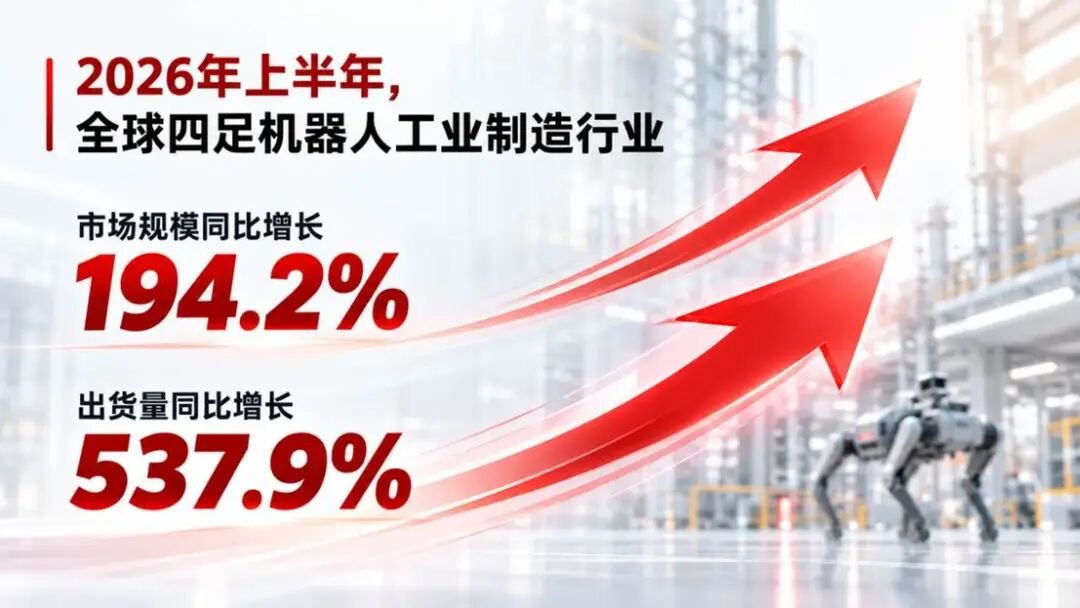
Zoom into industrial manufacturing and the slope steepens again. IDC puts the first-half global industrial manufacturing segment at about USD 76.75 million, up 194.2 per cent, on more than 4,100 deployments and unit growth of 537.9 per cent.
The reason is that industrial sites concentrate the tasks that are both hardest and most valuable to automate. Flammable zones in a chemical plant, broken terrain in a mine, high-temperature areas in metallurgy, high-frequency inspection rounds at power facilities. Human entry is expensive and dangerous, the work is repetitive, and the value of a stable substitute is measured in reduced exposure, higher inspection frequency and earlier fault detection.
The consumer market sells an experience. The industrial market sells an outcome. That is the fundamental difference, and it is why the competitive bar in industrial quadrupeds stacks up quickly. Explosion-proofing, water resistance and cold tolerance are the first layer. Multimodal sensing across vision, thermal, acoustic and gas channels is the second. Above that sit anomaly detection, task planning, arm coordination, fleet scheduling and integration with the customer’s own software systems. Whoever assembles that stack first gets closest to being a production tool rather than a demonstration.
The leaderboard changes when you change the segment
Across the whole market, IDC has Unitree first with 13.8 per cent of first-half revenue, Deep Robotics second at 9.2 per cent and MicVLC fifth at 6.3 per cent. Switch to industrial manufacturing and the order inverts: MicVLC first at 26.1 per cent, AgiBot second at 18.5 per cent, Boston Dynamics third at 9.9 per cent and Unitree fourth at 7.1 per cent.
That inversion says more about strategy than any specification sheet. Unitree’s advantage is standardised product and volume manufacturing. Deep Robotics has accumulated depth in power and industrial inspection. Boston Dynamics has spent years on industrial platforms. ANYbotics emphasises autonomous industrial inspection and a closed data loop. MicVLC has chosen a narrower path, from wheeled-legged platforms to explosion-proof, anti-magnetic, waterproof and cold-resistant configurations, plus specialised payloads, task software and an industrial intelligence platform. The goal is not to cover the most users but to raise usability inside a specific high-value scenario.
Frost and Sullivan’s 2026 white paper on the global quadruped and wheeled-legged robot industry places Unitree, Boston Dynamics, Deep Robotics, ANYbotics and MicVLC in the first tier, and describes them the same way: Unitree for scale delivery, Deep Robotics for industrial inspection, MicVLC for special-purpose platforms and hazardous sites, ANYbotics for autonomous inspection and data closure.
The phrase leading vendor is becoming a set of different answers in different segments.
The next contest is over tasks, not robots
Most quadrupeds entering industrial sites today still perform inspection: walk to a fixed point, capture images, temperature, audio and gas readings, and upload. The ceiling on the next phase depends on whether the machine can close the whole chain of movement, perception, judgement and manipulation.
IDC’s outlook notes that quadrupeds are extending from movement and inspection into equipment testing, maintenance, manipulation and emergency handling, closing the loop from sensing and recognition to decision and execution. Vendors are following. Deep Robotics is packaging power-inspection operating experience into replicable software assets. ANYbotics is strengthening inspection and data closure across multi-site operations. MicVLC is building an industrial embodied brain and a cloud-edge-device platform intended to coordinate arms, AGVs and PLCs, moving from single-machine work to system-level coordination.
The customer of the next phase may not be buying a quadruped. They may be buying a task that a robot can take over completely, which converts a one-off equipment sale into a recurring service.
Four legs were never the valuable part
Frost and Sullivan forecasts the global quadruped market growing from RMB 2.3 billion in 2025 to RMB 53 billion in 2030, a compound annual rate near 87 per cent. A market of that size will not be built on chassis sales alone.
As standardisation matures, hardware prices face long-term downward pressure, while specialised payloads, software platforms, data services, maintenance and industry solutions lift lifetime value per customer. EO Intelligence reaches the same conclusion: the business model is shifting from selling hardware to selling work, with rental structures scaling quickly.
The substance of that shift is a move from selling equipment to selling capability. Equipment is one-time revenue. Capability is recurring. If installed base rises from 100,000 units in 2025 to 1.17 million in 2030, as Frost and Sullivan projects, the relevant number is not the stock of machines but the subscription, maintenance and operations cash flow attached to them.
IDC notes that quadrupeds are evolving from platforms built for movement and inspection into general-purpose work platforms. Safety, reliability and return on investment are the three things industrial buyers actually care about, and they are also the acceptance criteria for a capability model.
Who makes the most money from this will probably not appear on the unit-sales leaderboard first. It will appear at the sites that are hardest to enter and most worth entering.
Editor’s note: This is an adapted translation of the original OFweek report. It has been trimmed and restructured for readability for an international business audience. The full original (in Chinese) is at https://robot.ofweek.com/2026-10/ART-8321204-8420-30707321.html.