Apple’s first foldable went on sale on 23 October. Within three days the resale premium of roughly RMB 10,000 had evaporated and buyers were posting photographs of bright lines and splits along the crease.
The interesting question is not whether Apple shipped a flawed hinge. It is why a company with the most scrutinised quality process in consumer electronics shipped a hinge that passed 10,000 folds in the lab and failed after dozens in a customer’s pocket.
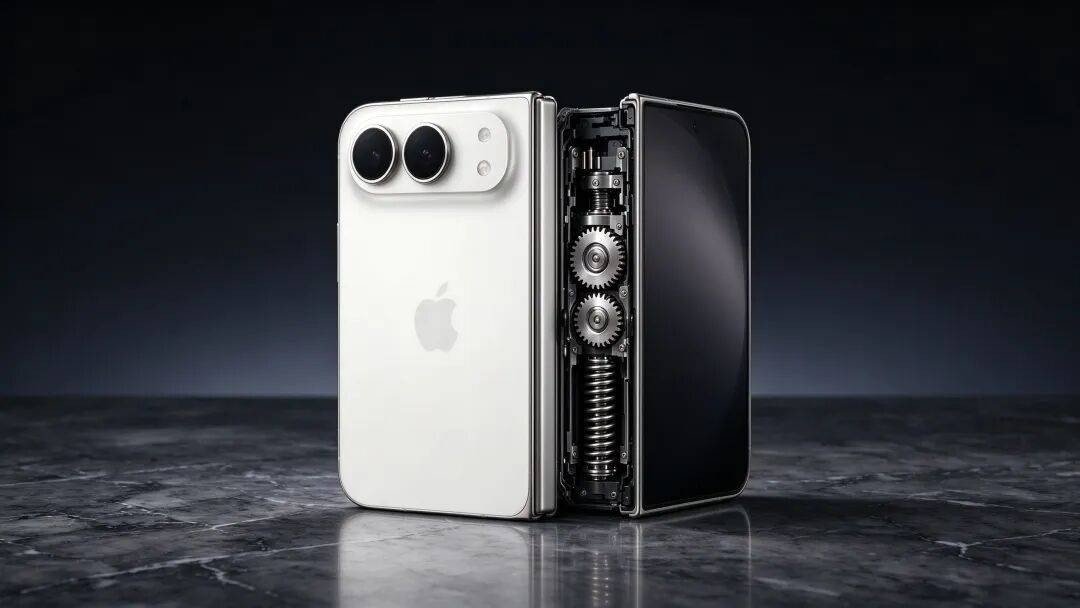
The teardown found a millimetre
iFixit did not simply photograph the parts. It used CT scanning, teardown photography and Apple’s published patents to reconstruct a three-dimensional model of the hinge assembly, then mapped user-reported failure locations onto it.
Most of the bright-line failures were not at the usual stress point where the flexible ribbon passes through the hinge. They sat slightly off it, in the transition zone between the cross-ribbon gap and the central hinge support, where several edges meet and the display’s support method changes as it folds. That is where stress accumulates.
iFixit offered two mechanisms. Either the central support bar did not fully retract when the phone closed, pressing an edge into a thin display, or the curved guide rail caught and a raised section scraped the inner surface of the screen.
Design passed, assembly did not
That gap is the whole story. A durability rig folds a correctly built hinge. A production line builds thousands of hinges a day, and the failure mode lives in the last step of assembly, where a part that is nominally within tolerance still has to seat in a way that no drawing fully specifies.
Li Nan, the former Meizu vice-president, put it in five words: Apple and its supply chain have grown unfamiliar with each other. The remark travelled because it names a mechanism rather than a defect.
What the old model actually bought
Before the first iPhone shipped, Steve Jobs decided late to replace a scratch-prone plastic screen with hard glass. In most supply chains that change stops a line for six months. In China, a plant woke 8,000 workers in the middle of the night and had a new line running within half an hour.
In 2018, when Pegatron’s iPhone 8 line went into production, Apple stationed more than 100 engineers inside the factory, working the same machines as the supplier’s engineers to close the gap between what the drawing specified and what the line could hold. That is what the supply relationship used to buy: engineers physically present, converting a tolerance argument into a conversation.
The new model is a balance sheet
Tim Cook’s model is different. Apple does not fund factories, and suppliers are legally independent, but Apple buys the equipment, reserves the capacity and sets the tempo. It produced the highest asset turnover in hardware history and a four trillion dollar market capitalisation.
A balance sheet optimises cost, not craft. Research firm SAG estimates China’s share of global iPhone manufacturing fell from 83 per cent in 2024 to 74 per cent in 2025, while India rose from 14 per cent to 23 per cent. In August 2025 Apple raised its US investment commitment to USD 600 billion.
Each move is defensible on risk. Each move also puts another time zone between the designer and the line. The iPhone Duo’s component map shows where that lands: the hinge assembly comes from Amphenol and Nidec, the display from Samsung Display as sole supplier, and Chinese companies sit mostly at the tier-two component level.
The more a product depends on several parts meshing at micron tolerance, the more it needs the friction of people in the same room. Apple has spent a decade systematically removing that friction.
The trap has no cheap exit
Apple cannot easily reverse. Admitting the foldable was not ready concedes five years to Samsung and Huawei. Pushing a half-honed process across global lines means every unit sold is a potential photograph.
Rebuilding the old feel means moving capacity back to Dongguan and back to the engineers who spent twenty years learning it, and that path is closed politically after the USD 600 billion commitment. Waiting for India or the United States to reach where China was in 2015 is a ten to fifteen year project, and a product with micron tolerances cannot wait.
A premium of RMB 10,000, gone in three days, is the market’s vote. A spreadsheet can price capacity and yield. It cannot price the habit of being in the room at three in the morning when a parameter needs changing.
Editor’s note: This is an adapted translation of the original Sohu Tech report. It has been trimmed and restructured for readability for an international business audience. The full original (in Chinese) is at https://www.sohu.com/a/1094292005_116132.