Chery has started building motorcycles. During the 2026 Chery Global Innovation Conference on 19 October, Lingwei Technology, the motorcycle business under Chery Holding, showed four technology and product results together for the first time: the SOLO X5 electric scooter, the GROW C3 range-extended tourer, the Kunpeng multi-mode hybrid system and an AI cockpit.
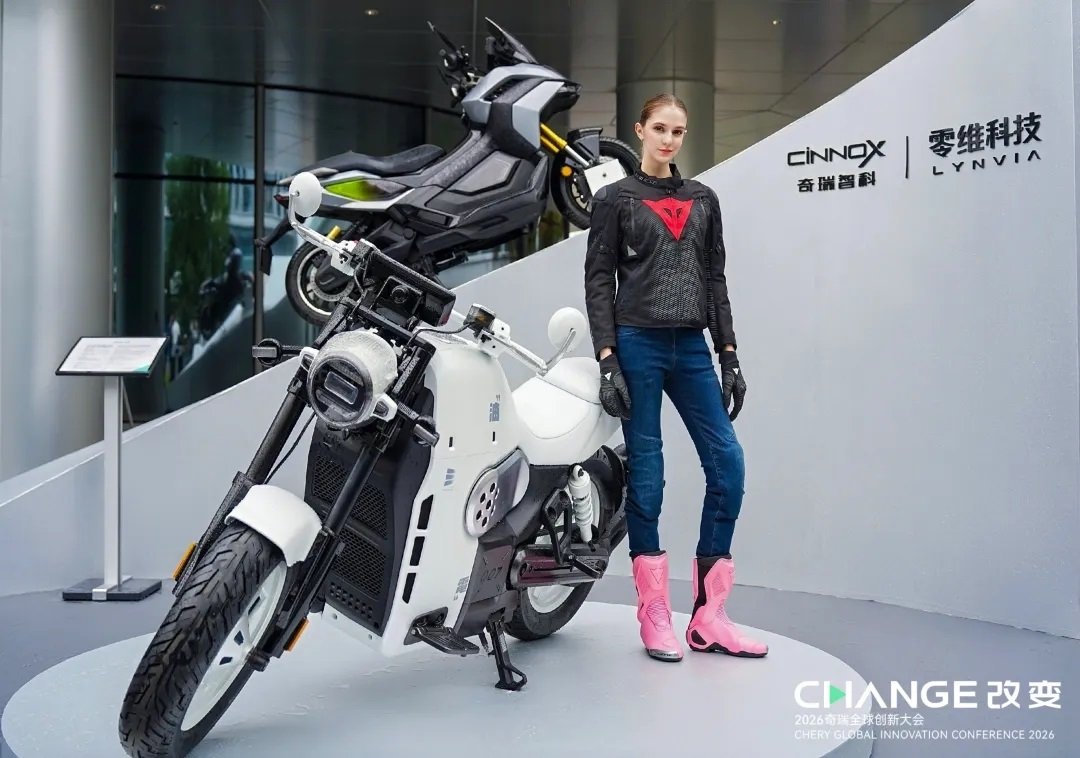
The move takes Chery’s business from cars into motorcycles, and it is not a sudden enthusiasm. Tu Xiaoyue, deputy general manager of Chery Intelligent Technology, said the two-wheel project started in 2023. After three years of preparation, Lingwei has a team of more than 200 people, over 70 per cent of them in research and development, and plans to launch three to four products in the first half of 2027. Internally, motorcycles are treated as the group’s second growth curve.
What Chery is actually buying into
Chery is not primarily interested in motorcycles as hardware. Global motorcycle sales reached 65.2 million units in 2025, up 4.7 per cent year on year and a third consecutive record, according to MotorCycles Data. The global market, including electric motorcycles and related services, is worth about USD 153.4 billion, roughly RMB 1.023 trillion. In the first eight months of 2026 global sales grew 8.9 per cent year on year, and the market is still climbing.
China is already the largest producer and exporter. Customs statistics released by the China Chamber of Commerce for Motorcycle on 24 October show exports of 15.164 million complete motorcycles in the first three quarters of 2026, up 11.8 per cent year on year, worth USD 10.29 billion, up 21.2 per cent, with Africa the main incremental market.
What China has not built is brand influence in the global premium segment at a scale matching its industrial base. Li Xiaojun, general manager of Lingwei Technology, put the gap in one line: China’s motorcycle export capacity is about four times Honda’s, and its profit is less than 60 per cent of Honda’s. The industry does not lack manufacturing capability. It lacks a route from scale advantage to technical advantage, brand premium and sustained profitability.
Yin Tongyue, Chery’s chairman, is betting that the electrification, intelligence and globalisation capabilities accumulated in new-energy cars can be run again in motorcycles, repeating an industrial upgrade China’s car industry has already been through.
Why a motorcycle and not a cheaper motorcycle
Chinese motorcycle companies historically competed on manufacturing efficiency, supply chain capability and cost. Their products met basic mobility needs in many markets, and their brands stayed pinned in the mid-to-low end.
Tu draws a distinction inside the global market. One part is transport, built around daily commuting. The other is consumption, organised around leisure, travel, riding culture and personal identity. Lingwei is aiming at the second.
The value of a motorcycle is not set only by engine displacement, power output and manufacturing cost. It also carries personal interest, aesthetic preference, mechanical experience and community identity. Tu gave an example: an enthusiast may spend RMB 20,000 on a bike and then spend more than that on modifications, riding gear and travel. Motorcycles, he said, are close to photography, where the object purchased is only part of the purchase.
That reasoning widens the business beyond vehicle sales. Lingwei may sell smart helmets and may offer motorcycle travel packages, on the argument that the motorcycle is only part of what the company is.
The logic of Chery’s entry becomes clearer. It wants to enter through a vehicle, then build riding culture, an equipment ecosystem, travel services and community around the user, so that a one-off product purchase becomes a lifestyle business with recurring interaction. It is also why the team tried from the start to escape the traditional way motorcycles are defined. Tu said early discussions were not about commercial return but about what kind of life the user actually wants, and that the goal was not to translate the car concept from four wheels to two but to find the real transport and equipment needs of this group.
He also sees the product changing. Motorcycles are moving from a vehicle that demands high operating skill toward a more accessible leisure activity. Technologies that lower the operating barrier, including continuously variable and automated manual transmissions, have drawn wide attention, because buyers want the feeling of riding without the complexity of operating it.
The test ahead
A 200-person team and three years of preparation is a serious commitment by Chinese two-wheeler standards, where most premium attempts have been thin. The risk is not manufacturing. It is whether a Chinese badge can hold a price in a segment where buyers pay for heritage, and whether the equipment, travel and community layers generate revenue before the vehicle line has to stand on its own.
Editor’s note: This is an adapted translation of the original Gasgoo report. It has been trimmed and restructured for readability for an international business audience. The full original (in Chinese) is at https://auto.gasgoo.com/news/202610/29I70476226C109.shtml.