The eighth Intelligent Driving Conference and the 2026 Huanxiu Lake Physical AI Industry Development Promotion ran together in Suzhou’s Xiangcheng district on 26 October. The previous session concerned vehicle-road-cloud integration, the export of Chinese driving systems and the commercialisation of driverless fleets. This year the boundary moved past driving entirely.
World models, reinforcement learning, on-device intelligence, simulation and Robotaxi shared the programme with humanoid robots and low-altitude aircraft. The reason is not fashion. Once AI enters a car, a robot or an aircraft, the same four questions appear: where the data comes from, how the model is trained and validated, how development cost falls, and how safety is demonstrated in the physical world.
The single-vehicle ceiling
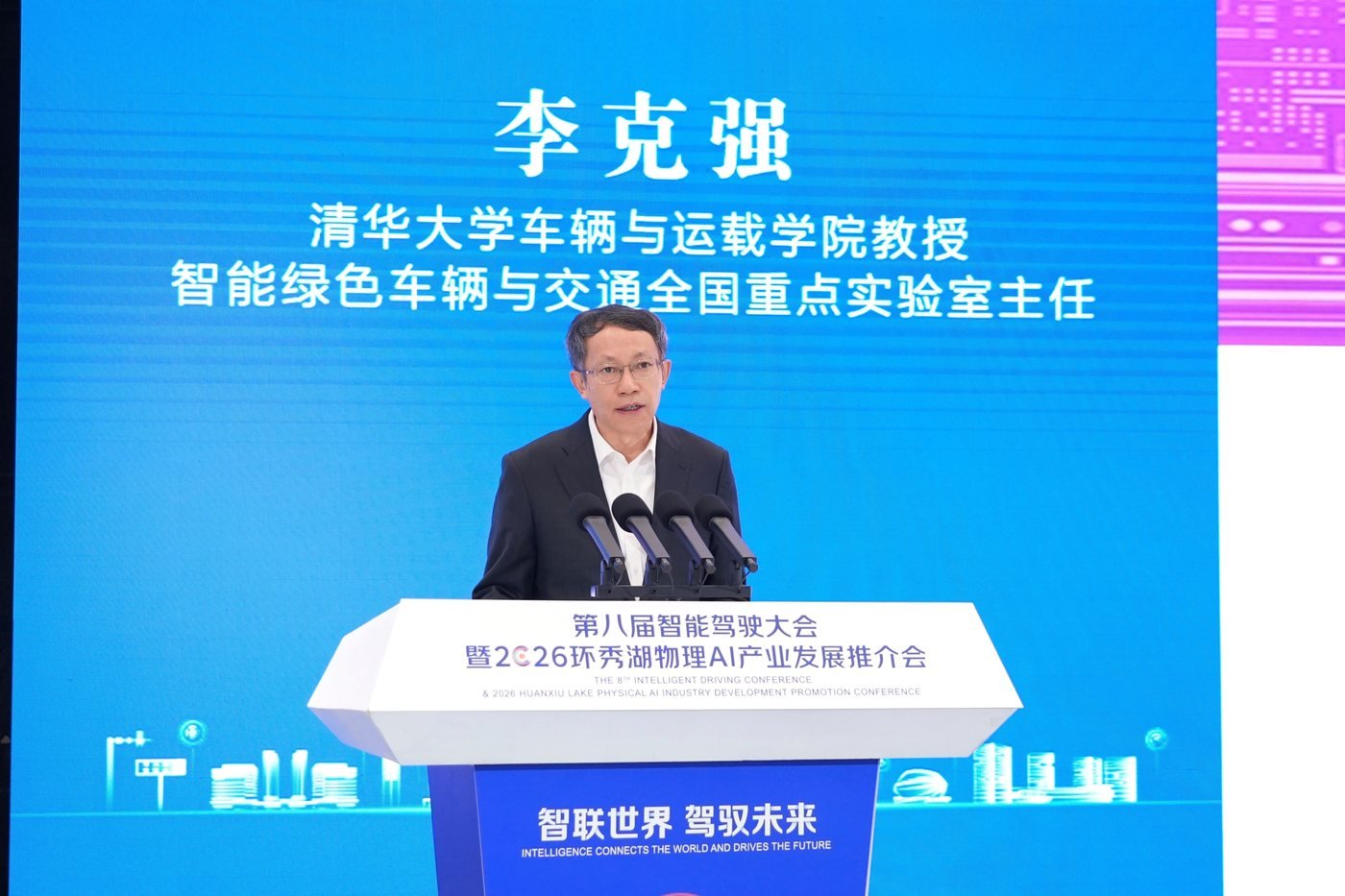
Li Keqiang, an academician of the Chinese Academy of Engineering and director of Tsinghua’s State Key Laboratory of Intelligent Green Vehicle and Mobility, argued that automotive intelligence has reached large-scale application and a closed commercial loop, and that the first problem is now system safety.
His position is that a vehicle relying only on its own sensors and compute has a physical boundary. A camera cannot see through the truck in front of it, so higher-level autonomy has to move from single-vehicle intelligence toward vehicle-cloud coordination and vehicle-road-cloud integration.
He grouped the industry’s bottlenecks into three. Some product definitions diverge from national and international standards. Key technologies for high-safety, high-reliability autonomy remain unsolved. Investment and commercial output still do not match.
At the technical level he named three failures. Perception has boundaries, and a stronger decision model cannot compensate for information that was never captured, so over-horizon sensing, digital signals and cooperative perception are needed. Training data remains incomplete in type and scenario coverage, which is a safety exposure as models move to multimodal architectures. Development efficiency is low, because much of the industry still builds in stovepipes without a unified base, producing high entry barriers, poor reuse and long validation cycles.
The integration proposal has two parts: a standardised data corridor supplying wide-area, multi-dimensional, real-time traffic information to vehicles, and a data service layer built for AI models that continuously feeds high-reliability data. Pilots with manufacturers are running in Beijing and Chongqing, covering stationary obstacles ahead, sudden pedestrian emergence and green-wave traffic flow. Seven carmakers are deploying this year and FAW has announced mass-production adoption.
From mapping the world to controlling it
Qu Xiaobo, a Tsinghua professor elected to the European Academy of Sciences, framed physical AI as a change in what a digital twin is for. The old version mapped and monitored physical entities. The new version has to understand, simulate and control them in real time.
The gap is latency. A twin that takes seconds to run a scenario cannot close a control loop. His national research programme targets four things: generalisable digital simulation, inference compressed below 100 milliseconds, an interoperability mechanism between the digital and physical sides, and a multi-scale architecture that reduces end-effector error.
Three layers carry the work. At component level, physical AI trained on existing motor data cuts certain single-point calculations from hours to milliseconds at roughly 10 per cent error, which changes motor design throughput. At vehicle level it addresses the Sim2Real gap, adaptation across airframes and dynamics, and fast validation for driving, autonomous cruise and construction machinery. At system level it coordinates heterogeneous vehicles, covering demand-responsive transit, low-altitude traffic management and mining equipment.
The flying car programme with Chery produced a modular composite-wing vehicle split into wing, cabin and chassis, which can be assembled either as an autonomous cruise aircraft or as a self-driving car. For construction machinery, a world model generates candidate trajectories and selects among them while optimising bucket fill and dump position, producing a continuous dig, haul and dump cycle.
The demand-responsive bus service has run for 18 months in the Zhuzhou vocational education district, where about 100,000 students and staff live and more than half have registered. Door-to-door journey time is roughly two minutes longer than a taxi. Average cost per trip is about RMB 2, against RMB 9.16 for the taxi.
The commercial thread
Ren Dongchun, chief executive of Tangyuan Technology, presented Yootta WorldLoop, a closed-loop training and evaluation system for driving and physical AI that spans data capture, data generation, algorithm training, evaluation, real-machine validation and data return. The pitch is the same one running through the whole conference: the value is not in a single model but in the loop that keeps correcting it.
The through-line across the day is that Chinese autonomy has stopped treating the vehicle as the unit of design. The unit is now the road, the cloud and the data pipeline behind both, which is a more expensive proposition and a more defensible one.
Editor’s note: This is an adapted translation of the original Leiphone report. It has been trimmed and restructured for readability for an international business audience. The full original (in Chinese) is at https://www.leiphone.com/category/transportation/pqEtZnYepE5D1PzD.html.