RoboSense has turned on a fully automated production line for digital lidar in Nanshan district, Shenzhen, and the number that matters is not the capacity but the headcount. Total assembly on the new line runs on six operators, working alongside the system rather than feeding it.
The line sits in the Honghualing base of Nanshan Smart Manufacturing, a project the city promotes as China’s first official example of putting factories inside multi-storey buildings. It reaches 99 per cent automation and is designed for 500,000 units a year from that line alone, built around more than 100 high-precision machines across 70-plus process steps.
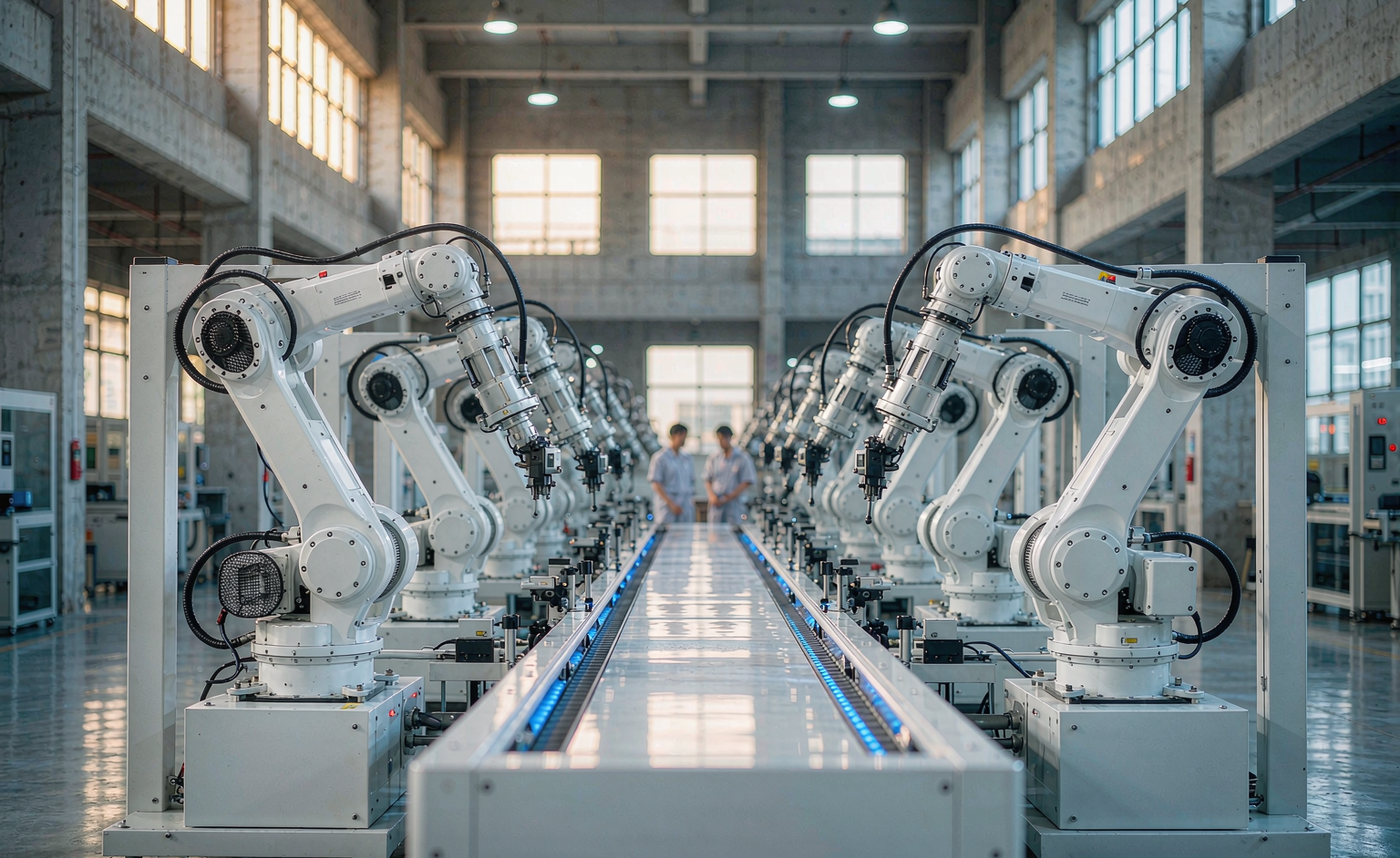
RoboSense’s MARS manufacturing base now runs more than 22 automated lines and produces one digital lidar unit every eight seconds on average. The new line traces 100 per cent of production data, runs automated inspection on 98 per cent of steps, and puts every unit through ageing, calibration and full-machine performance tests against 3,640 inspection metrics covering optical, electrical, mechanical, acoustic and functional safety performance.
Robots are now the volume driver
In the first nine months of 2026 the company sold 1.3148 million lidar units. Of that, 427,800 went into robots rather than vehicles, split across lawn mowers, unmanned delivery carts, commercial cleaning machines and Robotaxi fleets. GGII data has RoboSense first in global robot 3D lidar shipments, and the company also claims the largest share of China’s passenger-car high-performance main lidar market over the same period.
That mix explains why the line exists. A car programme takes one sensor spec and scales it across a platform with a five-year life. A lawn mower, a delivery cart and a cleaning machine each want different ranges, fields of view and price points, in volumes that are large but fragmented. Every additional customer segment adds changeover, calibration recipes and quality documentation.
The only way to hold margin across that spread is to take labour and changeover time out of the line itself. Six operators on a 500,000-unit line is the answer written in the only language a component maker can use.
Why the building matters as much as the machines
Honghualing is the part of this story that travels. The estate uses spiral ramps and multi-level elevated logistics platforms to bring freight traffic to different floors, so a truck can drive to the equipment entrance on the floor where the line sits. Without that, precision manufacturing does not go above the ground floor, because moving large machines and finished goods vertically is where the cost and the damage live.
The base now houses RoboSense, EngineAI and Dobot in the same park. A sensor maker, a humanoid maker and a collaborative robot maker sharing a logistics system is a different kind of industrial policy from a subsidy. Supplier meetings happen in a lift lobby rather than across the Pearl River Delta.
The new line is also a slice of a 4 million unit annual capacity plan. RoboSense is betting that the constraint in physical AI will not be algorithms but the supply of sensing hardware that can be built, tested and shipped in volume at a price robot makers can absorb.
Editor’s note: This is an adapted translation of the original OFweek report. It has been trimmed and restructured for readability for an international business audience. The full original (in Chinese) is at https://robot.ofweek.com/2026-11/ART-8321202-8460-30710395.html.