Sharpa used IROS 2026 in Pittsburgh to launch three products at once, and the combination reveals a thesis that most dexterous hand companies have not adopted.
On 28 September the company showed D01, a humanoid robot with electronic skin across its body. W02 is a full-palm tactile dexterous hand with 21 active degrees of freedom. AE01 is an exoskeleton data glove that captures human hand motion in real time and returns tactile feedback to the wearer. Three devices, one loop.
The specifications, in brief
D01 is positioned as an integrated tactile sensing and dexterous manipulation robot. Its arm payload-to-weight ratio is close to 1:1, maximum end-effector speed exceeds 10.5 metres per second, communication runs at 1,000 hertz, and repeat positioning accuracy is 0.2 millimetres. Electronic skin covers the whole body with a 100 hertz tactile sampling rate and a force sensing range of 0.1 to 20 newtons.
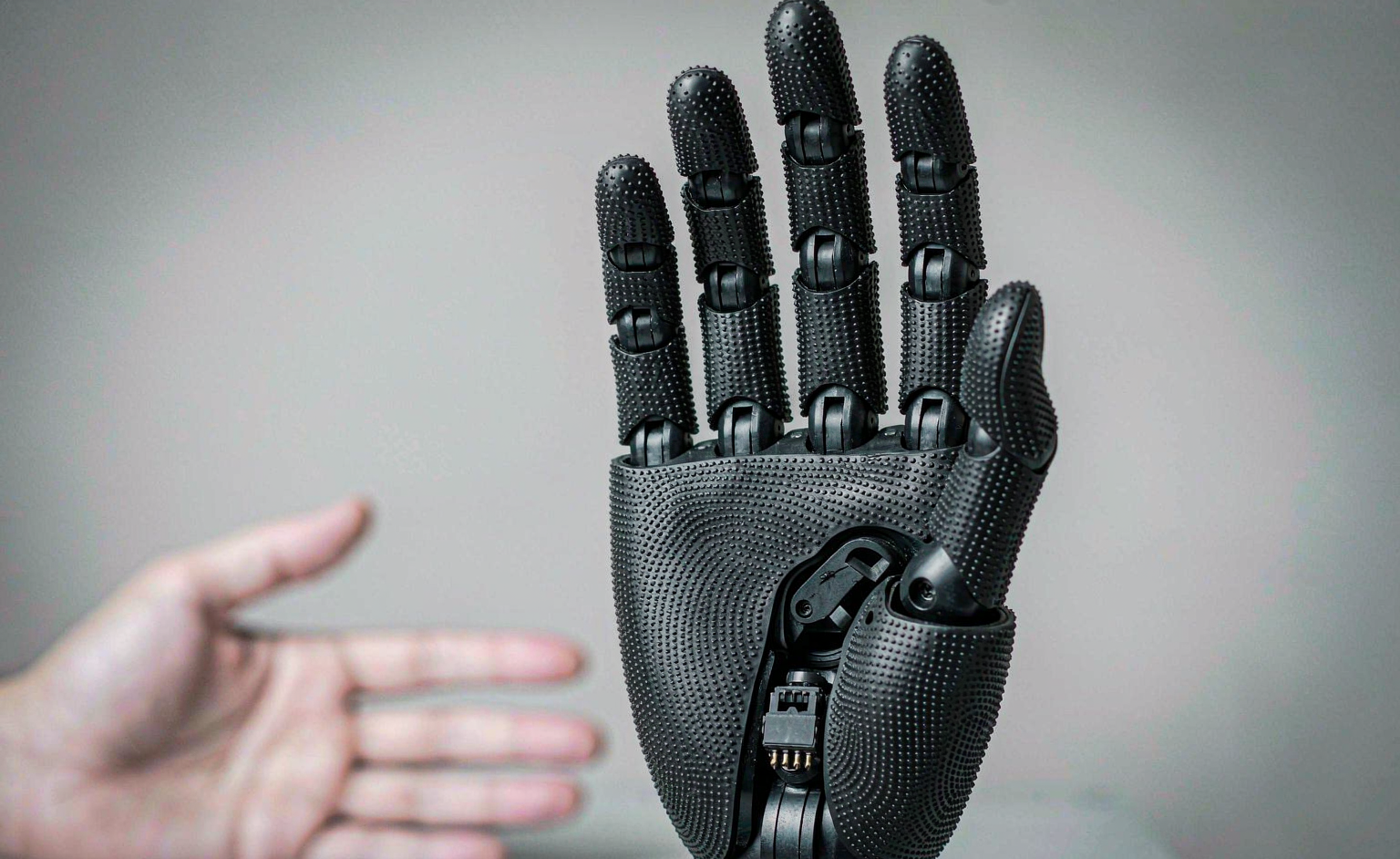
W02 fits 21 active degrees of freedom into a structure 30 per cent smaller than the previous generation, with high-resolution vision-based tactile sensors at the fingertips, a force range from 5 millinewtons to 30 newtons, full-hand electronic skin, zero grasp radius and IP54 sealing.
AE01 uses 22 encoders to capture hand motion, delivers 256 levels of continuous tactile feedback per fingertip, requires no calibration and resists electromagnetic, lighting, temperature and humidity interference. In the demo, an operator wearing AE01 teleoperated D01 through a cocktail sequence: ice, pour, shake, serve.
Why the loop matters more than the parts
The industry has split into two camps. Dexterous hand companies optimise the hand: degrees of freedom, fingertip precision, grip force. Humanoid body companies optimise the body: locomotion, endurance, payload. Between them sits a gap in data collection and teleoperation that neither side has an incentive to close.
Sharpa’s three products fill that gap directly. AE01 captures what a human does, feeding training data or live teleoperation into D01. W02 acts as D01’s end effector and returns tactile signal. The hand is not the product. The loop is.
The company’s background explains the ambition. It was founded in December 2024 by Hesai chief executive Li Yifan, chief technology officer Xiang Shaoqing and chief scientist Sun Kai. Hesai injected RMB 100 million in cash in April 2025 at a RMB 1 billion valuation. Dexterous hands entered volume delivery in October 2025, the first 70-degree-of-freedom humanoid followed in January 2026, and in August 2026 the company closed a round of more than RMB 4.5 billion at a post-money valuation of RMB 22 billion.
The investor list is the tell. Alibaba, Tencent, JD, Meituan, Sequoia China and Qiming Venture Partners all took part. Each of those four internet groups already has its own embodied AI position: Alibaba backed LimX Dynamics, Tencent runs Robotics X, JD is building RoboBase, Meituan has spread across a portfolio. Their simultaneous presence in one robot company suggests they are pricing a complete manipulation infrastructure rather than a hand or a humanoid.
How this reprices the sector
For two years the valuation anchor in dexterous hands was single-product performance: degrees of freedom, precision, price. PaXini has raised close to RMB 4 billion at a valuation above RMB 10 billion. Yimu Technology’s E round exceeded RMB 1 billion, taking it past RMB 10 billion. Tashan Technology completed three rounds in six months and serves more than 200 customers. All of them concentrate on one link in the chain.
Sharpa offers a different anchor: closed-loop system capability across body, hand and data capture, with the data flow between them as the defensible asset. It is structurally similar to Figure AI’s full-stack approach, entered from the hand rather than from the humanoid.
The listed supply chain is already moving on the same logic. Weihong’s dexterous hand drive modules have moved from sampling to small-batch production at roughly 30,000 modules a month, heading for 80,000 by year end, with customers including Linker Hand, Inspire Robots, BrainCo and VarTech as well as Nvidia, Stanford’s Fei-Fei Li lab and Apptronik. Fulai New Materials signed a 100,000-unit tactile sensor order and won approval for a RMB 707 million placement to expand electronic-grade materials. Zhaowei Electromechanical committed RMB 800 million to a dexterous hand industrial park. Leadshine is in volume supply with a 21-degree-of-freedom hand.
The sector’s investment case is shifting from proof of concept to proof of orders. Sharpa’s RMB 22 billion valuation is a bet that the loop closes. The booth at IROS is the easy part. A robot working a 55-step ice cream order in a Shanghai restaurant without spilling is the examination.
Editor’s note: This is an adapted translation of the original OFweek report. It has been trimmed and restructured for readability for an international business audience. The full original (in Chinese) is at https://robot.ofweek.com/2026-10/ART-8321205-8110-30709447.html.