Landian Intelligent has disclosed a contract with Wuhan Chuxin New Energy worth RMB 258 million for the phase-two warehouse and logistics equipment at a battery plant in Wuhan. The company said the deal falls within ordinary course of business and is expected to contribute to its 2027 results rather than the current year.
The order sits against a mixed set of accounts. Revenue for the first nine months of 2026 was RMB 1.215 billion, up 7.40 per cent. Net profit attributable to shareholders was RMB 67.81 million, down 27.67 per cent, and the adjusted figure excluding non-recurring items fell 23.46 per cent to RMB 61.23 million. Backlog stood at RMB 2.53 billion at the end of June.
What the customer buys
Wuhan Chuxin is a wholly owned subsidiary of Chuxin New Energy, the largest lithium battery manufacturer headquartered in Hubei. The group operates four production bases in the province, at Wuhan, Xiaogan, Yichang and Xiangyang, with annual capacity above 110GWh and effective capacity inside the national top five. Its energy storage cell shipments ranked in the global top three in 2025, and it has appeared on the BloombergNEF Tier 1 list of storage manufacturers five consecutive times.
The phase-two project at Wuhan carries total investment of roughly RMB 22 billion and plans 80GWh of annual capacity for power cells, storage cells and pack modules.
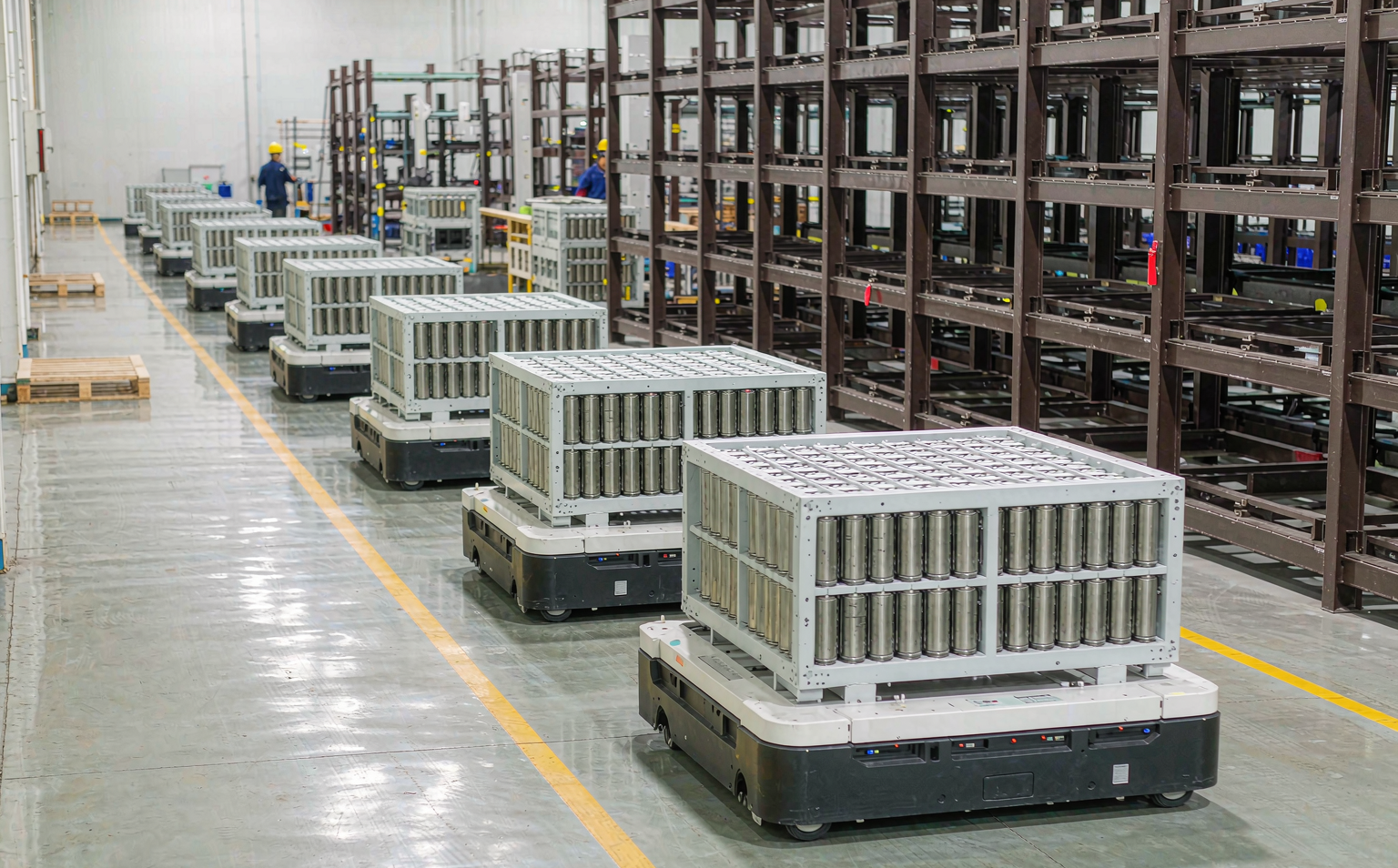
Battery manufacturing is a harder environment than general assembly. Coils and cells cannot tolerate a knock, a dust particle or a static discharge without yield loss, and manual transfer makes full-chain traceability impossible. Warehouse robots entered lithium plants for exactly these reasons: they remove the human handling that introduces the risk, and they connect storage to coil loading and formation and grading so that material can be traced end to end through the MES and scheduling systems.
The requirement is no longer moving boxes. It is linking storage, line-side delivery, formation, grading and finished-goods dispatch into a continuous flow that supports flexible changeover between cell formats and runs around the clock.
Thirty-three years of aisles
Landian has been in logistics automation since the early 1990s and now offers a product matrix covering storage, shuttle, transfer, picking, loading, depalletising and overhead robots, with a software layer it calls Blue Brain positioned as a general-purpose brain for multi-category logistics robots. The company says it has deployed more than 30,000 robots across close to 20 industries including new energy, automotive, semiconductors, e-commerce, tobacco and pharmaceuticals. Its customer list in batteries includes CATL, Sunwoda, BYD and GAC.
For lithium coil handling it builds the CX1300 cantilever robot, an omnidirectional chassis designed for narrow aisles with a multi-axis adjustment mechanism and vision guidance, holding end positioning to plus or minus 1mm and 0.3 degrees for coils up to 1,300kg. Its custom latent AGV uses laser SLAM navigation with an in-house curve control algorithm to move between work-in-progress racks, electrode libraries, lifts and U-shaped conveyors across buildings.
The strategic read is that orders concentrate. As battery plants scale, they buy from suppliers with a complete product matrix, deep process knowledge and the delivery capacity to hit a construction schedule. That concentration rewards Landian with volume and punishes it with pricing pressure, which is one plausible explanation for revenue rising while profit falls.
Whether the RMB 258 million converts into margin depends on delivery timing, project mix and how quickly scale effects arrive. Those are the three variables the next two annual reports will settle.
Editor’s note: This is an adapted translation of the original OFweek report. It has been trimmed and restructured for readability for an international business audience. The full original (in Chinese) is at https://robot.ofweek.com/2026-11/ART-8321202-8120-30709996.html.