A backlight module factory in Kunshan has just become the first customer and the only outside shareholder of a robot company that is less than three months old. Weishi (Suzhou) Robotics closed a seed round of tens of millions of yuan on 4 November, with listed display maker Weishi Electronics as sole investor and Yushi Capital as financial adviser.
The money is not remarkable on a 2026 funding table. The structure is. Weishi Electronics is not a venture fund taking a position in a category. It is the factory floor the robots are meant to work on, buying a stake in the company that has to make them work there.
What the factory actually asks
Goldman Sachs raised its global humanoid shipment forecast in late August, from 256,000 units in 2030 to 890,000, and from 1.4 million in 2035 to 6.5 million, implying a market of USD 138 billion. The report names logistics and automotive manufacturing as the earliest deployments.
On an actual production line, the questions are narrower. Is the precision sufficient. Can it run continuously. How long until the investment pays back. None of those are answered by a robot that resembles a person. Humanoid form adds degrees of freedom, dexterous hands and maintenance load. A factory wants fewer stoppages, faster changeover and stable yield.
Founder Du Xiaolong spent years running core business at another robot company, taking humanoid and industrial collaborative machines through commercialisation, which means he has already carried a supply chain, a sales channel and a delivery schedule. The algorithm team comes out of Shanghai Jiao Tong, Zhejiang, Northwestern Polytechnical, Beijing University of Posts and Telecommunications and China University of Mining and Technology, covering vision-language-action models, world models, imitation learning, reinforcement learning, simulation-to-real transfer and motion control.
Half a tenth of a millimetre
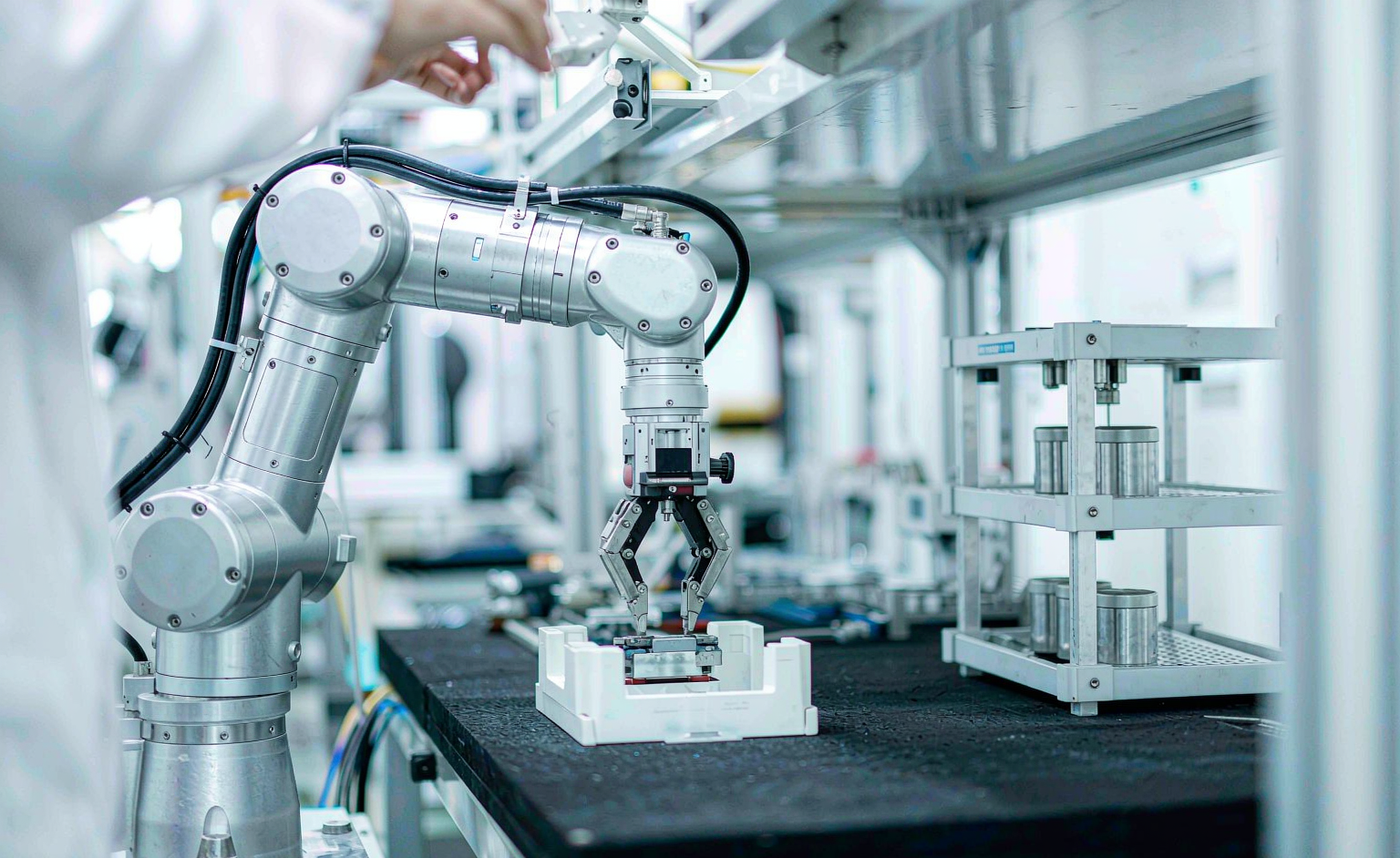
The V2 product targets light-load precision work with repeat positioning at plus or minus 0.05 millimetres, covering more than 90 per cent of flexible manufacturing processes and a 99 per cent operational yield. It is a standard body with modular end effectors, so sensing, feeding and tooling are configured per job rather than engineered per customer.
In 3C assembly, auto parts and semiconductors, a 0.1 millimetre deviation is enough to keep a line offline. A humanoid arm with long reach and many joints accumulates error at every transmission stage. Holding the end effector at 0.05 millimetres requires structural stiffness, reducer backlash, thermal drift compensation and a calibration system working together, which is not a tuning problem.
The company splits the brain from the cerebellum deliberately. Task understanding, process decomposition, dynamic planning and process constraints sit on one side. High-precision motion generation and rolling optimisation sit on the other. Industrial control runs at millisecond servo cycles and a line will not slow its takt for an inference call.
The shareholder is also the benchmark
Weishi Electronics was founded in Kunshan in 2003 and makes backlight and LCD modules with automotive as its core market. In the first half of 2026 it booked RMB 1.133 billion in revenue, up about 16 per cent, a net loss of RMB 51.7 million and a gross margin of 6.84 per cent. A manufacturer earning under 7 per cent gross has only one place to recover profit, which is the cost structure: labour, changeover, yield, downtime.
That is why the first deployment goes on this line. Sub-millimetre tolerances that keep tightening, high-mix low-volume runs where changeover costs more than production, and a clean room where people are the least stable variable.
The three-stage plan is short: deploy at Weishi, then win medium-term orders to break even with revenue above RMB 100 million, then enter 3C, new energy and semiconductors ahead of IPO coaching. The obvious risk is symmetrical. A single industrial shareholder is an accelerator and a ceiling, because competing factories will hesitate to buy from a robot maker owned by a rival. Turning a Weishi-specific process package into an industry-generic one is the actual test, and it is not a fundraising question.
Editor’s note: This is an adapted translation of the original OFweek report. It has been trimmed and restructured for readability for an international business audience. The full original (in Chinese) is at https://robot.ofweek.com/2026-11/ART-8321202-8420-30710431.html.