Watching a film has become a standard way for rear passengers to pass a journey, and a roof-mounted screen is the usual answer. The screen works, but once folded down it also becomes a visual wall between the rear and the front of the car.
At SAECCE 2026, the 33rd annual congress of the Society of Automotive Engineers of China, Zeiss Microoptics showed a rear-seat holographic entertainment prototype for the first time. It keeps the folding roof-mounted layout but uses transparent glass as the display surface, so passengers can watch content and still see the front cabin and the road.

Stephan Hoefer, senior vice president for automotive and consumer markets at Zeiss Microoptics, argues that designing a rear display is not only about what plays on it but about how the device fits the cabin. Transparent display, he says, lets rear passengers keep eye contact with the front and see the road while watching, which keeps the cabin visually continuous.
Alongside the rear unit, Zeiss showed a holographic windscreen display and a transparent camera, the latter attempting to fold imaging into a transparent surface.
How the glass displays an image
A picture generation unit provides the light, and a holographic film laminated inside the transparent glass directs it to the passenger’s viewing area. The glass does not emit light itself. Working with the projector, it presents content while remaining transparent.
Because the layout follows the existing roof-mounted screen, the ceiling area already used for a display housing can be considered for the projection unit, which reduces changes to wiring and structure and opens the option for facelifted models rather than only clean-sheet designs.
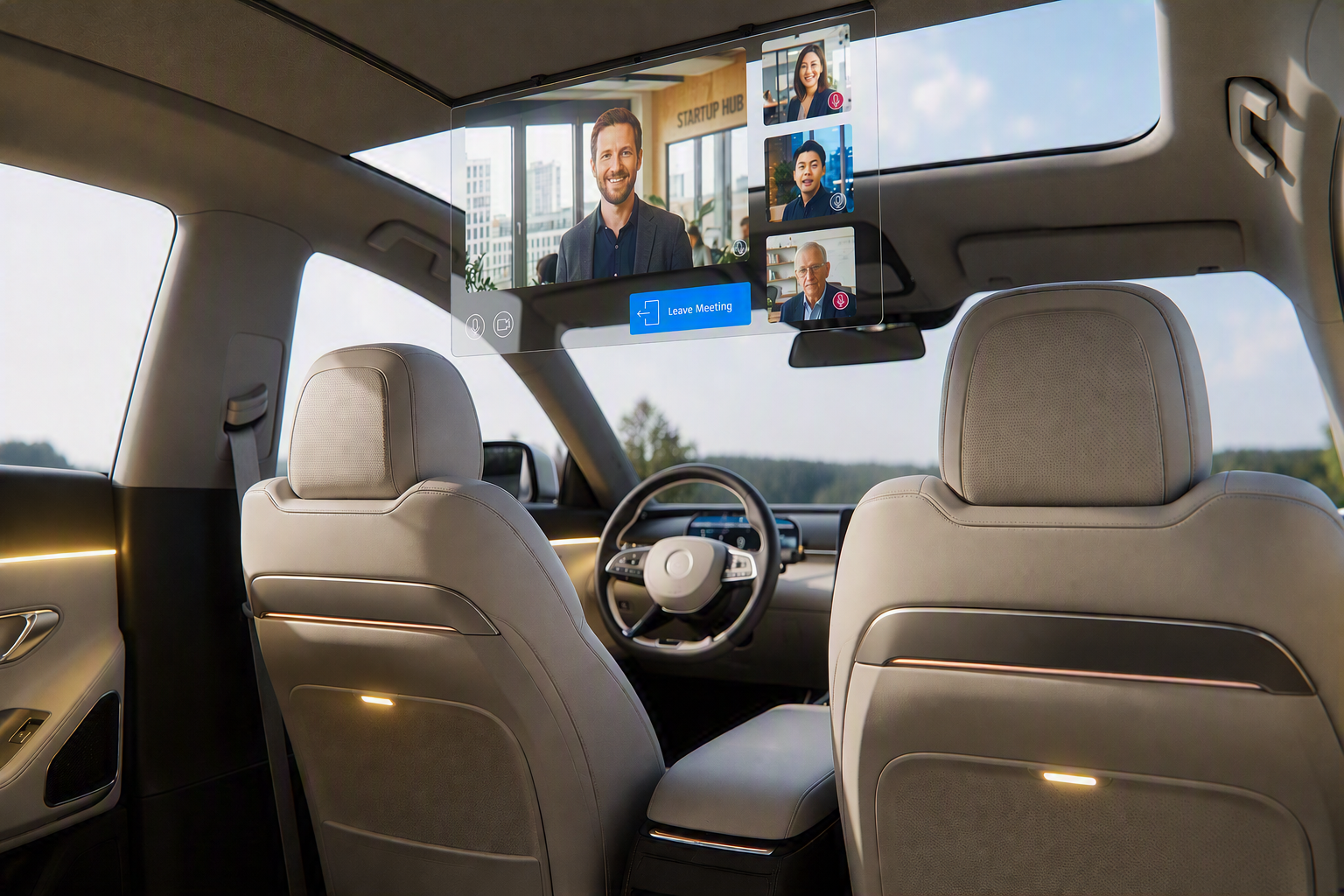
Hoefer is careful about scope. The roof layout is one way to do rear entertainment, not the only way, and side windows are also being explored. This was the first public showing, he says, precisely to collect real demand feedback from carmakers, tier-one suppliers and end users.
The windscreen and the eyebox
The windscreen version controls not only what is projected but who can see it. Light from the projector is directed by holographic structures in the glass into a pre-defined viewing volume called the eyebox. A driver can read vehicle information while the passenger watches entertainment, and from the driver’s position the passenger’s display area remains transparent.
The second difference is the off state. A conventional screen is visible hardware even when idle. With projection off, the glass shows nothing. Hoefer calls it display on demand.
Because the holographic structure steers light, the projection unit does not have to sit directly in front of the driver, which helps shrink the unit and relieve packaging pressure inside the instrument panel.
Mass production timing
Putting holographic windscreen display into production means coordinating automotive glass, projection hardware and interior packaging, and solving system integration. Hoefer stresses that it cannot be treated as a standalone part, since it affects vehicle design and must be planned from the start.
He expects holographic windscreen display to reach mass production around 2029. The rear transparent display faces lower integration hurdles because it does not deal with windscreen curvature, so it could arrive sooner, subject to the carmaker’s model plan.
On 8 October Zeiss announced the acquisition of Ceres Holographics, based in Scotland, folding it into the micro-optics business. Ceres brings design, mastering and replication of thin-film holographic optical elements, with automotive windscreen display as a focus application. The two teams use different approaches to holographic structures and Zeiss describes them as complementary, with the acquisition also bringing scarce specialist engineers.
Editor’s note: This is an adapted translation of the original Gasgoo report. It has been trimmed and restructured for readability for an international business audience. The full original (in Chinese) is at https://auto.gasgoo.com/news/202611/6I70476865C103.shtml.