At the World Internet Conference in Wuzhen, JD set out a physical AI acceleration plan that includes a five-year commitment to procure three million robots, one million autonomous vehicles and 100,000 drones.

The framework is not a firm order, and the company does not present it as one. Its value is as a signal that a very large buyer is prepared to open real warehousing and retail floors to robot vendors, and to let the transaction data those floors generate flow back into model training. AgiBot and other embodied AI vendors have already been testing inside JD facilities.
Why the warehouse comes first
The capital market’s valuation logic for embodied AI is shifting from narrative to scenario and order. JD’s plan supports the view that logistics and supply chain is where deployment actually works, for reasons that are structural rather than promotional.
The first is the environment. A general-purpose humanoid operates in unstructured space, where tolerance for precision and cycle time is very low. A warehouse is comparatively standardised, with more room for error and a fixed set of tasks repeated at volume.
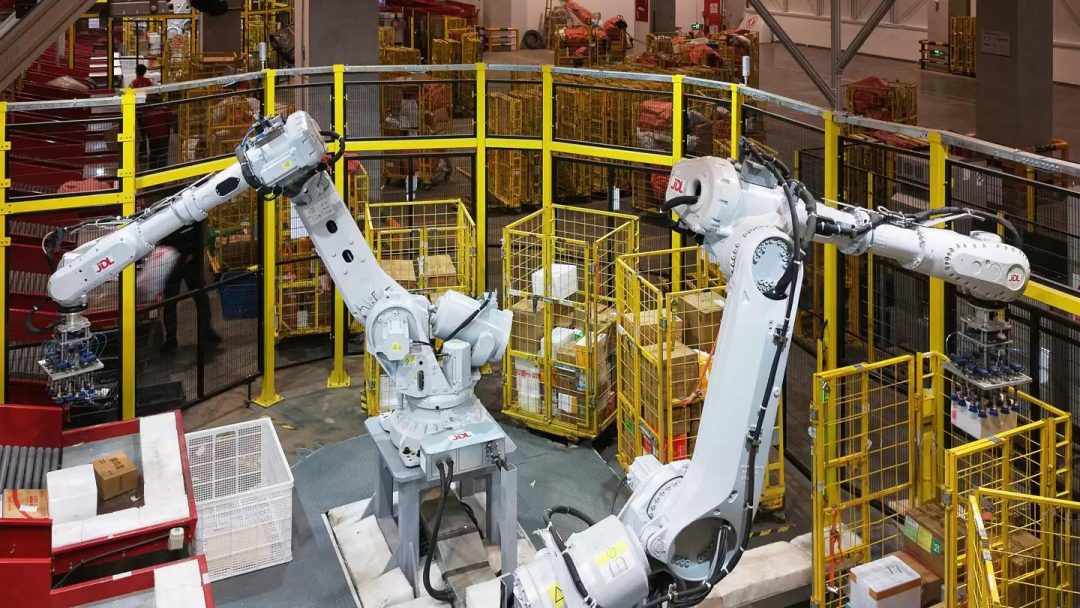
The second is the form factor. Logistics work can be done by heterogeneous fleets, a wheeled chassis carrying an arm for handling and sorting, rather than a bipedal humanoid. That lowers the technical difficulty considerably and fits what the supply chain can already build.
The cash loop
Compared with general humanoids, where the development cycle is long, logistics has a clear cost and efficiency balance point. Once equipment cost is controllable, the scenario can generate positive cash flow relatively easily. More importantly, the grasping and movement data produced every day flows back into embodied foundation models, which shortens the training cycle for the algorithm.
Bernstein has made a similar argument, identifying four scenarios with the fastest payback and estimating a 2.5-year return for them.
What could go wrong
The five-year figure depends on technical maturity and on the cost curve continuing to fall. The size of individual batches is uncertain. And logistics-specific embodied equipment is not the same technology stack as a general humanoid, so a burst of orders in warehousing should not be read as a burst in humanoids.
The metrics that will actually settle this are narrower than the headline. The size of the first confirmed batch, and real-machine stability data over a full shift inside a warehouse.
Editor’s note: This is an adapted translation of the original OFweek report. It has been trimmed and restructured for readability for an international business audience. The full original (in Chinese) is at https://robot.ofweek.com/2026-11/ART-8321202-8110-30710398.html.