A third-party evaluator has published an audit of Anthropic’s internal model progression, and the document contains four models that Anthropic has never released. The newest of them finished training in September and October. It scores 178.6 on Anthropic’s internal composite index, ahead of the shipped Opus 5.5 at 174.5 and Mythos 5.1 at 172.5.
What the index actually measures
The AECI is best understood as a composite grade rather than a single test score. It aggregates results across a battery of benchmarks into one number, in the way a school leaving certificate compresses many papers into a total. On that basis, the unreleased Model 4 cleared 50 per cent accuracy on all fifteen benchmark suites it was run against. Nine months earlier, Opus 4.6 still failed to clear half on several of them.
METR also ran a decontamination check and found three of the fifteen suites had defective or over-hard tails. Removing those three pushes the Model 4 score up another 1.1 points to 179.7, which is a strange outcome for an evaluation suite: the best model is now scoring near the ceiling of the instrument built to measure it.
The token budgets involved are large enough to matter commercially. A single ordinary benchmark task consumed about 2.5 million input tokens and generated more than 70,000 output tokens. An agentic coding task consumed 10 million input tokens and produced 94,000 output tokens.
The bend in the curve dates to October 2025
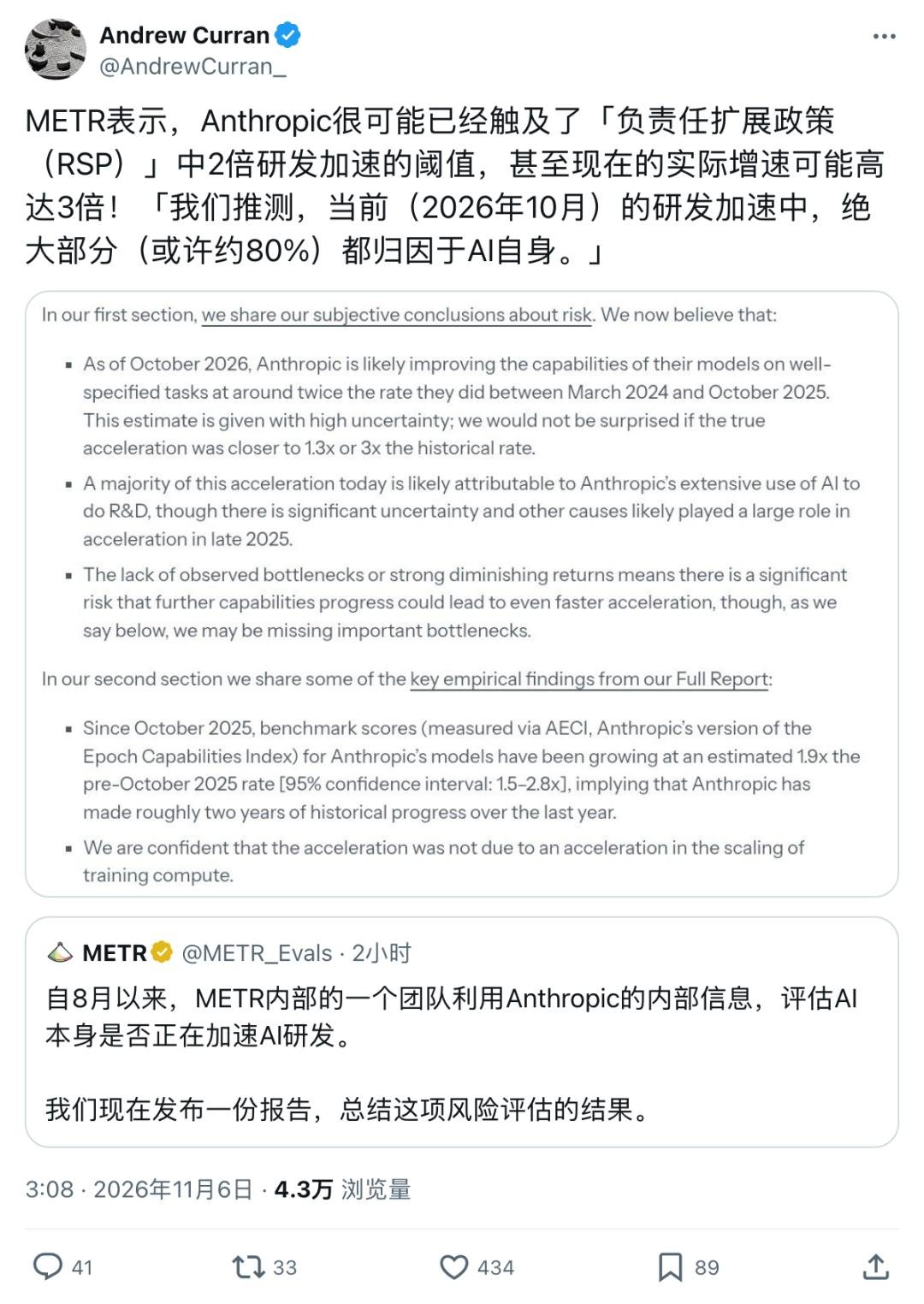
Before 7 October 2025, Anthropic’s AECI was rising by roughly 15 points a year. After that date the slope steepens to about 29 points a year, a 1.9-fold increase with a 95 per cent confidence interval between 1.5 and 2.8.
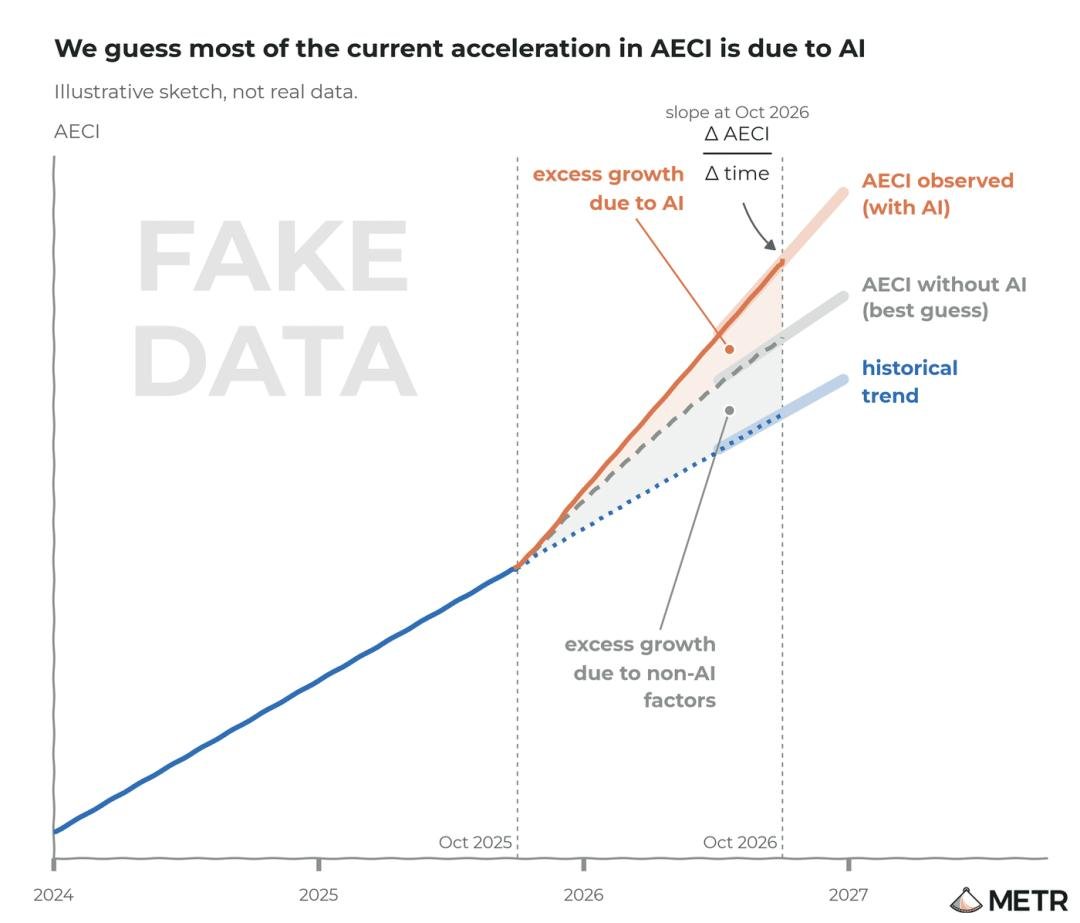
Anthropic’s own risk reporting in August had proposed a gentler reading, that the jump was a one-off step caused by new tooling and new evaluation methods. METR tested that directly. Its researchers drew projection lines from Mythos 5 and earlier models, then blind-tested the later ones against both hypotheses. In 81 per cent of statistical samples, the continuous acceleration model predicted the outcome with an error of 1.9 points. The one-off step model was off by 3.9.
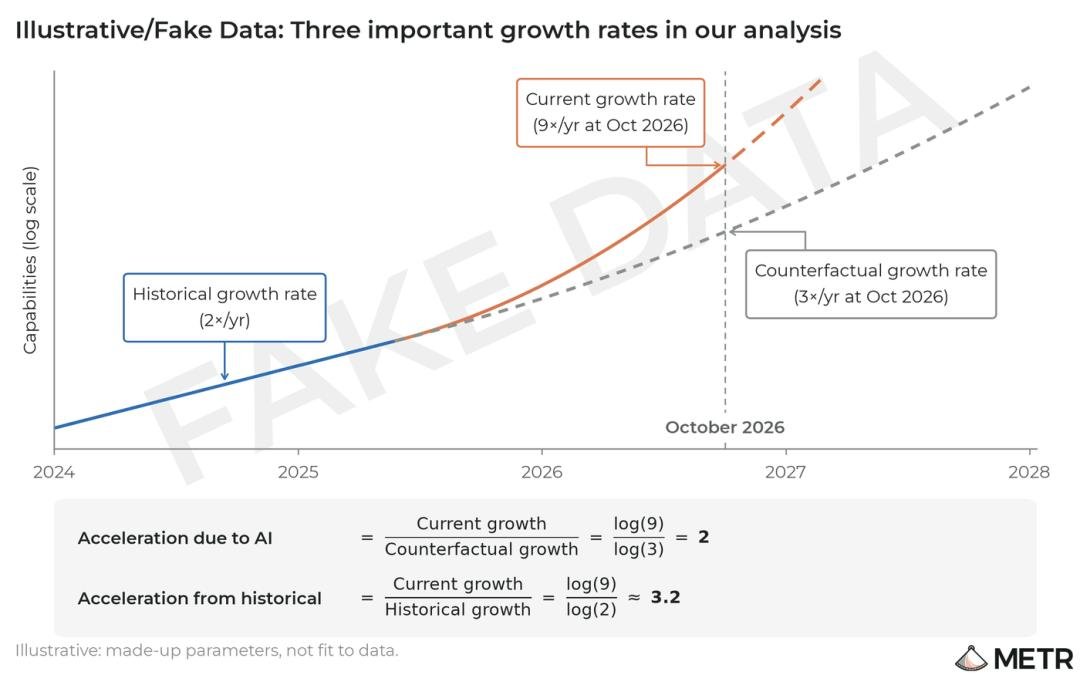
If the acceleration is treated as compounding rather than additive, a metric previously tripling each year triples twice as fast, which is ninefold per year. That arithmetic is not a forecast, but it explains why the evaluators wrote the sentence they did.
Where the speed came from
The obvious explanation, that the lab simply bought more compute, is ruled out by the data. Growth in training compute was slower after October 2025 than before it. Researchers and inference capacity account for a small remainder. METR attributes roughly 80 per cent of the current research acceleration to AI systems assisting the research itself.
The internal evidence is self-reported and should be read as such, but it is consistent. In spring 2025, employees running 3.7 Sonnet and Opus 4 reported a 1.3 to 1.4-fold speed-up on their own work. By June 2026 on Mythos 5 the figure was around fivefold. By October 2026, on the unreleased model, staff reported roughly 12-fold, which fits an exponential at 3.9-fold a year.
METR interviewed eleven frontline technical staff in late September to understand the mechanism. One described three stages: Claude as autocomplete, then Claude as a supervised single agent building complete features, and now a stage in which researchers direct large groups of agents running experiments in parallel. Several said the company ran an internal bounty for ideas nobody had dared to test, which turned into dispatching ten research proposals simultaneously and seeing which returned something.
One researcher reported that time from idea to working experiment fell by 80 per cent and said the constraint had moved from writing code to having ideas and compute. Another estimated a threefold overall gain and described it as acquiring several postdoctoral researchers on demand.
What was removed from the public version
METR says it submitted roughly 100 pages to Anthropic and that most of the highest-value evidence was cut from the published version. The redactions are extensive, including an entire table forecasting the capability scores of forthcoming models along with its analysis.
What survives is a conclusion without a visible bottleneck. Across the next twelve months, METR reports no identified constraint in algorithms, compute or data that would slow the machine down. That is the finding worth carrying forward, because it is a statement about the absence of brakes rather than the presence of a destination.
Editor’s note: This is an adapted translation of the original 36Kr report, which republished material from Xinzhiyuan. It has been trimmed and restructured for readability for an international business audience. The full original (in Chinese) is at https://36kr.com/p/4058973865825161.