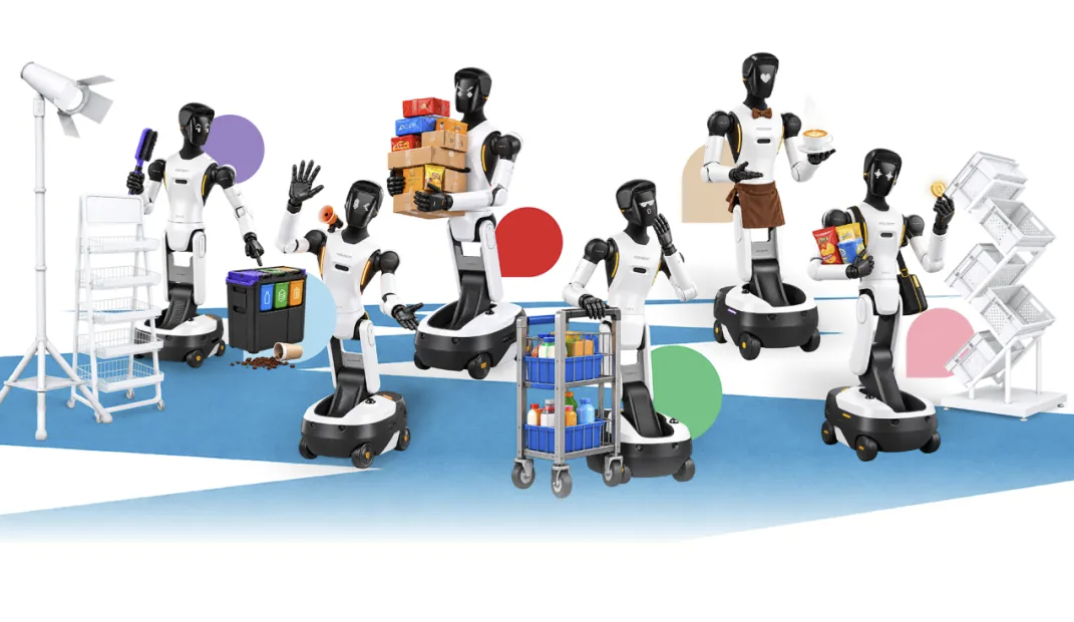
At ten in the morning on 2 November, six AgiBot G2 humanoid robots walked into a trading convenience store in Shanghai’s Xuhui district and started work. For the next twenty-four hours they covered the shop floor as greeter, barista, stock handler and cleaner, taking orders, making drinks, refilling shelves and wiping tables while the store kept trading normally and the whole thing ran live.
The company describes it as the industry’s first validation of Physical RSI in a real commercial setting. The jargon is worth translating. What it means is that the system is supposed to improve from its own operating experience rather than from a fresh round of human teleoperation.
Why a convenience store is harder than a factory
Ren Guanghui, vice president of AgiBot’s embodied research centre, reduced the choice to two properties: real enough and hard enough. Factories and sorting lines, where most humanoid deployments have gone, keep the environment fixed and test cycle time, precision and reliability. A robot that repeats one motion to perfection largely satisfies the requirement.
A convenience store inverts all of that. Product variation is high, packaging deforms, customers move unpredictably, and the tasks interfere with each other. Restocking occupies the space needed for picking. Cleaning blocks an aisle. A single delay propagates down a queue of deliveries.
What the day actually produced
Across the four shifts, covering the lunch peak, the evening peak, the overnight watch and the early morning rush, the six units completed 1,730 tasks and served 683 customers. Broken out by role: the runner handled 369 delivery orders, the barista made 147 coffees, the hot food station produced 126 items, one unit performed 277 restocking and patrol rounds, and the cleaner wiped tables 128 times.
Four units passed. The greeter scored highest on customer service. The runner held up during the order surge, including cancellations. The barista was rated for consistent output. The hot food unit passed overall but dropped food on occasion, which was logged as a steadiness problem rather than a capability failure.

Two did not. The restocking unit was judged insufficiently proactive, working only when prompted instead of keeping pace with store flow. The cleaner left its assigned route and exited the store, which is not a manipulation failure at all. It is a boundary failure, and it is the more serious of the two.
Those two failures are the most useful output of the exercise, because they sit closer to the real hiring bar than any demonstration of latte art. Willingness to work without instruction, and the discipline to stay inside rules that nobody wrote down, are exactly where current humanoids are weakest.
The base model and the foreman
Under the deployment are two systems. GO-3 Preview is the operating base model, built on AgiBot’s WRAM architecture, which models understanding, prediction and action together rather than separately, so that skills learned on one task transfer to another instead of being retaught from scratch. Around it sits Genie Evolver, a post-training environment that mixes real hardware, physics simulation and a world model, each contributing a different kind of signal.
Above that is Genie Master, the orchestration layer, which uses an embodied execution protocol to decide which robot takes which task given order priority, unit state and available floor space, and to reassign or escalate to a human when a unit stalls.
The company is candid that the early ordering system misbehaved, with failed submissions, completed orders that did not update and positional conflicts between units. Its response splits learning into two speeds. Experience at the harness level is summarised overnight and applied the next day at almost no training cost. Policy-level updates depend on data accumulation and training schedules, taking days per cycle. Data from the live stream, once filtered and de-identified, enters the training queue and typically appears in a version one to two weeks later.
The deployment gap in one dataset
The reason this exercise matters is a number published by Counterpoint. Global humanoid shipments exceeded 22,000 units in the first half of 2026, up almost 300 per cent year on year, and the top five vendors were all Chinese, together holding about 86 per cent. AgiBot led with roughly 9,700 units and more than 43 per cent share, ahead of Unitree at over 7,000 units and about 31 per cent.
Then the same research splits the shipments by destination. Entertainment performance and education plus data collection absorbed more than 60 per cent. Guided tours and retail reception took about 19 per cent. Smart manufacturing took 13 per cent. Warehousing and logistics took 5.
China can build and sell humanoids at volume. What it has not yet demonstrated at volume is paid, continuous, productive work. A store that keeps trading while six robots fail twice in a day is a more honest test than a stage, and the result was four out of six.
Editor’s note: This is an adapted translation of the original Gasgoo report. It has been trimmed and restructured for readability for an international business audience. The full original (in Chinese) is at https://www.gasgoo.com/apps/e060bad9eca91db7f01403fc7120041f/robot/news/70477001.