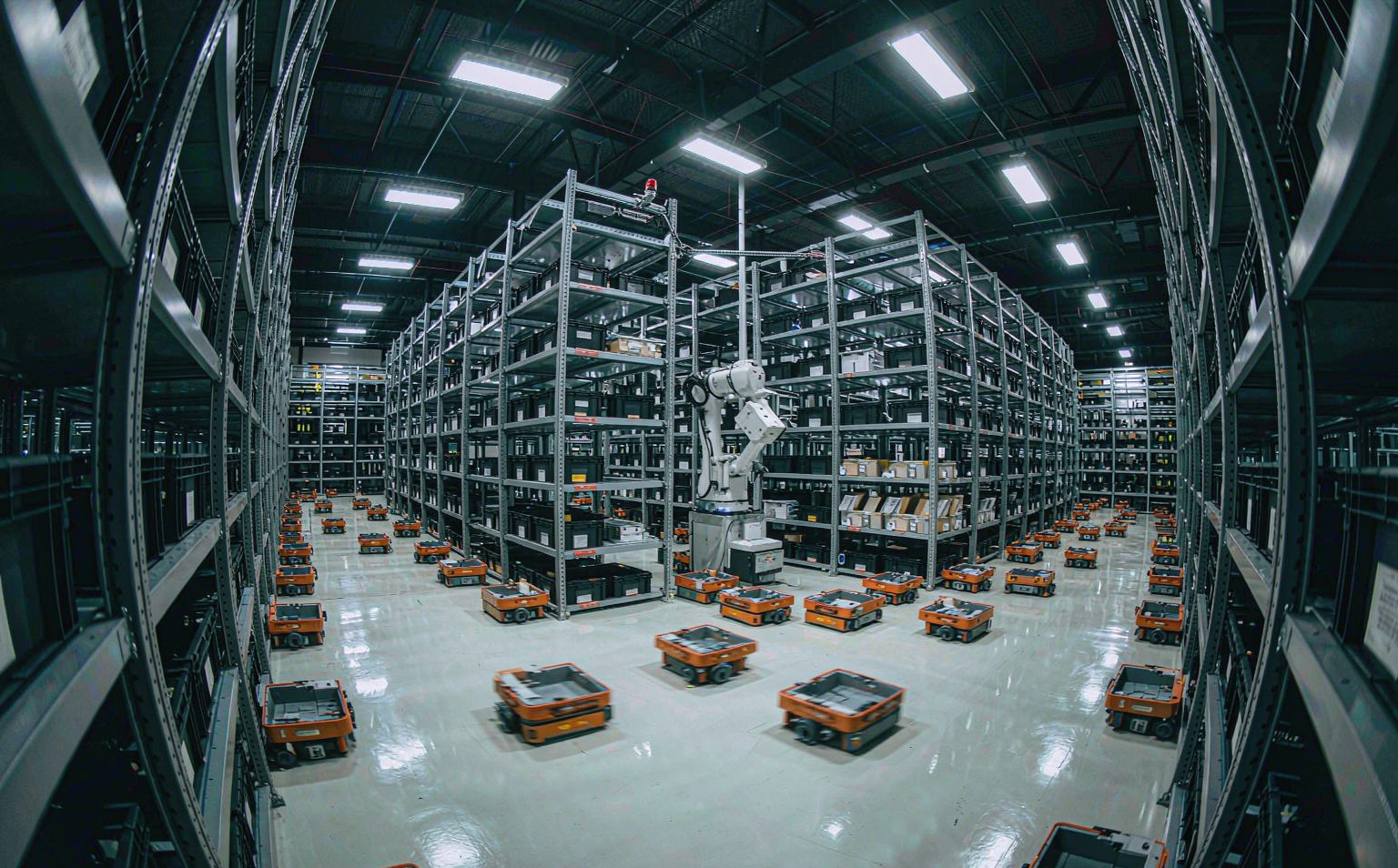
Geek+ has set out a plan it calls the 24/7 autonomous warehouse, with a stated goal of a facility that runs continuously, learns from its own operations and improves without a new integration project each time. The company is framing this as the next stage of physical AI rather than as an extension of its existing automation line.
The awkward fact underneath the category
Warehouse automation has an uncomfortable shape. The more automated a facility becomes, the more its residual human dependency concentrates in the hardest remaining step. A decade of AMR deployment automated movement and storage to the point where goods can find their own way to a picker. Then the picker meets a thousand SKUs in packaging that changes monthly, and the automation stops.
That is the bottleneck Geek+ is naming: point efficiency no longer lifts the whole building. A faster robot in a process that stalls at the boundary between two systems produces a faster stall.
Three steps, stated as three gaps
The plan is sequenced as full-process coverage, then an intelligence loop, then scale. Read against the industry, those correspond to three genuine gaps. Can a robot finish a complex task unaided. Can the building decide for itself when hundreds of units are running. Can the model be replicated without an engineering team on site.
On the first, the company has a unified embodied framework called Gravity and a 4D embodied world model that models geometry, force and contact rather than pixels. The claimed capabilities are cross-task generalisation to unfamiliar objects without per-object training, resistance to interruption when items move or become occluded, decomposition of long multi-step tasks, and correction by natural language instruction instead of reprogramming.
Its Gino 1 humanoid handles picking and box handling and coordinates with mobile units for continuous pick sequences. The unmanned picking workstation, which takes over the pick-and-put work that has resisted automation, was piloted at Schneider Electric’s Shanghai logistics centre at twice human throughput with accuracy above 99.99 per cent.
The building gets one nervous system
The orchestration argument is that conventional warehouse stacks optimise locally. The fleet manager optimises routes, the business system optimises order execution, the data platform produces reports, and none of them holds a view of the whole building. Geek+ is consolidating orders, inventory, robots, arms and workstations into a single state model, with three systems underneath handling robot scheduling, business execution and operational analytics.
Above that sit three agents with distinct jobs: one watching for anomalies, one tracing causes and proposing fixes, one adjusting parameters and deploying the resulting policy. The company says the agents are seeded with something less common than model weights, namely its accumulated site operating experience and efficiency analysis frameworks, so that problems a senior warehouse manager used to diagnose by walking the floor become queries the system can run.
The cadence differs by layer. Scheduling adjustments can land in minutes. Operating policy changes accumulate against daily data.
The scale it already has
Geek+ reports seven consecutive years as the leading AMR vendor by share, more than 1,000 customers across 40-plus countries, and over 81,000 robots deployed cumulatively. At this year’s CeMAT trade fair it ran a live coordinated exercise across its full AMR range and the AI scheduling layer together.
Its vice president of systems, Tan Wenzhe, proposed four measures for whether a warehouse is genuinely self-operating: the ability to handle exceptions unaided, throughput stability under difficult conditions, continuous runtime, and recovery speed after failure. Those are reasonable measures, and they are also the four things a customer discovers only after signing.
The commercial risk is familiar from every automation cycle. A facility can be built at great expense and still need a person at three in the morning. The plan is an argument that the person can eventually be replaced by an accumulated record of everything that went wrong before.
Editor’s note: This is an adapted translation of the original OFweek report. It has been trimmed and restructured for readability for an international business audience. The full original (in Chinese) is at https://robot.ofweek.com/2026-11/ART-8321202-8420-30710305.html.