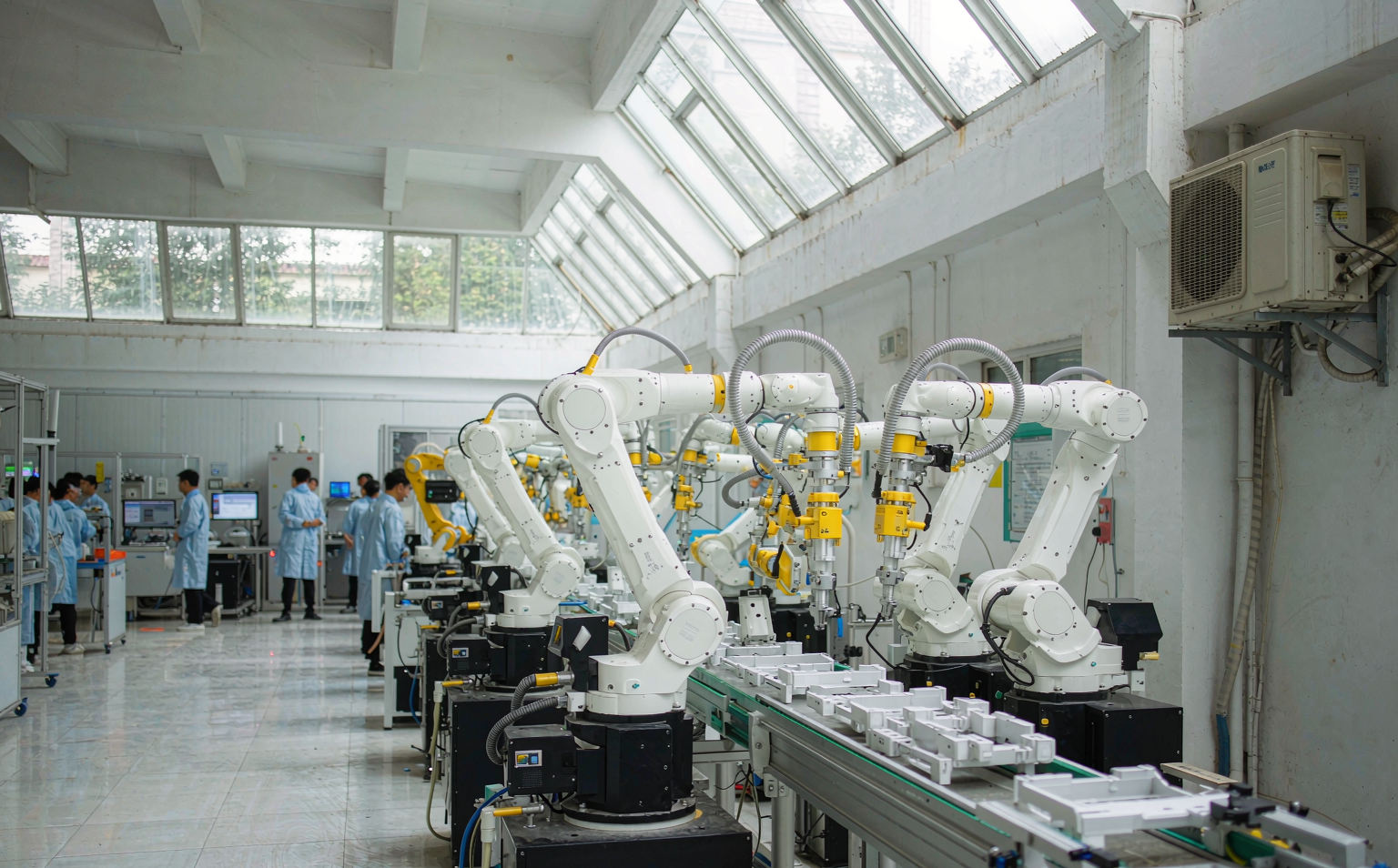
Construction has started on the Shanghai Lvlian Intelligent equipment base in Sijing, Songjiang. The site combines research, manufacturing and delivery in one campus, with completion scheduled for August 2027 and production from December of that year. Initial annual capacity is planned at 6,000 consumer robots and two million compute boards.
The company is a national-level specialist and sophisticated supplier, one of the small-firm classifications Chinese industrial policy uses to designate component makers with defensible technology. It holds more than 200 patents and software copyrights and has spent fourteen years in connected devices, building intelligent controllers, AI display modules and an IoT platform before extending into consumer AIoT products.
The numbers behind the groundbreaking
The controller business passed RMB 50 million in revenue in 2014. By 2025, with the second phase of its Wuxi plant in production, group revenue approached RMB 400 million.
For the first half of 2026 the company reported revenue of RMB 246.0 million, up 66.59 per cent year on year, net profit attributable to shareholders of RMB 6.42 million, up 35.13 per cent, and adjusted net profit of RMB 6.12 million, up 50.03 per cent. The margin structure is worth stating plainly: a net margin of about 2.6 per cent on a business growing at two thirds a year. This is a hardware supplier converting a component capability into a finished product, and it is not yet being paid like a product company.
What the coffee robot is actually selling
Lvlian entered embodied products in 2024 with an unmanned coffee unit, which began delivery in 2026 with 500 units planned for the year. Unlike the automatic machines already common in offices, this one carries a multi-axis arm and reproduces the full motion set of a human barista, including extraction, milk steaming and latte art, with two arms working together.
The operating model matters as much as the arm. The unit carries material monitoring and state sensing, and the back end manages a fleet from the cloud, so an operator can see bean and milk levels and machine condition remotely instead of staffing a site.
In November 2025 the company signed a strategic agreement with Yingzhi Technology, a leading domestic food service embodied robot brand, to build a line with annual capacity in the ten-thousand-unit range. Chairman Li Bo put the expected revenue contribution at about RMB 1.5 billion a year with more than a thousand jobs.
Why coffee, of all things
China has about 550 million coffee drinkers consuming roughly 25 cups a year each, across a market close to RMB 130 billion and more than 260,000 stores. The bottleneck in that market is not equipment or real estate. It is the barista, a role with a long training period, high turnover and rising wages.
A robot that reproduces the motion sequence and moves replenishment to remote operations attacks the heaviest variable cost in the single-store model. That is the entire thesis, and it explains why the machine does not need to be intelligent in any general sense. It needs to be consistent, and it needs to remove one hire per shift.
The category economics are being priced accordingly. Stratics MRC puts the global coffee robot market at about USD 700 million in 2026, rising to USD 2.79 billion by 2034 at an 18.8 per cent compound rate. The domestic market was worth roughly RMB 10.67 billion in 2025.
Two million compute boards alongside 6,000 robots is the part worth watching. It suggests the company expects the controller and edge compute business, not the robot line, to remain the volume driver. Whatever the robots do, the boards ship.
Editor’s note: This is an adapted translation of the original OFweek report. It has been trimmed and restructured for readability for an international business audience. The full original (in Chinese) is at https://robot.ofweek.com/2026-11/ART-898890-8120-30710545.html.