The humanoid robot has spent three years being introduced to the public through performance, and the performances have become genuinely impressive. What they have not become is productive. The gap between a robot that can walk, turn and finish a rehearsed sequence and one that can be left alone in a building for a shift is the central unresolved problem of the category, and it is now visible in the numbers companies publish about themselves.
What a success story looks like before the hype
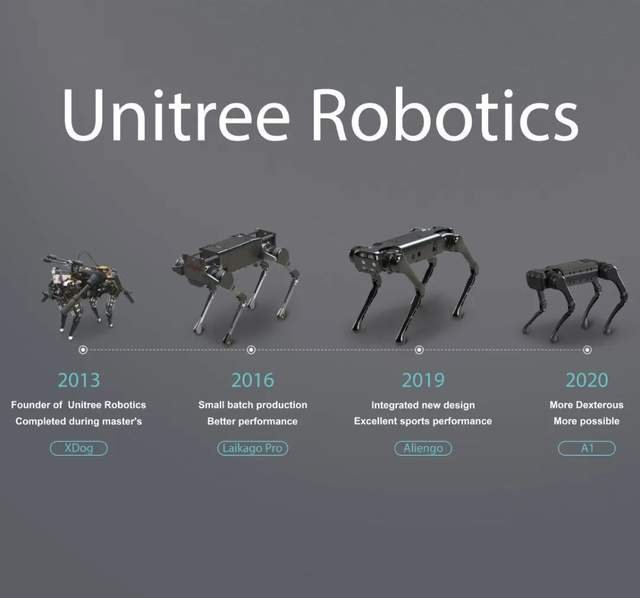
Unitree is the cleanest case in the sector, and its advantage predates the boom. Founder Wang Xingxing spent his graduate years at Shanghai University on a quadruped called XDog, whose thesis documented a motor-driven design for a complete machine, including a driver he designed himself after buying and testing nearly ten brushless model-aircraft motors.
The comparison at the time was Boston Dynamics, whose early BigDog used an engine and hydraulics, with pumps, lines, valves and cooling hardware producing enormous power at the cost of mechanical complexity. Direct brushless drive traded some of that power for a machine that was smaller, cheaper and far simpler to build and repair.
The commercial insight arrived with the product. When Aliengo shipped in 2019, university AI labs were the buyers, because a lab needs a platform to run and verify algorithms and will pay for performance, price and development access. That is a real product-market fit in a narrow segment, reached years before any general commercial application existed.
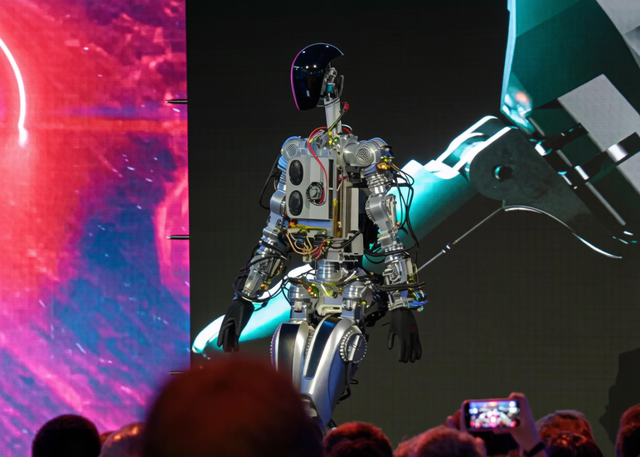
When the company moved to humanoids, joints, motors and motion control carried over. The 2025 Spring Festival broadcast, with sixteen H1 units dancing in floral jackets, did the rest. A decade of engineering reached the public in one televised minute, and the public response was built on a machine with a human outline rather than on any demonstrated ability to work.
The measurement that matters
Tesla opened this phase at AI Day in 2021 and showed a prototype in 2022, with Elon Musk describing a market where volume would drive cost down and reshape the global economy. Chinese manufacturers then attacked the price. Unitree’s G1 launched in May 2024 from RMB 99,000, which put a humanoid within reach of institutions that had never considered buying one.
Affordable and mobile is not the same as capable. The missing layer is autonomy, usually described in three parts: a cognitive layer for perception, reasoning and task planning, a motor layer for control, and a body for execution, all three coordinating continuously.
Figure provided the most honest public measurement available. In September 2026 it reported results from Helix 2.5 running in thirty homes that had never contributed data, on three task families: tidying toys, folding towels and making beds. The tasks had been trained elsewhere, so the test measured transfer to unfamiliar rooms and objects. By the company’s own whole-task completion standard, the success rate was 56 per cent.
That is well beyond replaying a script, and the system corrected some of its own errors. It is also three defined task types in thirty homes, which does not support an inference that a robot can take over a household. A capability demonstrated is not a service delivered, and the difference shows up in exactly the conditions a demo cannot fake: a different room, a different set of objects, an interruption halfway through, and hour eight of continuous operation.
What the products say when you read the page
1X is unusually direct about this. Its current NEO product material tells early buyers they are receiving basic autonomy, and that for tasks the robot does not yet handle they can book a company specialist to supervise remotely, complete the work and teach the capability. That is a legitimate service model. It is also an admission that the autonomy is partly human, delivered over a network.
This is where public expectation and shipped product diverge most sharply. What people are waiting for is a partner that understands a request, acts on its own and can be trusted. What is available now is performance, interaction and question answering, with companionship and tutoring added on top. Those are real products. They are not general labour.
The money is already asking
Capital has not stopped. Gasgoo’s embodied intelligence desk counted 49 disclosed funding rounds in September 2026 alone, spread across complete machines, models and components. What capital has begun to do is ask a question that demonstration videos cannot answer: apart from the next round, who keeps paying?
That pressure explains the rush into performance, education and companionship, all of which are genuine businesses. It also produces the harder question underneath them. If the value is conversation and content, why does it need an expensive body? A form factor can enlarge a story. Only utility sustains a subscription.
There are deployments that quietly work. In October 2026 the logistics group GXO disclosed humanoid units operating in its facilities. Those are narrow, measured, unglamorous jobs, which is what an early industrial market looks like. The category will be judged on how many of them exist in two years, not on how many robots can be sold into a show.
Editor’s note: This is an adapted translation of the original OFweek report. It has been trimmed and restructured for readability for an international business audience. The full original (in Chinese) is at https://robot.ofweek.com/2026-11/ART-898890-8420-30710455.html.