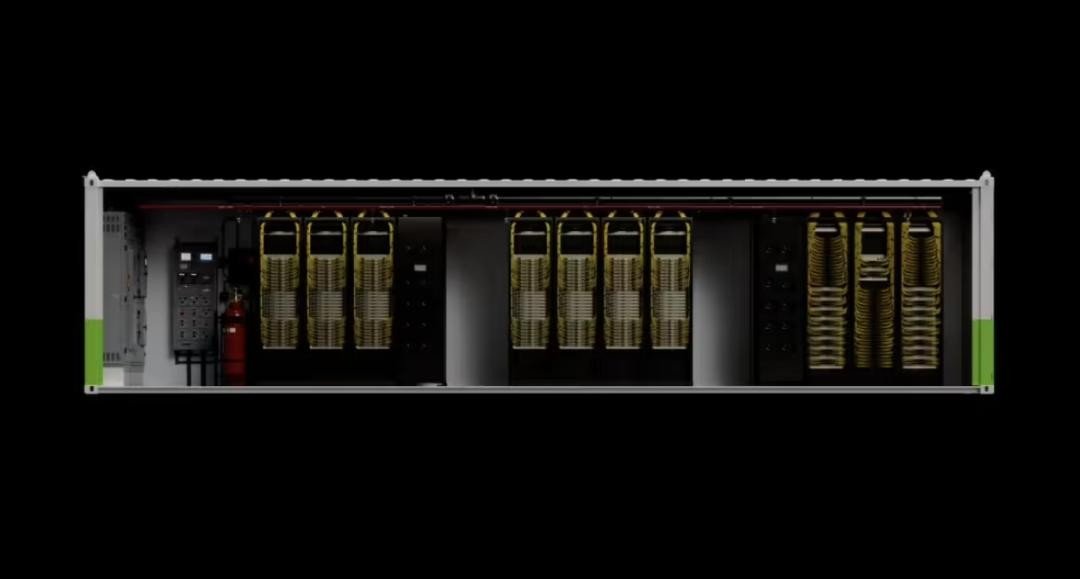
At GTC in Berlin, Jensen Huang stood in front of a rendering of a Vera Rubin rack and announced DSX POD. It is a modular AI factory reference design in which compute, networking, cabling and liquid cooling plumbing are pre-installed in a partner’s factory, then shipped to site and running 14 days after power and coolant are connected. The previous cycle was measured in six months.
Almost simultaneously, Chinese sell-side research converged on the same conclusion. CITIC Securities wrote that domestic and foreign vendors are releasing supernode products in quick succession and that the category has moved from proof of concept to volume delivery, naming server integrators, switch chips, connectors and liquid cooling. Its call is that 2026 is the first volume year for domestic supernodes.
The problem supernodes solve
Communication overhead. A GPU is only as fast as the data arriving from the other GPUs. The conventional approach is scale-out: thousands of cards spread across servers joined by Ethernet or InfiniBand. It scales, but cross-node latency and bandwidth remain the bottleneck, and tensor parallelism is acutely latency-sensitive. The industry term is compute idleness. On a traditional cluster, linear speedup often comes in below 50 per cent, meaning ten thousand cards deliver the throughput of slightly more than five thousand.
Supernodes answer with scale-up. Dozens, hundreds or thousands of cards sit in one tightly coupled domain addressed as a single pool. From the software’s point of view it is one enormous graphics card with directly addressable memory across all of it, and latency drops from microseconds to nanoseconds. ZTE’s supernode white paper puts it plainly: one rack is one giant GPU.
Two forces drove the shift. Mixture-of-experts architectures replaced dense all-to-all exchange with sparse on-demand routing, which raised the bandwidth requirement and narrowed the latency tolerance, because expert routing windows are short. And single-die reticle economics stopped keeping pace with parameter growth, making tighter coupling of more chips a more practical engineering path than continuing to shrink transistors.
Three interconnect strategies
Huawei’s Ascend 960 SuperPoD, announced at its September Connect conference, scales to 4,096 cards per supernode with unified memory addressing over its Lingqu UnifiedBus and 8 EFLOPS of FP8. The more notable choice is the interconnect. Its Hi-ONE near-package optical engine delivers 7.2 terabits in total using 5,500 optical engines in place of the 48,000 800G optical modules the design would otherwise need, cutting more than 550 kilowatts.
Alibaba’s route runs through its own interconnect silicon. The Pangu AL128 puts 128 cards in a single rack with peer-to-peer latency below 150 nanoseconds and rack bandwidth at the petabit level, and it is already carrying Qwen, DeepSeek and Kimi inference on the Bailian platform. In September Alibaba released the AL64 with distributed near-package optical interconnect, which it calls the first scale-up-specific near-package optics in production, with an AL144 on the roadmap for 2028.
Nvidia keeps NVLink and is packaging integration itself. NVL72, then NVL144, NVL288 and NVL576, each enlarging the scale-up domain and increasing the optical share. DSX POD turns that system integration capability into a reference design handed to Dell, Supermicro and Quanta, which makes Nvidia look less like a chip vendor and more like the company that sells the whole rack specification.
Huawei is pushing the same idea further. Xu Zhijun has described an ambition to make a million processors behave as one computer. Multiple Ascend 960 supernodes networked over Lingqu or RoCE can reach 512,000 cards, and with multi-rail topologies the theoretical ceiling is a million.
The China Academy of Information and Communications Technology reports that cluster linear speedup is climbing from below 50 per cent toward 88 per cent and above, as tightly coupled scale-up plus cross-supernode scale-out becomes the new standard. That number, not any single chip’s peak throughput, is what the next two years of capital expenditure is actually buying.
Editor’s note: This is an adapted translation of the original 36Kr report. It has been trimmed and restructured for readability for an international business audience. The full original (in Chinese) is at https://36kr.com/p/4062351932085382.