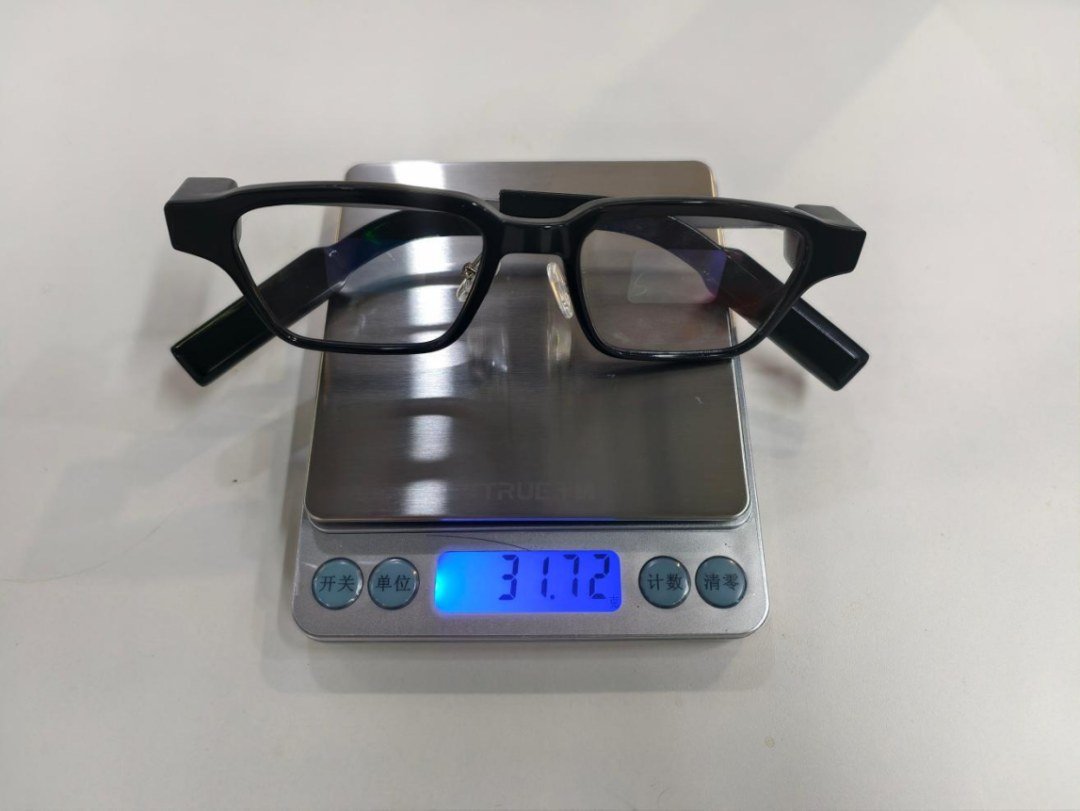
Qingmu Digital, a Shenzhen smart glasses startup founded in November 2025, has closed a seed round from Nanjing Shike, a traditional optical retailer, and is raising an angel round. The first product is aimed at office work: binocular dual waveguide displays, a microphone array, dual speakers, no camera, and 31.7 grams on the scale.
The subtraction problem
The last year of Chinese smart glasses has been a weight race conducted by deletion. One competitor reached 36 grams, another 34, and most of the savings came from removing the camera or the speakers. That does not actually solve wearing, because 30 to 40 grams is still twice the weight of an ordinary pair, and an industry contact told Leiphone that all-day wear remains uncomfortable at that figure.
Qingmu’s claim is that 31.7 grams is the lightest publicly known configuration that keeps both displays, multiple microphones and stereo speakers. It got there by designing the optics, acoustics and structure rather than buying modules: the waveguide was co-developed with a waveguide specialist, the chip was tuned with the silicon vendor on the first full unit, and focus runs from half a metre to infinity.
The acoustics are the more unusual decision. The speakers sit behind the ear and pipe sound through an air channel inside the temple, using a custom rear chamber and a leakage port. The temple itself is held to 3.7 millimetres in height, with a hollow, flared front section to stop the arms clamping the head.
Why the team is the story
Chief executive Li Longzai is a Tsinghua master’s graduate from the first cohort of Chinese AR glasses practitioners. He joined XREAL in 2019, worked through three generations of product and shipping, and built the third-generation XREAL Air that became China’s shipment leader. He moved to Honor in 2022 as a systems engineer for smart glasses, led the Honor and XREAL co-developed viewing glasses, and worked on MR glasses positioned against Apple’s Vision Pro from product definition to final acceptance.
The other two co-founders fill the gaps that usually sink hardware startups. Xiao Jiasheng holds a Tsinghua doctorate, more than twenty papers and over thirty optics patents. Cao Zilan, a Tsinghua master’s graduate and former Alibaba senior operations specialist, ran the commercial launch of Tmall’s Magic Box set-top box from zero to one.
Glasses first, assistant second
Li’s framing is blunt: smart glasses have to be a competent pair of glasses first, because a user has to be willing to wear them before any intelligence gets a chance to matter. Beyond a certain weight, he argues, the second half of the category is AI.
The architecture that follows from that is a three-way split. The glasses do perception. The phone holds memory and orchestration. The cloud does inference only and retains no data. The company plans to lean on Tsinghua alumni networks for agent development and to enter through workplace tasks, starting with meeting minutes.
That split is a bet on where the constraint sits. Running memory on the phone keeps the latency and the privacy argument local, while inference in the cloud keeps the frame light. It is also the least differentiated part of the pitch, because every glasses maker in Shenzhen now describes the same topology.
The hardware claim, at least, is checkable. A pair of glasses on a scale can be verified by anyone, and the 3.7 millimetre temple with a hollow front section is a manufacturing decision rather than a slide. What is not yet checkable is whether an office worker wants a head-mounted assistant that takes notes, which is the same question that has stalled the category for a decade.
Editor’s note: This is an adapted translation of the original Leiphone report. It has been trimmed and restructured for readability for an international business audience. The full original (in Chinese) is at https://www.leiphone.com/category/weiwu/Lfff1nBYqpWoqgMF.html.