The most useful number from Lingjiedian’s industrial trial is not the 98 per cent success rate. It is 8.5 minutes against 8 minutes, the gap between one arm with a five-finger hand and a human worker doing the same 72-step sequence at Wolong Xier’s factory.
Lingjiedian is the dexterous-hand company led by Qiao Tianjie, who is also a vice-president at AgiBot. The proof of concept was shown at AgiBot’s innovation day and ran live from the Wolong Xier production site.
What the 72 steps actually are
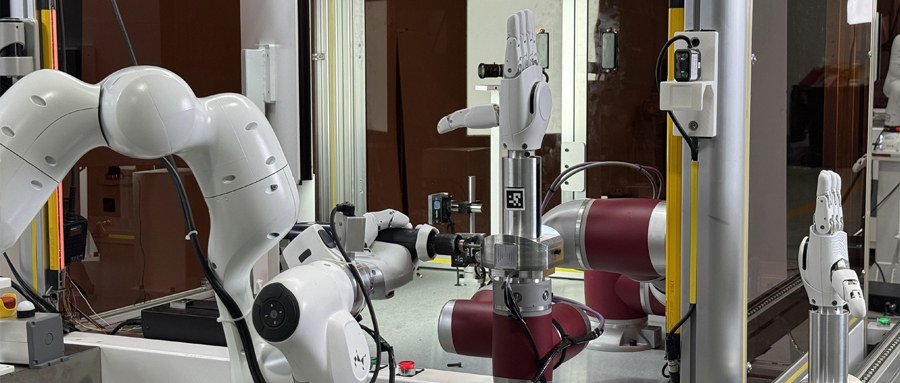
The workstation tests dexterous hands before they ship, and it does so using another dexterous hand. An arm-mounted hand lifts the unit under test from a conveyor, places it on the test fixture, scans its code, then picks up a screw gun, aligns the bit to the screw, and fastens the unit into position.
With the unit fixed, the hand returns the gun, presses the start button, waits through the performance test, presses stop, picks the gun up again, removes the screws and puts the unit back on the conveyor.
That single flow spans flexible assembly of a delicate part, tool operation with force control, and interaction with a machine panel. It is 72 discrete steps, completed by one arm and one hand with no tool change.
Why a gripper could not do it
The company says it started with two-finger grippers and hit a wall. Screw-gun reaction torque pulled the tool out of the grip. Fixing the gun to the end effector solved that and broke everything else, because the same end effector then could not pick up the product or press buttons.
Force control is the second constraint. The bit has to enter the screw head at sub-millimetre accuracy, and the fixture uses reusable captive screws that shift by about a millimetre inside the hole. The gun is heavy and tethered, and cable drag adds its own error. A one-millimetre error at the grip can become three to four millimetres at the bit.
In a live demonstration, staff pushed the arm mid-fastening to knock the gun off target. The robot did not stop. It re-localised, found the hole and finished the screw. In a second test, staff shifted the fixture base so a screw only went in partway. The system detected the failure from torque and vision, re-aligned and drove it home.
Recovery is the product
Two systems do that work. Reinforcement learning trained on real hardware lets the robot adjust from visual and tactile feedback in real time, and the company claims screw-driving speed more than four times faster than teleoperation after training. An agent framework called Omni-Maestro handles failures, judging task completion from vision, torque and fixture signals, then re-running the step or rolling back to the failed one.
Lingjiedian plans to move the cell into formal production within the year to test long-run stability and deployment cost.
The data side
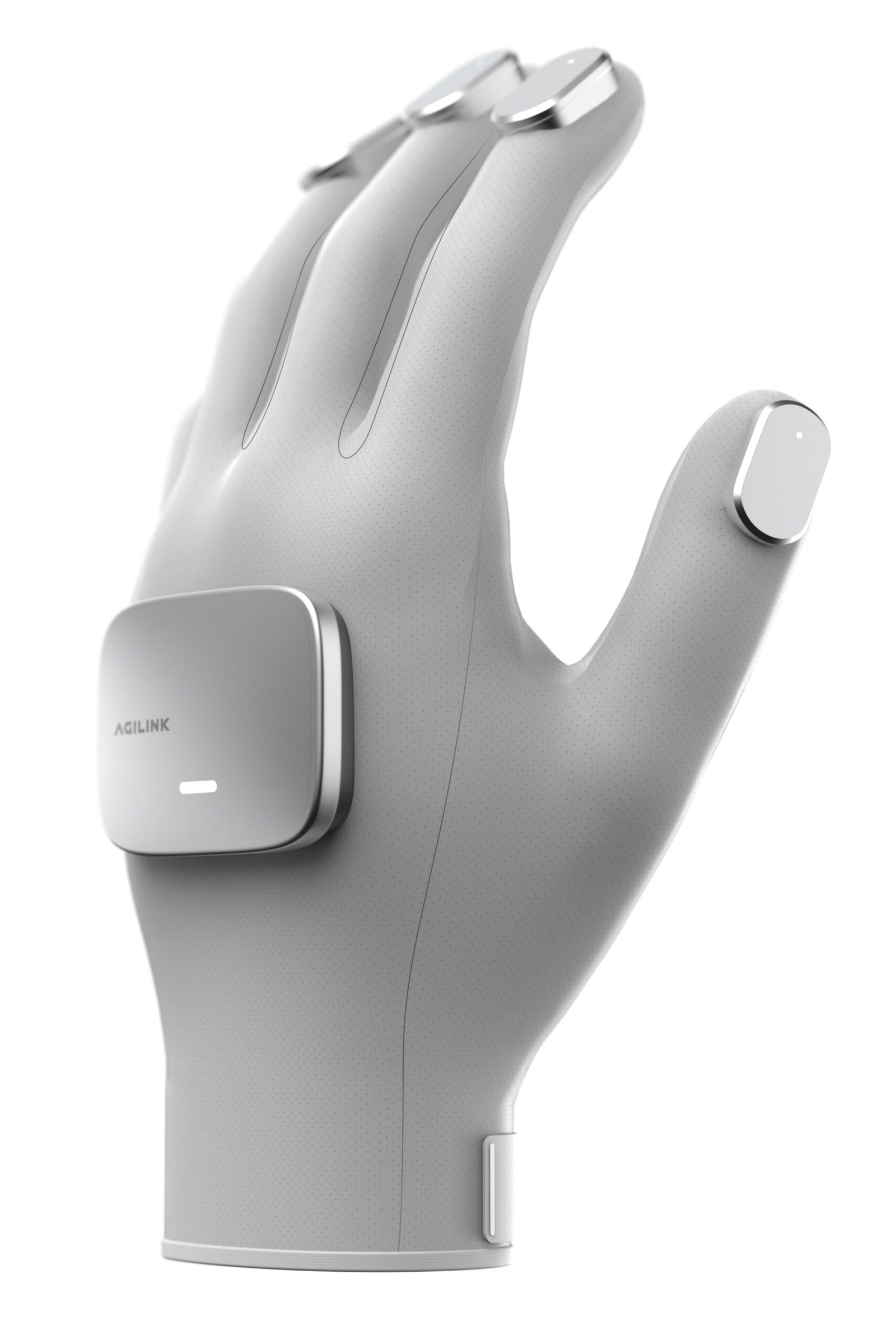
The company also launched OmniGlove Pro, a teleoperation and data-capture glove now in volume delivery. Each fingertip uses magnetic field positioning fused with inertial sensing for 0.1mm positioning accuracy, and the glove carries 746 tactile sensing points at 3mm spatial resolution.
That matters because first-person human video is cheap to collect but weak on contact. Camera-based hand pose estimation struggles with occlusion, and with no tactile channel the data cannot describe what contact actually felt like. Capturing position, pose and touch together, then retargeting across embodiments, produces what chief embodied scientist Huang Bidan calls machine-ready first-person data.
Deploying a full humanoid to test a hand is expensive. An arm plus a hand is the cheaper unit, and the 8.5-minute figure suggests the cheaper unit is now close enough to a human shift to be sold on labour substitution rather than on novelty.
Editor’s note: This is an adapted translation of the original Zhidx report. It has been trimmed and restructured for readability for an international business audience. The full original (in Chinese) is at https://www.zhidx.com/p/605625.html.