Baidu disclosed ApolloWorld on 3 November, an agent-driven multimodal world model built for physical AI. The headline claim is that a single day of virtual road testing inside it equals about three years of continuous real-world testing by a vehicle with a safety driver aboard.
The framing matters as much as the number. Waymo completed a USD 16 billion round in February at a post-money valuation of USD 126 billion, published a world model built on Google DeepMind’s Genie 3 four days later, and took on USD 5 billion of debt financing in October. Baidu’s Apollo Go has reached 28 cities, more than 23 million rides and over 350 million kilometres of driverless distance, with fully driverless commercial service in Dubai and Abu Dhabi, public road testing in London and Switzerland, and Hong Kong’s first fully driverless test permit.
Three phases, one bottleneck
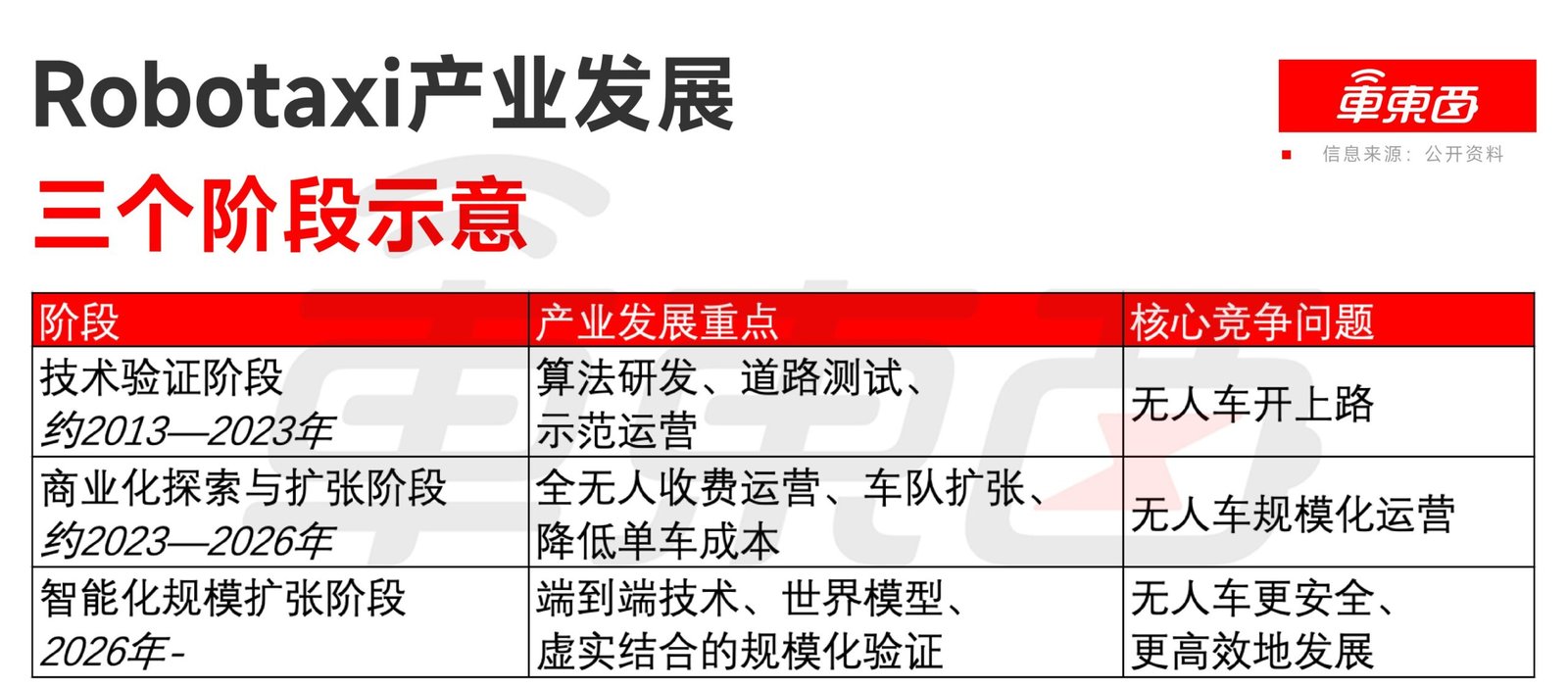
The industry moved from technology development and road testing between 2013 and 2023, to paid robotaxi operation from 2023, and now to cross-city, cross-market scaling. Each phase has a different constraint, and the current one is time.
Real roads are full of low-frequency, complex and dangerous situations that more test kilometres cover only slowly. Every new city also demands vehicles, staff and months spent learning local road behaviour and driving custom. If every algorithm upgrade and every market entry restarts that clock, expansion speed is capped by logistics rather than by software.
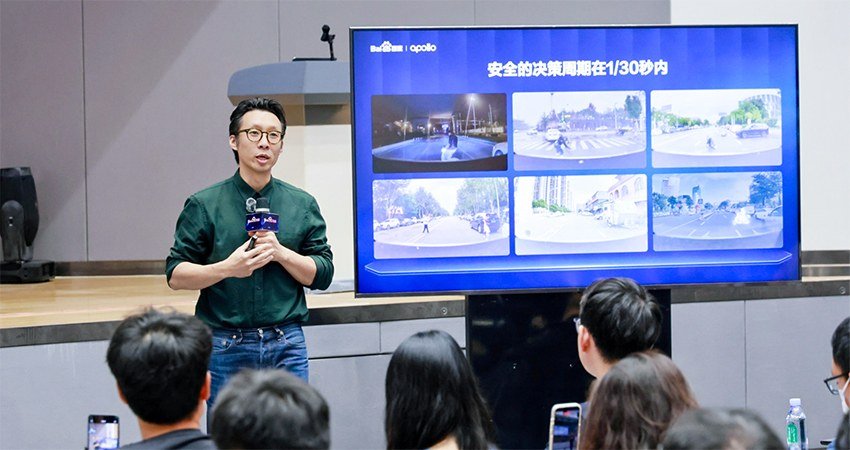
World models offer a second path. Instead of accumulating miles, the system meets situations it has not yet encountered in a generated environment, under control.
What Baidu says a world model must do
Fei-Fei Li sorted world models into renderers, simulators and planners in June 2026: one draws the world, one predicts how it changes, one decides what to do. Baidu’s chief architect for its intelligent driving group, Wang Liang, argued that while a car’s control actions are comparatively simple, driving is a dynamic game among many participants on open roads.
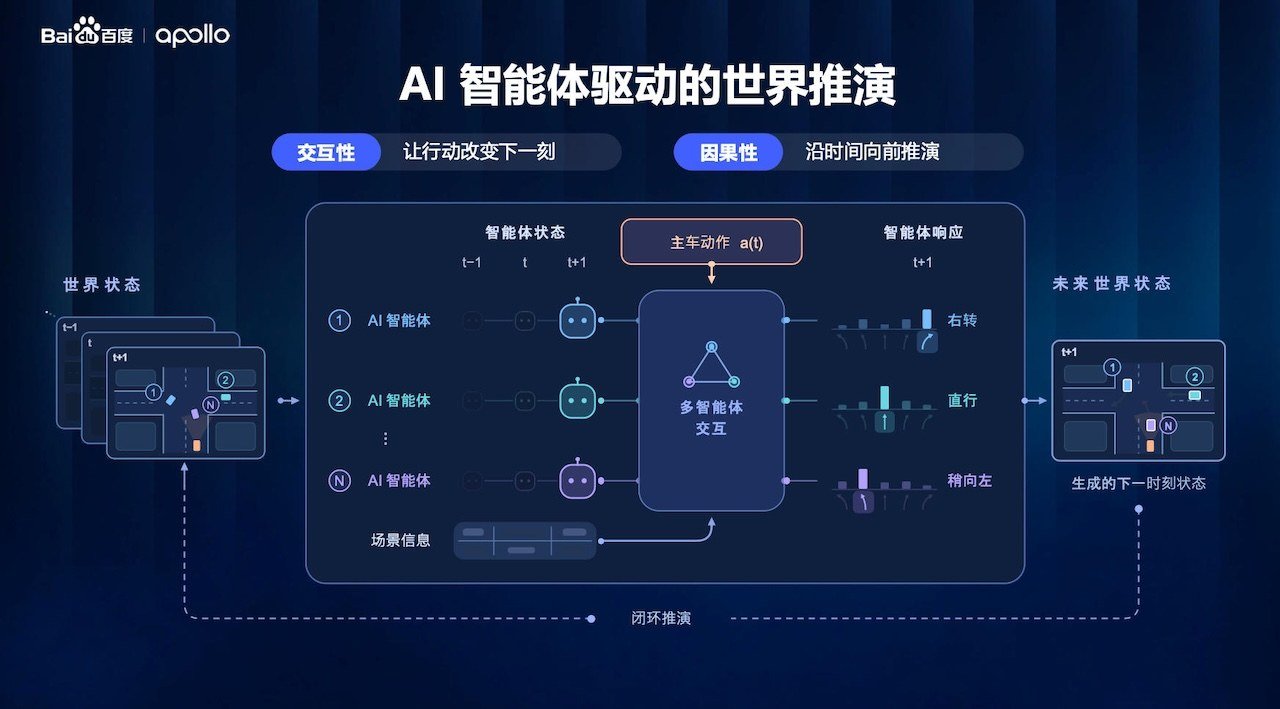
A car approaching a junction cannot know whether the other vehicle will yield or accelerate, and its own choice changes what the other driver does next. The hard problem is predicting other participants and the chain reaction their choices set off.
Baidu’s response is a two-plus-three standard. The two gates are causality, meaning the model predicts forward from current state, and interactivity, meaning it responds to external actions so that different decisions produce different outcomes. In one ApolloWorld scene, a car reaching a motorway entrance sees side-road traffic merge if it takes the ramp, and sees that traffic stop and wait if it stays on the service road.
The three further criteria are physical accuracy, persistence over long rollouts, and real-time response to vehicle action. Sensor fidelity sits underneath all of them, since simulated lidar has to reproduce how rain, snow and spray change real returns.
Why this is a competitive question, not a research one
A world model that only produces convincing video is a content tool. One that can be used as a test environment changes unit economics, because validation stops competing for vehicles and safety drivers and starts competing for GPU hours.
That has a direct bearing on Europe. Robotaxi entry into a European city currently means permits, a depots, a safety fleet and a long local validation campaign. If a meaningful share of that validation migrates into simulation, the cost of entering the second city falls faster than the cost of entering the first, and the advantage shifts to whoever owns the simulator rather than whoever owns the largest fleet.
Editor’s note: This is an adapted translation of the original Chedongxi report. It has been trimmed and restructured for readability for an international business audience. The full original (in Chinese) is at https://chedongxi.com/p/379261.html.