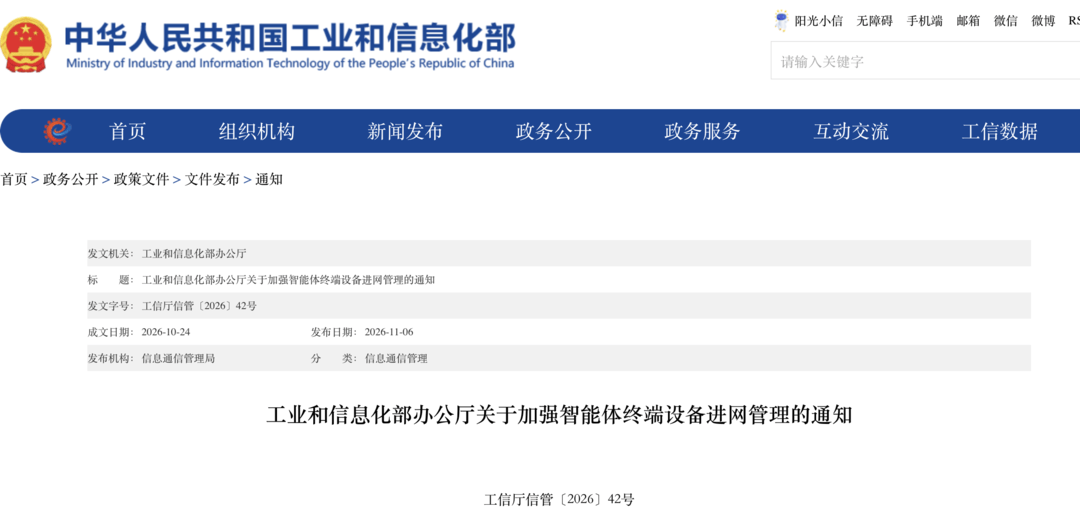
On 6 November the Ministry of Industry and Information Technology issued a notice on strengthening network-access management for agent terminal devices. The ministry’s information and communications administration said in its interpretation that the purpose is to improve the rules governing agent terminals, strengthen management of them, and provide a tolerant and prudent environment for new forms of the business, guiding AI technology to be used by people, serve people and remain under human control.
Experts quoted on the impact expect a modest increase in research and mass-production costs in the short term, and in the longer term the elimination of shoddy products carrying security flaws, which would clean up the competitive field.
What developers now owe
The notice sets explicit requirements for agent developers. They must strengthen adaptation testing with terminal devices, and tighten management of permission calls, communications capability, network and data security, user rights and task execution, so that operation is stable and compatible with regulatory requirements and user expectations.
On disclosure, developers must standardise how agent information is managed, publish a compatibility verification list on the product settings page listing the terminal models and operating system versions that have been tested, and protect users’ right to know and to choose. Before an agent is listed on an app distribution platform, its developer must submit the compatibility verification status to that platform.
The device becomes the unit of approval
The change to network-access management is the most consequential part. The notice requires agent adaptation verification and risk assessment within the network-access process, with detailed provisions for special cases.
Phones, tablets, wearables and other agent terminals with a pre-installed agent must undergo agent adaptation verification as part of network-access testing, in line with the relevant standards. Fraud risk assessments and pre-emptive anti-fraud capability evaluations must be carried out in accordance with the law, and important communications requirements must be met.
Agents used on a terminal are expected to carry a unique identity code with reference to the national standards series on agent interconnection. Terminal manufacturers must ensure consistency before and after a device obtains its network-access licence. If an agent terminal changes materially, the manufacturer must report to the ministry and carry out network-access testing again.
That makes the agent a regulated object in its own right rather than an application running on an approved device. An identity code plus a compatibility list plus a re-testing trigger on material change is a licensing regime for software that acts on a network.
Three duties for the app stores
Distribution platforms get three specific obligations. First, they must require app developers to declare by electronic signature whether they consent to agent invocation, and an agent may not force access to an application that has not declared consent. Second, they must publish the compatibility verification list on the download page and must not offer downloads or installations of an agent to incompatible device models. Third, they must patrol the compatibility verification status of listed agents and impose deadlines for rectification or take them down where verification is incomplete.
The economic base is what makes this a priority rather than a detail. Ministry data puts the scale of China’s AI core industry above RMB 1.2 trillion in 2025, and shipments of smart terminals of all kinds above 100 million units in the first half of 2026.
The ministry frames the notice around three objectives: implementing the AI plus terminal action plan by building a full chain covering adaptation verification, network-access testing, live-network upgrades and distribution management; protecting users by constraining forced agent invocation and incompatible installation; and improving coordination across terminal manufacturing, agent development and app distribution.
For handset makers and model companies, the practical effect is a compliance step inserted between shipping a model and shipping a device. For foreign vendors, the requirement to publish compatibility lists and submit them to distribution platforms adds a disclosure layer that is administered domestically. The rules do not ban agents. They make every agent traceable, and they make the phone the place where traceability is enforced.
Editor’s note: This is an adapted translation of the original Sohu Tech report. It has been trimmed and restructured for readability for an international business audience. The full original (in Chinese) is at https://www.sohu.com/a/1098509038_121448078.