Two curves are now moving in the same direction at the same time. Volume is climbing towards the ten-thousand-unit mark, and average selling prices are falling faster than costs.
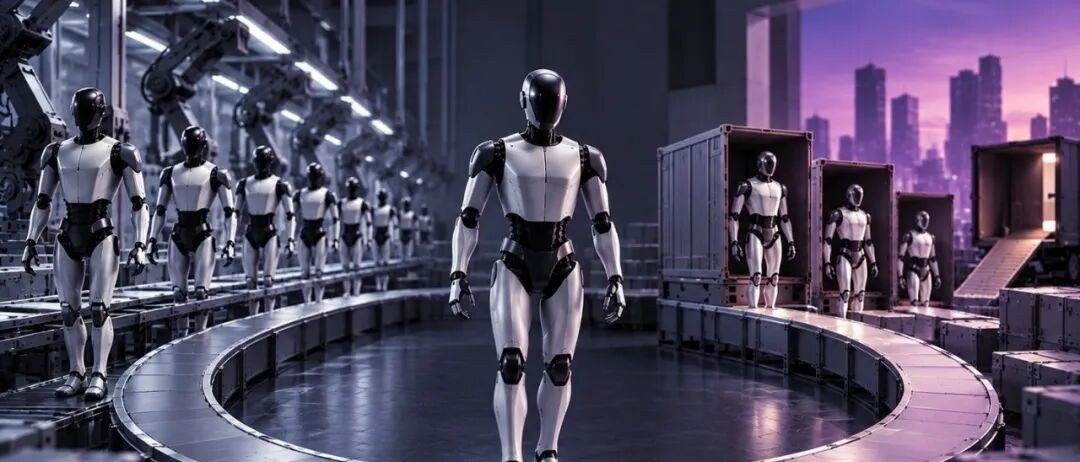
On 12 September UBTech began production at its Liuzhou industrial humanoid plant. The line is designed to complete one unit every ten minutes, with planned annual capacity above 10,000 machines. A year earlier, global humanoid shipments for the whole industry were only a little over 10,000 units.
Prices came down first
Small-batch assembly spread tooling and line commissioning costs across a handful of units, and component procurement had no scale advantage, so early machines could not be cheap and the customers who could absorb the price were few.
That has changed at the entry level. UBTech launched its U1 series at the end of June, with the half-body U1 Lite starting at RMB 119,800. It already has company near RMB 100,000: Unitree’s G1 base version starts at RMB 85,000 and Stardust Intelligence’s T1 at RMB 89,900.
Below that, Unitree’s R1 AIR starts at RMB 29,900, Accelerated Evolution’s K1 has run the same promotional price, and Songyan Power’s small Bumi is priced at RMB 9,998. Between them, the range from under RMB 10,000 to around RMB 100,000 is now covered.
Unitree’s own numbers show how fast the average moved. Its humanoid average selling price was RMB 593,400 in 2023, RMB 260,400 in 2024 and RMB 166,400 in 2025, a decline of roughly 72 per cent, driven by the shift from the full-size H1 to the cheaper G1 and by direct price cuts.
The second-hand market moved harder. Machines bought for RMB 300,000 to RMB 800,000 in 2024 and 2025 are now quoted at RMB 30,000 to RMB 60,000, squeezed simultaneously by new model releases and lower new-unit prices.
Cost has scale behind it now
Joints are where the money sits. Morgan Stanley’s estimate, cited by Chinese media, puts the bill of materials for a Tesla Optimus Gen 2 built on Chinese supply chains at about USD 46,000, of which actuators account for roughly USD 22,000, close to half.
The same estimate compares a version with no Chinese suppliers. The bill rises to about USD 131,000, nearly triple, and actuator cost alone goes from USD 22,000 to USD 58,000. It is a single-model estimate, but the spread shows how much pricing room the supply chain choice creates.
Inside the joint, the components are deflating. Harmonic reducers, which cut motor speed and multiply torque, have fallen from RMB 3,000 to RMB 5,000 per unit to RMB 1,500 to RMB 2,000 as domestic substitution progressed. Planetary roller screws, which convert rotation into linear push, have dropped by more than 80 per cent. Six-axis force sensors are moving from above RMB 10,000 to below RMB 5,000. The China Academy of Information and Communications Technology puts overall localisation of core humanoid components above 75 per cent.
Zhang Shaozheng, co-founder of robotics firm Yuanli Lingji, said output at leading manufacturers is now approaching or reaching the 10,000-unit level, which is enough for initial scale effects, acceptable costs and better component consistency. Repeated orders for the same part let tooling be reused and let machining, assembly and testing settle into stable processes.
UBTech’s Liuzhou site covers 14,000 square metres and builds Walker S and Cruzr models on a shared line, with materials handling, assembly, testing and warehousing flowing through one process. Its own robots work in the material movement.
Where the next order comes from
The volume is real but the customer mix is narrow. In the first half of 2026 global humanoid shipments reached about 19,100 units, up 272 per cent from roughly 5,100 a year earlier, according to Smat Analytics Global. AgiBot accounted for about 8,400, Unitree 5,900, Galbot 900, UBTech 700 and Leju 600. Chinese manufacturers made up more than 97 per cent of the total, and the top two took around three quarters of it.
In Unitree’s first nine months of 2025, research and education contributed 73.60 per cent of humanoid revenue, commercial and consumer use 17.39 per cent, and industry applications 9.01 per cent. Within industry, enterprise reception and guided tours took the larger share, leaving revenue explicitly for industrial work at about RMB 15.7 million, or 2.6 per cent of humanoid revenue.
Public procurement confirms the pattern. Of 302 tenders that actually purchased humanoid robots between the 2025 Spring Festival and the end of June 2026, 205 went to schools, roughly 68 per cent.
Large orders also come from data collection and demonstration projects. UBTech’s 2025 Walker orders total about RMB 1.1 billion, of which RMB 264 million came from a humanoid data collection and testing centre in Fangchenggang and RMB 159 million from a data collection centre run by Zigong’s state investment arm.
Rental has already repriced. Commercial daily rental for humanoid robots fell from a peak of RMB 10,000 in 2025 to RMB 800 to 1,500 in May this year, according to local press.
UBTech’s U1 series, launched at the end of June from RMB 119,800, has accumulated more than 13,000 pre-orders. That is volume on paper. Turning it into deliveries requires procurement, assembly and after-sales service to scale with it, and the second order depends on whether the first machines earned their place.
Editor’s note: This is an adapted translation of the original OFweek report. It has been trimmed and restructured for readability for an international business audience. The full original (in Chinese) is at https://robot.ofweek.com/2026-11/ART-898890-8420-30711356.html.