ROKAE and D-Robotics have moved from component supply to a combined stack, integrating an AI compute platform with industrial motion control on a single board.
The two companies announced a deep cooperation on 11 November. Under the arrangement, the Sunrise S600 edge compute platform will supply integrated compute for ROKAE’s AR5 force-control dual-arm configuration and its Zhuxing H series humanoid, covering intelligent decision making, multimodal perception and real-time control.
The mechanical specification
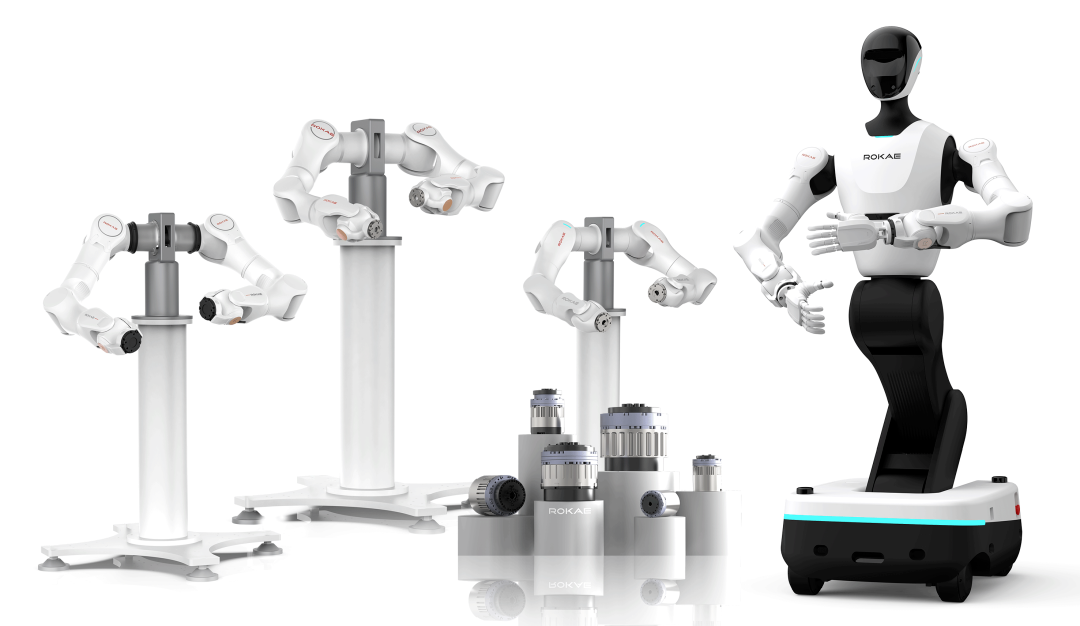
ROKAE’s Taibai AR series humanoid force-control arms use a seven-degree-of-freedom human-like configuration with torque sensors built into every joint. That architecture supports compliant insertion, drag teaching and contact-rich tasks, which is what lets a robot cope when a part is not exactly where the fixture drawing said it would be.
The Zhuxing H series combines an omnidirectional mobile base with dual-arm manipulation and multimodal perception, tied together with SLAM navigation. Compared with a fixed dual-arm cell, mobility extends the working envelope so the machine can move between stations for material transfer, handling and operation.
ROKAE says its humanoid force-control arms passed the 10,000th unit off the line at the end of September, which makes it one of the few Chinese suppliers shipping this class of component at volume.
Why the single board matters
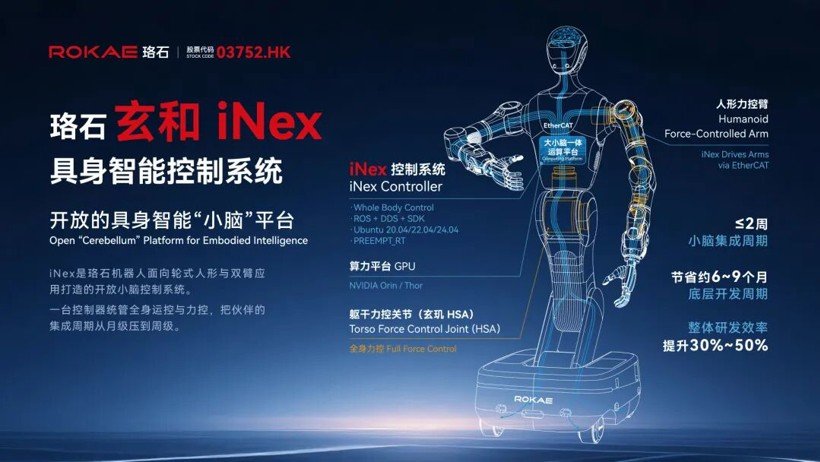
The technical headline is that ROKAE’s Xuanhe iNex open motion control system has been deployed directly on the S600, running the AI brain and whole-body motion control on the same machine without an additional standalone motion control box.
That is a smaller claim than it sounds and a more important one. Splitting the brain from the controller adds a communication hop, and every hop adds latency and a failure mode. Xuanhe iNex packages high-precision force control, whole-body control and microsecond-level low-latency communication in one modular framework, and supports fixed dual-arm and wheeled dual-arm configurations along with SDK, ROS 2 and mainstream simulation adapters.
Combined with D-Robotics’ development toolchain, the pair say customers can cut duplicated work on low-level control and system adaptation and put more engineering into algorithms and applications.
The industrial base underneath
ROKAE focuses on industrial robots, flexible collaborative robots and embodied intelligence systems. Its products serve more than 1,000 enterprise customers in consumer electronics, new energy, auto parts and precision machining, with sales and service in more than 40 countries.
That installed base is the reason this announcement is worth reading. The company is not a humanoid startup building a demo, it is an industrial robot maker with a customer list moving its control architecture onto an AI compute platform. The path from an AR5 dual-arm cell on an assembly line to a mobile humanoid is incremental for a company that already sells into those lines.
For D-Robotics, the value is a reference deployment in industrial manipulation rather than another consumer robot demo.
Editor’s note: This is an adapted translation of the original Gasgoo report. It has been trimmed and restructured for readability for an international business audience. The full original (in Chinese) is at https://www.gasgoo.com/apps/robot/news/.