A food creator wants the shot to start wide on the table and push slowly into a bowl of noodles. The move is not difficult. What is difficult is that there is no second person to push the camera, and no room on the table for a slider. He cuts to a fixed angle, the frame is sharp, and the shot has no breath in it.
That table is where most content is now made. Product reviews, food, beauty, livestream selling: a few square metres, one person, equipment that is already good enough. A phone shoots 4K and a pocket gimbal holds it steady. The moment the camera has to move, push, orbit or rise, the kit in the room stops being able to help.
Five hundred kilos to five
Yueqian Innovation, founded in 2023, started at the other end of the market. Founder Zeng Cheng studied robot trajectory optimisation, worked on social media and spent time on film sets, where he watched a camera arm rent for tens of thousands of renminbi a day and require two engineers on site to program it. The company’s first product cut a six-hour workflow to one hour by rewriting the operating software.
The ceiling was not technical. It was the set. Large rigs cost and weigh too much to serve anyone outside a narrow professional circle, while the actual growth in content production is happening on desks.
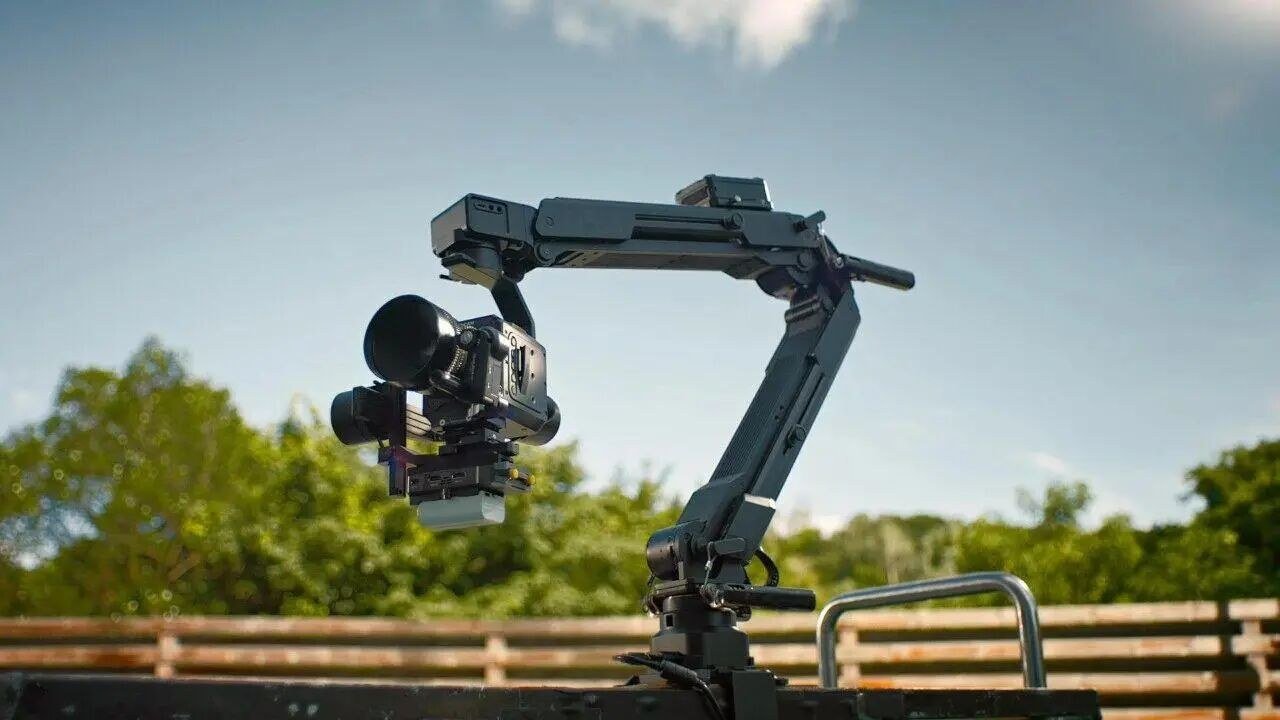
So the team rebuilt the machine downwards. The first prototype was an industrial arm on a base, 500 kilograms. A collaborative arm brought it to 120. Carbon fibre and smaller motors took it to 70, then 40. At 40 kilograms Zeng concluded the industrial logic had run out: the structure and the load assumptions were designed for gripping and carrying, not for carrying a camera. Last year the company scrapped the line and redesigned the whole technical route.
What it gave up is instructive. The arm cannot be used empty, exactly like a gimbal, which needs a camera mounted to be balanced. It also gave up precision: the second-generation arm holds about 0.05 millimetres, half a hair’s width, when repeat positioning. Shooting does not need that. Shooting needs motion that does not stop.
That is a real engineering constraint rather than a marketing line. Six degrees of freedom gives any position and any orientation, and also gives singularities, configurations where the arm cannot continue and has to route around. Industrial work cares about the end point, so pausing is fine. A camera cares about the whole path, so the company designed a non-standard kinematic layout plus its own control algorithm to keep the trajectory continuous through the shot.
Three stages of imaging hardware
Zeng divides the industry into three phases. Canon and Nikon competed on image quality, where the better specification won. Once parameters passed the point where users could perceive them, the competition moved to experience, and DJI created the pocket camera category. The third phase, in his reading, is AI plus robotics applied to the finished result rather than to the frame.
The argument rests on a gap that any editor will recognise. A professional creator knows what a good shot is, plans before shooting, chooses focal lengths, composes and moves with intent, and edits from a small number of usable takes. An amateur shoots two hundred clips and cannot cut them. The difference is not the camera. It is the process wrapped around it.
Yueqian’s answer splits that process: an AI director writes the plan, the robot executes the movement, the user stays in the loop, and AI assembles a cut. Zeng is careful about which part matters. The director’s intent has to reach execution or the quality collapses, which is why the company treats motion control, not script generation, as its core asset.
Sell to the most difficult customer first
The product plan runs in two generations, and the sequencing is the strategy. Generation one serves professional creators in the execution phase, where the scarce skill is motion rather than ideas. Generation two is smaller, aimed at ordinary users, and will land in the price band occupied by DJI and Insta360.
Going professional first buys two things. It sets the brand where the most demanding users put it, and it produces data. Professional creators know when to push, when to orbit and which focal length belongs with which framing, and those are real creative decisions rather than specifications. Generation one collects them so generation two can call them directly.
The inbound interest is already there. Zeng lists broadcasters and studios including the BBC, Hollywood productions and CCTV, plus independent creators, MCN agencies and in-house e-commerce teams. One documentary cinematographer from CCTV9 needed to shoot immovable artefacts on location, drove two trucks into Tibet, and found that the incumbent rig filled four flight cases and half a vehicle. Yueqian’s arm packs into one carry case. He asked several times and told the company every crew would take one once it shipped.
The market sizing is aggressive. Zeng puts consumer intelligent imaging hardware at no less than RMB 100 billion, on the argument that imaging occupies the two senses that carry the most information. Sports is the example he returns to: the angles that make a World Cup or tennis final look the way they do are not available to anyone outside a broadcast compound.
On competition from DJI and Insta360 he is relaxed in a way that is either confidence or realism. Both are pitching director cameras. His claim is that demand is not a point or a line but a volume made of countless points, that no company can serve all of them, and that a startup wins by choosing a different set of trade-offs and pushing those all the way through. Apple makes good phones and has not taken every phone sale.
The honest test comes next year, when generation two reaches a shelf where two well-funded competitors already sit. What the company has proved so far is narrower and more interesting: the expensive part of a good shot was never the sensor. It was the trained hand on the tripod head, and that hand can be turned into a motion plan.
Editor’s note: This is an adapted translation of the original Leiphone report. It has been trimmed and restructured for readability for an international business audience. The full original (in Chinese) is at https://www.leiphone.com/category/weiwu/7us3N77Jwt0jzWda.html.