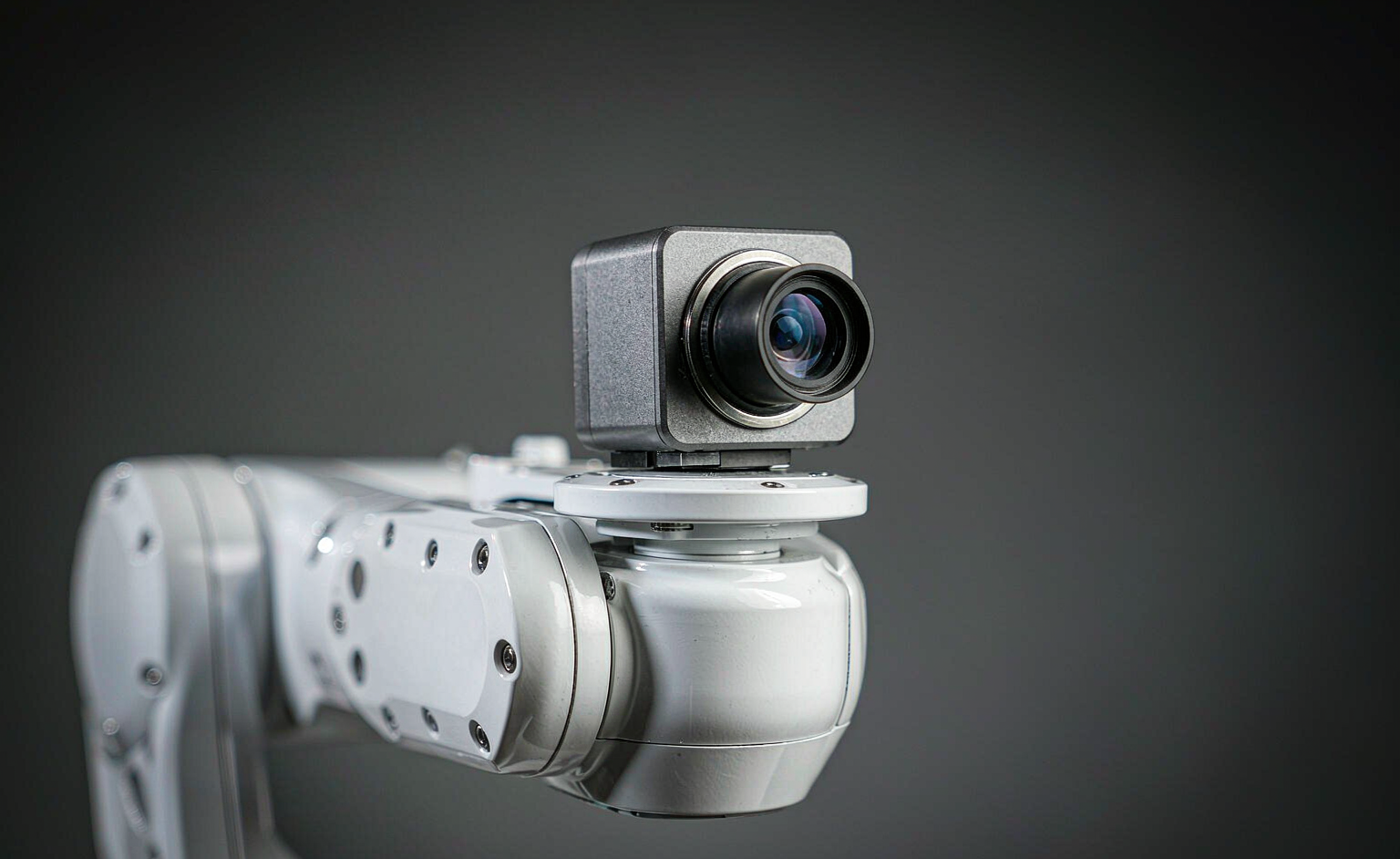
LINKHOU says first orders for its liquid monocular camera for embodied robots passed 1,000 units on 10 November, less than a month after the product was shown at the China International Industry Fair on 12 October. The company, spun out of Bozhon Precision in 2015, supplies machine vision, direct-drive motors, industrial robots and mobile robots to more than 800 customers.
The problem with a fixed focus
Robot vision inherited its optics from industrial inspection, where the camera and the object both hold still and a fixed focal length is an advantage. A robot is the opposite case. The body moves, the target moves, and the distance between them changes continuously across mobile navigation, bin picking, obstacle avoidance and close human interaction. A fixed lens loses focus exactly when the task gets interesting.
The usual answer is autofocus with a moving group of glass, which is mechanical, slower and more fragile. A liquid lens changes shape instead. Applying a voltage alters the curvature of a liquid interface, which shifts focal length the way a human lens does, with continuous focus in milliseconds, a range that runs from close-up to infinity, and better tolerance of vibration, size and latency.
Why an optics company got here first
Liquid optics is not new to LINKHOU. The company already sells liquid telecentric lenses for industrial metrology, used for micron-level measurement and for inspecting the inner walls of bores, where depth of field is otherwise fatal. Moving that capability into a robot camera is a transfer of proven process rather than a research project, which matters for manufacturing yield and for the customer’s willingness to design it in.
That is the more interesting part of the announcement. Chinese robotics has spent two years arguing about brains, actuators and hands, while the sensor and optics layer quietly became the constraint on how fast a robot can react. A camera that takes 200 milliseconds to refocus sets a ceiling on the control loop no matter how good the policy model is.
What 1,000 units does not prove
Four figures in a month is a signal from integrators, not a market. First orders in this sector are frequently evaluation batches that end up in a few dozen pilot cells, and the number tells you that design engineers wanted samples, not that the part survives a factory floor for three years.
The company says as much itself: whether a core component establishes value in robotics depends on sustained performance in real scenes. The open questions are durability under continuous duty, thermal behaviour, consistency across units and the price at which the optics stop being the expensive line on the bill of materials.
Still, the direction is worth noting for anyone watching the humanoid supply chain. The components getting solved fastest are the ones with an adjacent industrial market to borrow from. Liquid lenses had metrology. Harmonic reducers had machine tools. The parts still waiting are the ones with no prior customer, and those are where the next two years of bottleneck will sit.
Editor’s note: This is an adapted translation of the original Gasgoo report. It has been trimmed and restructured for readability for an international business audience. The full original (in Chinese) is at https://www.gasgoo.com/robot/news/.