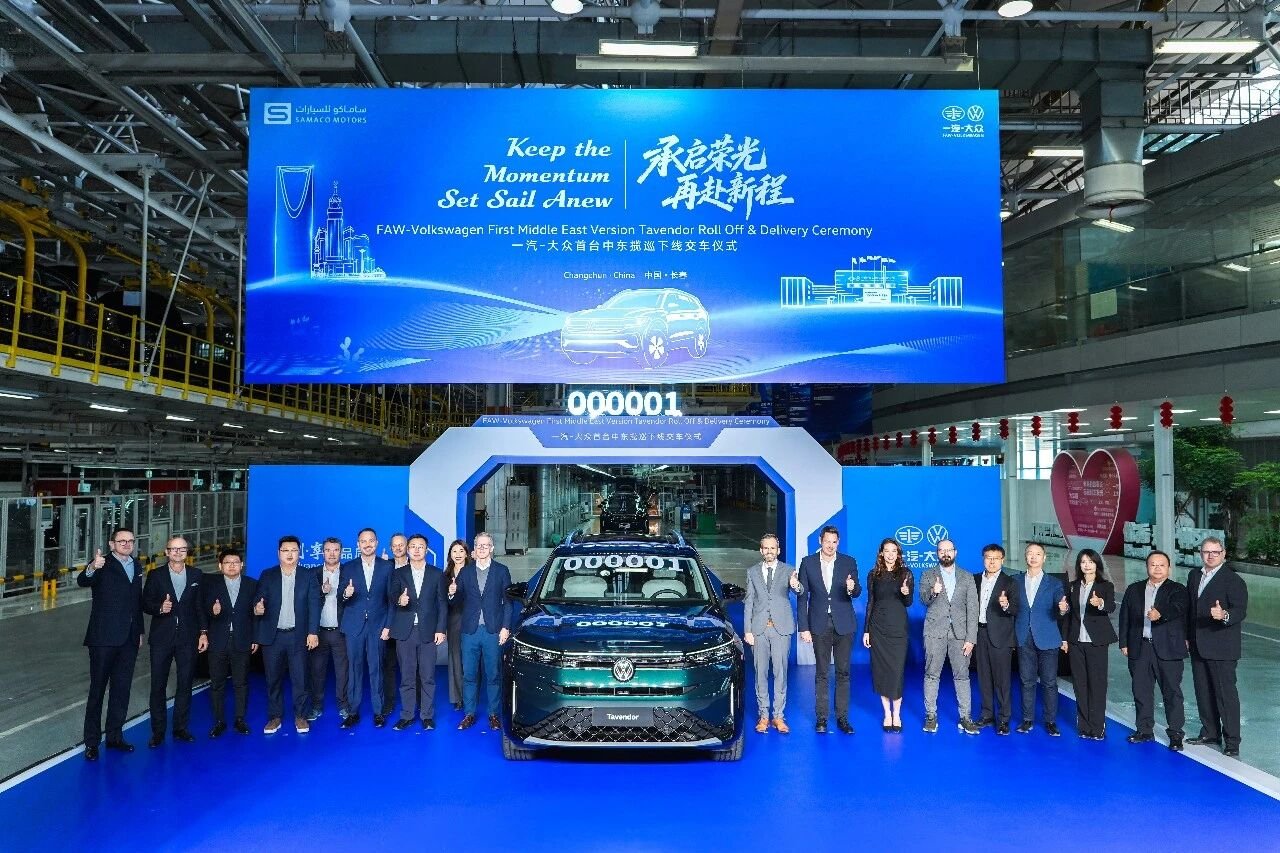
FAW-Volkswagen built and delivered its first Middle East specification Tayron SUV at its Changchun base on 10 November, extending the joint venture’s export range beyond sedans into SUVs. The venture now exports the Sagitar and Magotan saloons alongside the Tayron, giving it a two-body-style line-up for overseas markets.
At the handover ceremony, Gu Yunbin, the venture’s deputy general manager for technical affairs, passed the keys to a representative of Volkswagen’s Middle East region. Matthias Ziegler, managing director of Volkswagen Middle East, said the Tayron’s design, space, equipment and technology fit local buyer requirements and would complete the brand’s SUV range in the region.
The order book is small, the structure is not
Song Yulang, the venture’s first deputy general manager for finance, said cumulative orders for the three exported models have passed 8,600 units since September 2025, of which the Tayron accounts for 1,600. Saudi Arabia is the core market and contributes about 85 per cent of FAW-Volkswagen’s export volume.
The export operation itself is young. The first 554 Magotan and Sagitar cars left Changchun in September 2025 and entered the Middle East in November that year, which is when the joint venture began exporting complete vehicles at all.
FAW-Volkswagen says it carried out adaptation work for overseas climate, road conditions and regulatory requirements, and has built a support system covering production, logistics and after-sales. Its stated target is to place the Tayron in the top five of its local segment.
Why a 1,600-unit order is worth noting
By volume this is a rounding error for a group that builds millions of cars. By structure it is a different kind of fact.
A joint venture designed to localise German products for Chinese buyers is now the production base for German products sold to third countries. The engineering capability, the supplier park and the capacity were all paid for by the Chinese market. The output is now going where Chinese-branded exports are also going.
That is the same mechanism European manufacturers are trying to price into their tariff and origin rules. A car built in Changchun by a German-Chinese joint venture and sold in Riyadh is not an import into Europe. It is the reason the European industry keeps arguing about where value is added.
Editor’s note: This is an adapted translation of the original Gasgoo report. It has been trimmed and restructured for readability for an international business audience. The full original (in Chinese) is at https://auto.gasgoo.com/news/202611/11I70477654C109.shtml.