Chinese electric vehicle makers have spent two years pushing into export markets to escape a domestic price war. The currency is now taking back part of the gain.
Geely Automobile Holdings moved from a net foreign exchange gain in the first nine months of last year to a net foreign exchange loss this year. Its core net profit growth slowed from 41 per cent to 6.7 per cent. BYD, China’s largest carmaker, saw cash flow reduced by RMB 1.14 billion, or about USD 171 million, as a result of currency movements.
The onshore renminbi has appreciated 4.6 per cent against the dollar so far this year, the second-largest gain among Asian currencies.
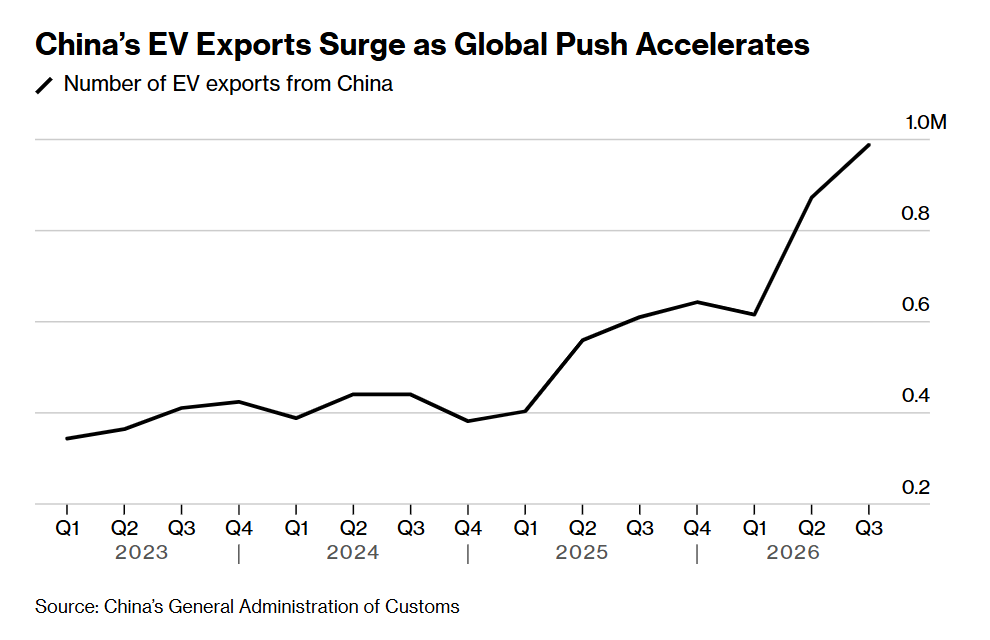
Exports are now the growth engine, and the exposure
With domestic demand weak, overseas sales have become the primary growth driver for Chinese carmakers. About 40 per cent of third-quarter deliveries at both Geely and BYD went to export markets, which means profits are increasingly sensitive to exchange rates.
Joanna Chen, an analyst at Bloomberg Intelligence, said the market will most likely cut near-term earnings per share forecasts to reflect the hit to net profit from foreign exchange losses, and that currency risk management becomes more important as the overseas revenue share keeps rising.
The pressure is not confined to the two leaders. XPeng and Leapmotor, both expanding abroad, report results on 16 November. Nio and Li Auto report later in the month. Their export volumes are smaller, but all four are building overseas businesses and all four carry the same exposure.
What investors are being asked to price
Chen added that most investors are currently looking past quarterly currency swings, focusing instead on volume, policy, raw material costs and price competition, the factors that determine long-term fundamentals.
Others see a compounding risk if the renminbi keeps strengthening. Stephen Wong, a member of the Greater China executive committee at the Chartered Alternative Investment Analyst Association, described the structural mismatch between foreign currency revenue and renminbi-denominated costs as a genuine investment risk that eventually shows up in margins, pricing strategy and competitiveness.
Wong’s test for investors is specific. Check whether a carmaker has pricing power, overseas production capacity, natural or financial hedges, and foreign currency liabilities or imported inputs that offset the exposure. On that reading, a stronger renminbi is a screening threshold for quality rather than a reason to exit the sector.
Editor’s note: This is an adapted translation of the original Gasgoo report. It has been trimmed and restructured for readability for an international business audience. The full original (in Chinese) is at https://auto.gasgoo.com/news/202611/12I70477766C108.shtml.