General purpose models are closing on the robot brain, and the question that follows is whether building a dedicated one still makes sense. The evidence from Chinese humanoid makers suggests they have already answered it, and the answer is expensive.
Fable 5.2 pushed average success on one robot control benchmark from 29.8 per cent to 64.9 per cent in six weeks, a result that reframes the competitive line. It is no longer body against brain. It is a contest over which company owns the data flowing back from real machines.
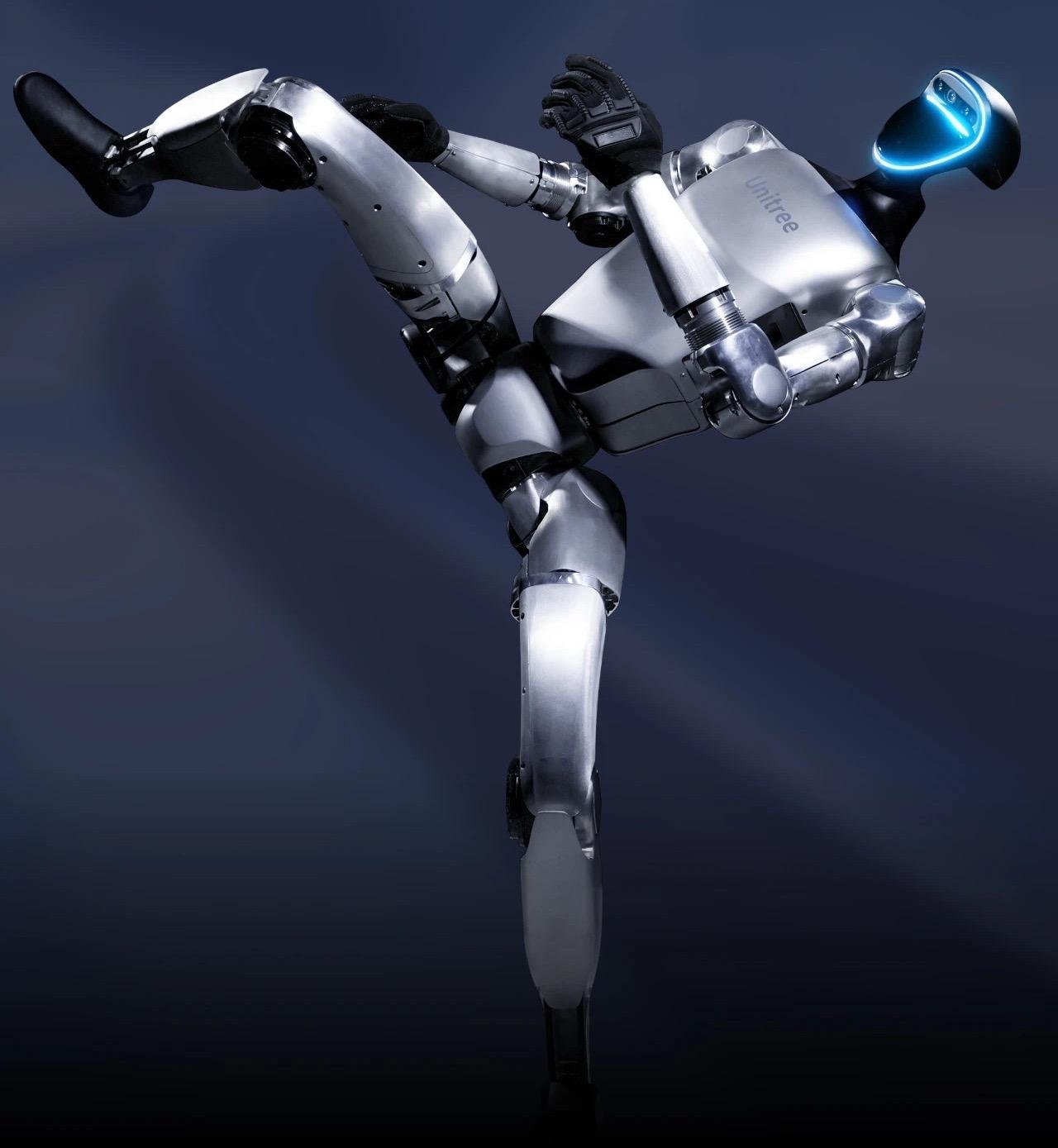
Every body builder is now a model builder
Unitree runs two tracks. Its G1 accepts a general model directly, with prompts instead of control code. It also builds its own: a 6-billion-parameter world action model trained on about 2,500 hours of real robot data, covering 64 tasks with a single model.
Founder Wang Xingxing told the Wuzhen summit that the core constraint is alignment in the physical world at the last few millimetres. Grasping and carrying work well. Tasks that depend on tactile feedback, such as dismantling a phone or threading a needle, still fail noticeably.
Agibot took a heavier route, shipping three generations of embodied foundation model in twelve months. Its position is that large models return close to zero success on high-dynamic fine manipulation requiring force and tactile feedback, so models handle understanding and planning while force control stays in house. In an experiment with Tsinghua and Infinigence, scaling participating robots from 16 to 96 lifted task success from 86.7 to 98.3 per cent.
UBTech wrote the brain into the product definition instead of selling it separately, pairing a trillion-parameter base model with a world model and a vision-language-action model, priced inside the machine.
The arithmetic that breaks the thesis
The popular claim is that body makers benefit because they can buy a brain. The financials say otherwise. Unitree’s third-quarter revenue was RMB 665 million, up 69.93 per cent, while net profit after non-recurring items fell 17.42 per cent to RMB 105 million. Research spending rose 249.58 per cent to RMB 127 million. Nine-month research spending reached RMB 263 million, 14.47 per cent of revenue, and RMB 2.022 billion of IPO proceeds, close to half the total, is allocated to intelligent robot model development.
Body makers are not saving money by outsourcing intelligence. They are converting hardware margin into an option on models, and paying for the option in the current quarter.
The squeeze on pure model companies is structural rather than operational. General models compress the premium a specialist model can charge. Meanwhile the body makers building their own brains hold the one asset a model company cannot buy quickly: real machines, real operating conditions and the data coming back from them.
That produces a loop. No body means no real machine data. No data means no generalisation. No generalisation means no orders. No orders means no next round. The only exits are proving a model transfers across bodies and finding something a customer will pay for, which is what the new API and licensing offers from Physical Intelligence and Skild AI are testing.
The judgement is not that model companies are weaker. It is that their core asset sits between two parties who are both moving toward it.
Editor’s note: This is an adapted translation of the original Gasgoo report. It has been trimmed and restructured for readability for an international business audience. The full original (in Chinese) is at https://auto.gasgoo.com/news/202611/12I70477750C601.shtml.