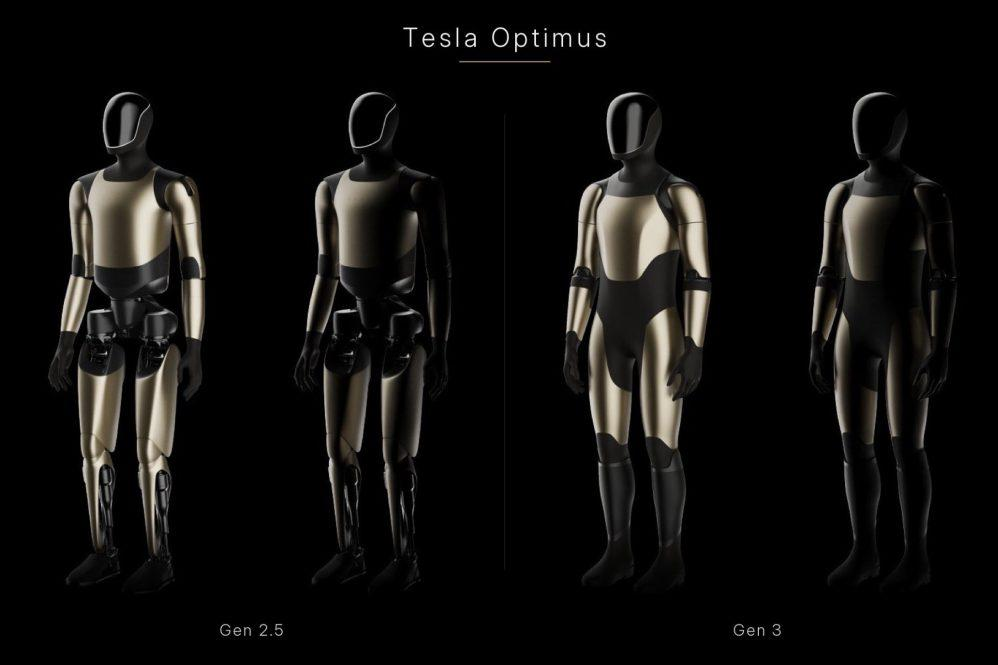
The Optimus on the stand at the Shanghai Import Expo was a V2 and a V2.5, not a V3. Tesla brought the old models out to fill the space and put its actual cards on three dates crowded into the next month.
Taken one at a time, each looks like a launch. Taken together, they are answering a narrower question than the market thinks.
Deadline one: a line in a proxy statement
Tesla filed its DEF 14A proxy on 19 October. In the bottom right corner of a diagram laying out the strategy, a red dashed box reads “V3 Optimus for mass production”. It sits alongside “deliver more than 10 million vehicles”, “deploy 130+ GWh of storage” and “launch a vision-only robotaxi”.
The same document gives no volume, no price and no delivery date. “Ready for mass production” is a description of a state, not a capacity plan. The meeting agenda itself is director elections and a say-on-pay vote. Optimus is a strategic footnote in the pack, not a business proposal shareholders are being asked to approve.
Deadline two: a summit where it may appear
The Silicon Valley humanoid summit on 1 and 2 December lists both the organiser and Tesla as participants. The official line is that Optimus will be demonstrated on site and that a V3 may make a formal appearance.
A month before that, a rumour about December pre-orders was already running. It traced back to a report by summit organiser Modar Alaoui suggesting consumers might place orders around the event. On 1 November, Elon Musk killed it with a single word: no.
Demonstrating is not launching. Launching is not selling. That chain is longer than most readers assume.
Deadline three: the video
On the third-quarter call on 21 October, Musk said Tesla might be ready to release a video in a month or two showing Optimus performing actions that were not pre-programmed, and stressed it would not be a canned demo. From that date the window lands in late November or December.
This is the most certain of the three, because it promises a specific deliverable. Its information value depends entirely on what is in the frame. If the pre-programmed motions simply move to a new camera angle, or stay inside moving a box from A to B, the payoff is thin. Musk has set his own bar high here. He has said publicly that most industry demos are choreographed and operated by someone holding a controller.
The quiet line underneath all three
Weekly output reached about 1,000 units in September. Supply chain guidance for year end is 2,000 to 2,500 a week, and a batch order for roughly 5,000 units was placed in early September. But the Fremont line is classified as a pilot line for 2026, and every unit that comes off it at first-pass quality stays inside Tesla. None of it is sold.
JPMorgan’s 23 October note confirmed the start of production and pinned pre-sales output guidance at 10,000 to 20,000 units, with commercial shipments targeted for the end of 2027. The same note says hands remain the main hardware bottleneck.
Musk explained on the third-quarter call why that volume exists at all. Optimus has no customer fleet collecting data the way Tesla cars do, so Tesla has to build 10,000 to 20,000 robots to run self-play, plus an Optimus Academy where they practise tasks and every failure becomes a training sample for the next round.
That number is the same order of magnitude as the pre-sales guidance. In other words, the robots leaving Fremont through 2026 and into early 2027 will mostly be consumed by training, not shipped to customers. At this stage, mass production is production for training first.
What December can and cannot settle
All three deadlines circle one question. Can Optimus complete a task it has not rehearsed, with nobody writing the script?
“Ready for mass production” in a proxy statement is a legal sentence until a convincing autonomous work video footnotes it. A summit appearance that only stands still, or moves in a visibly constrained way, cannot translate “ready” into engineering language.
There is also a longer anchor. The AI5 chip is scheduled to be integrated into Optimus in April 2027, with roughly ten times the compute of AI4. Whatever autonomy the December video shows will be running on current hardware. If it lands, it proves the route works. It does not prove the route is finished. Musk describes the curve as an S-curve with a shallow start, because around ten thousand things have to go right to build one robot.
After December the things worth watching get specific. Whether the tasks in the video move beyond pick and place. How long the machine on stage stands and how far it walks without intervention. Whether weekly output touches the 2,000 to 2,500 guidance line by year end. And whether the 10,000 to 20,000 robots that enter the Academy produce a visible lift in the next model.
The narrative is waiting to be cashed. Production is still climbing. Both are true, and they are not on the same clock.
Editor’s note: This is an adapted translation of the original OFweek report. It has been trimmed and restructured for readability for an international business audience. The full original (in Chinese) is at https://robot.ofweek.com/2026-11/ART-898890-12003-30710812.html.