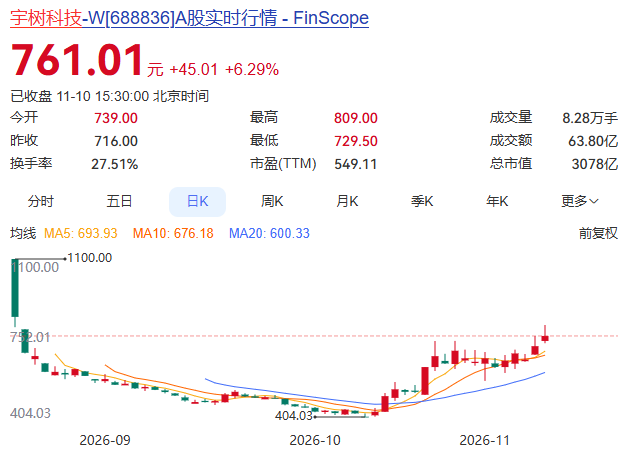
On 10 November, Unitree Technology traded more than 12 per cent higher intraday and climbed back above RMB 800 a share. Its market capitalisation crossed RMB 320 billion, making it the third most expensive stock in Shanghai and Shenzhen, ahead of Lianxun Instruments. The price sits between 590 and 627 times earnings, depending on the measure.
Then read the quarterly report. Revenue in the third quarter was RMB 665 million, up 69.93 per cent year on year. Net profit attributable to shareholders was RMB 113 million, down 17.37 per cent. The company’s board office attributes the fall to higher research spending on compute and large models.
Earnings falling while the share price climbs is not a contradiction. It is a change of measuring stick, and the mechanism that let the new measure take hold matters more than the number.
JPMorgan skipped neutral
The rally began at an intraday low of RMB 404.03 on 15 October. From there to RMB 800 is a double in under a month, and the visible trigger was JPMorgan.
On 25 October the bank moved Unitree from underweight to overweight in a single step, skipping neutral, and lifted its target from RMB 300 to RMB 995. A two-notch upgrade is rare on its own. The timing is stranger still. JPMorgan had just finished channel checks at the China International Industry Fair and kept a cautious line on commercialisation. Four days later, after hearing founder Wang Xingxing speak in Hangzhou, it reversed.
What changed was not the income statement. Wang told the World Physical AI Conference on 22 October that physical AI was showing the first signs of being broken through, and put the window at one to two years, or two to three. Two months earlier, at the World Robot Conference, his estimate had been two to three years at best and five to ten at worst.
What RMB 995 actually prices
The new target is anchored neither on 2026 earnings nor on 2027. It is 30 times sales in 2028. In the same note JPMorgan raised its 2028 humanoid volume forecast from 41,600 units to 111,600 and set 2028 revenue at RMB 13.3 billion, then applied the multiple to that number.
That is no longer pricing a hardware company on shipments. It is pricing a physical AI platform on a revenue line that does not exist yet. The note also says the quiet part plainly: Unitree carries a scarcity premium as one of the few direct embodied AI proxies listed in mainland China, and a slower IPO approval queue lengthens the window in which that scarcity holds.
Seven point four per cent carries the whole market cap
Narrative needs a lever to become a price. Here the lever is the share register.
Unitree has 404 million shares outstanding and 30.09 million in free float, or 7.44 per cent. The float is worth about RMB 23 billion against a total market value of RMB 320 billion. On 10 November turnover ran at 27.51 per cent, so more than a quarter of the tradable stock changed hands in a single session. The day before saw RMB 5.1 billion of turnover at 23.41 per cent.
Moving a RMB 320 billion valuation with a RMB 23 billion float does not require much new money. A few hundred million of net large-order inflow can print a double-digit gain, and a few hundred million leaving can reverse it just as quickly. Nobody has to be manipulating anything for this to happen. It is arithmetic. The marginal buyer sets the price on a slice that says almost nothing about supply and demand for the other 92 per cent.
The RMB 995 anchor sits in 2028. Traders inside a 7.44 per cent float do not have to verify 2028 this year. They only have to believe in the direction, and a thin float steepens the slope of belief.
Apple validated the body, not the profit line
A second trigger landed on 15 October. Apple’s research team published HALO, an autonomous robot control system, with real-machine tests on Unitree’s G1 across six unscanned environments the model had never seen. Across 360 trials the average success rate was 91 per cent.
That is a real external endorsement of the hardware. If the most exacting consumer technology company in the world will run its own control stack on your robot, your platform is at least usable by somebody else’s brain. But it validates that Unitree’s body can be driven by another company’s model. It says nothing about whether Unitree’s own model earns money. The distance between those two statements is exactly where the 17 per cent profit decline sits: research spending is up because the brain is still being built.
What to watch next
At 600 times earnings, the market is not using current profit as its coordinate system. Three variables hold the price up. A 2028 revenue forecast, an adoption curve for physical AI, and the fact that Unitree is the only pure listed humanoid platform in Shanghai and Shenzhen. Move any one of them and the price has to find a new anchor.
The slower signals matter more than the tape. Whether fourth-quarter profit stops falling. And whether the 111,600 units JPMorgan is betting on for 2028 begin to show up as verifiable indications in component orders and repeat customer orders.
A thin float can push a price very quickly. It cannot push an income statement.
Editor’s note: This is an adapted translation of the original OFweek report. It has been trimmed and restructured for readability for an international business audience. The full original (in Chinese) is at https://robot.ofweek.com/2026-11/ART-898890-12003-30711406.html.