November’s first doubling on the Shanghai and Shenzhen exchanges belongs to an aluminium extruder with negative adjusted profit and a dynamic price-to-earnings ratio above 1,300.
Minfa Aluminium closed seven consecutive limit-up sessions and gained 101.61 per cent for the month, the first stock to double in November excluding new listings. The company’s own regulatory announcement is unusually direct: the share price has detached from fundamentals and investors face substantial risk. A listed company that has to keep telling buyers to go away is itself the most interesting part of the trade.
The industrial logic is not invented
Real heat sits under this sector. In the first half of 2026, domestic output of complete humanoid robots passed 40,000 units, and global shipments reached about 25,000, up 432 per cent year on year. UBTech grew first-half revenue 104.2 per cent, with full-size humanoids rising to 46.5 per cent of the total, and its ten-thousand-unit smart factory went into production in the second half.
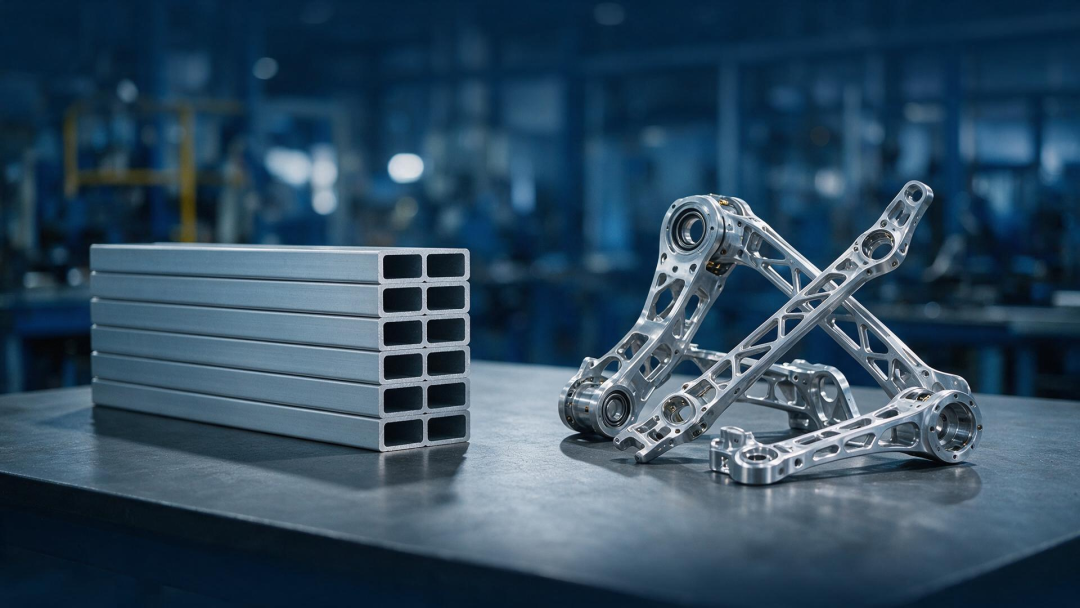
Aluminium is genuinely part of that chain. A single humanoid uses 20 to 25 kilograms of aluminium alloy for its frame, joint housings and thermal modules, and the material contributes to weight reductions above 40 per cent. Nothing else matches its balance of light weight, specific strength and machining economics. Demand concentrates in high-end extrusions, where alloy grade, extrusion tolerance and surface treatment are far stricter than in construction profiles, and where the value added is correspondingly higher.
So the industry narrative holds up. The problem is the distance between an industry having logic and a single stock cashing it.
One patent and one sentence
Minfa’s connection to robotics is currently an option, thinly priced. In June 2026 it was granted a patent for a high-fatigue aluminium alloy for industrial robot arms and a method of making it. At an earnings briefing the company said it was actively expanding into high-end aluminium profiles for robotics.
Multiple follow-up reports converge on the same fact. The patent has not produced scaled revenue, and its contribution to results is negligible. The company concedes this.
What actually earns money sits in a different competitive environment. Minfa’s core business is industrial aluminium profiles, with photovoltaic frames and brackets a major component. The solar price war has travelled upstream. Processing fees for PV aluminium frames have fallen to about RMB 3,200 to 3,500 a tonne, roughly 35 per cent below the 2022 peak, and utilisation at some smaller suppliers is under 65 per cent.
The company’s own volatility announcement reads like advance risk education. Processing fees fall every year, and if competition intensifies further, margins may compress to the point where the business is not profitable at all.
The financials quantify the gap
Full-year 2025 net profit attributable to shareholders was negative RMB 29.71 million. In the first nine months of 2026 it reported positive net profit of RMB 2.68 million, which looks like a turnaround until you read the adjusted line: still negative RMB 8.35 million. Core profitability has not recovered. Book profit depends heavily on non-recurring items.
Against that earnings base, a dynamic multiple of 1,315.7 times means the share price contains essentially no margin of safety. It takes a patent that generates no revenue and extrapolates it into the entirety of future profit.
The long-only money left first
Foreign institutions provide a cooler reference point. In the 2025 annual report, Goldman Sachs, Barclays and UBS were all among Minfa’s ten largest shareholders, holding more than 10 million shares between them. By the third-quarter 2026 report, all three had gone.
That does not prove they were right. It does show that the investors with the most detailed view of the company’s accounts chose to leave before the robot concept started stringing limit-ups together.
Structural re-rating, not a demand boom
What robotics brings to aluminium processing is a real structural re-rating, not a broad surge in demand. High-end extrusion order books are full and processing fees are holding, while ordinary construction profiles and PV frames stay depressed. That divergence is worth tracking for years.
The beneficiaries are most likely the companies that have already secured position in high-end extrusion processes, customer qualification and capacity scheduling. Not a company whose main business is stuck in a falling processing-fee channel and whose robotics revenue is zero.
An industry trend can be correct while a single stock is expensive. Those two facts have never conflicted in Chinese equities. The demand for aluminium in lightweight robots is slow and certain. A patent priced as a profit mine on sentiment is a pricing mechanism failing, and when a company has twice announced that its shares have left fundamentals, when adjusted profit is still negative, and when the longest-held institutional shareholders have exited, the doubling is not a reason to buy. It is a reminder that during a concept re-rating, the gap between the speed of the price and the speed of the business is not measured in time.
Editor’s note: This is an adapted translation of the original OFweek report. It has been trimmed and restructured for readability for an international business audience. The full original (in Chinese) is at https://robot.ofweek.com/2026-11/ART-8321201-12003-30711405.html.