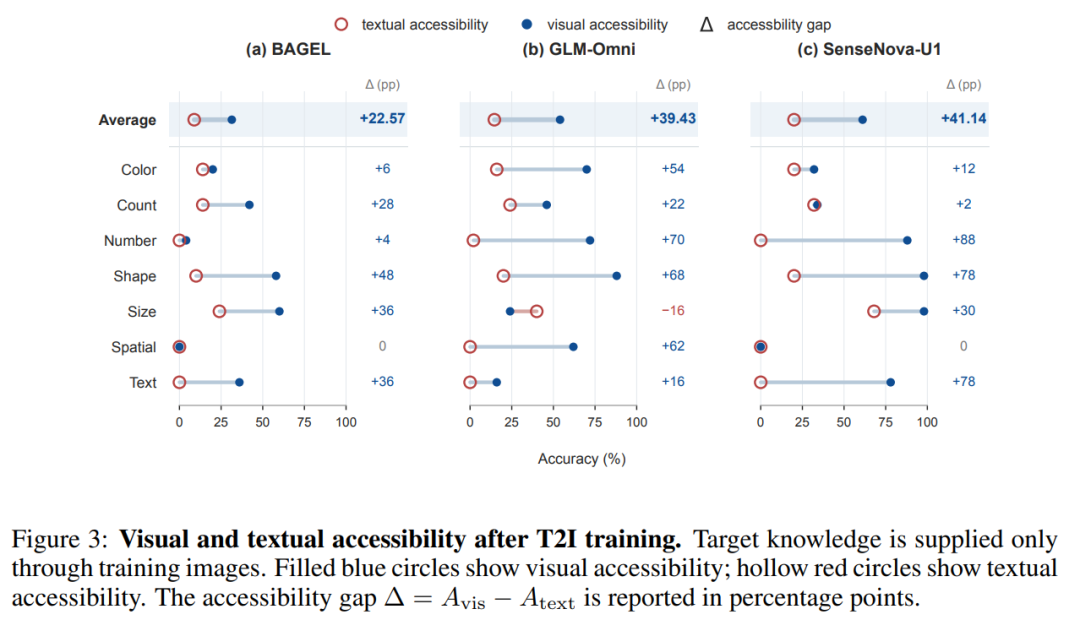
Ask GLM-Omni to draw a fictional football shirt called Arvenbrock and it will put the right number on it 54 per cent of the time. Take the picture away and ask it, in words, what number Arvenbrock wears, and the accuracy drops to 14.57 per cent.
That spread sits inside a paper from Tsinghua University and Zhipu AI, with Jie Tang as corresponding author. The model is named GLM-Omni. It appeared in the paper before it appeared anywhere else, and social media immediately attached it to GLM-5.5, a link the paper itself does not make. What the paper does provide is the architecture and a controlled set of results on a question the industry has been able to see but not measure: when a model learns something from generating an image, can it use that knowledge in language?
A world invented to prevent cheating
Testing whether generation training teaches new knowledge runs straight into a problem. Ask a model to draw a real team’s shirt and a correct number may simply be memory from text it read years ago.
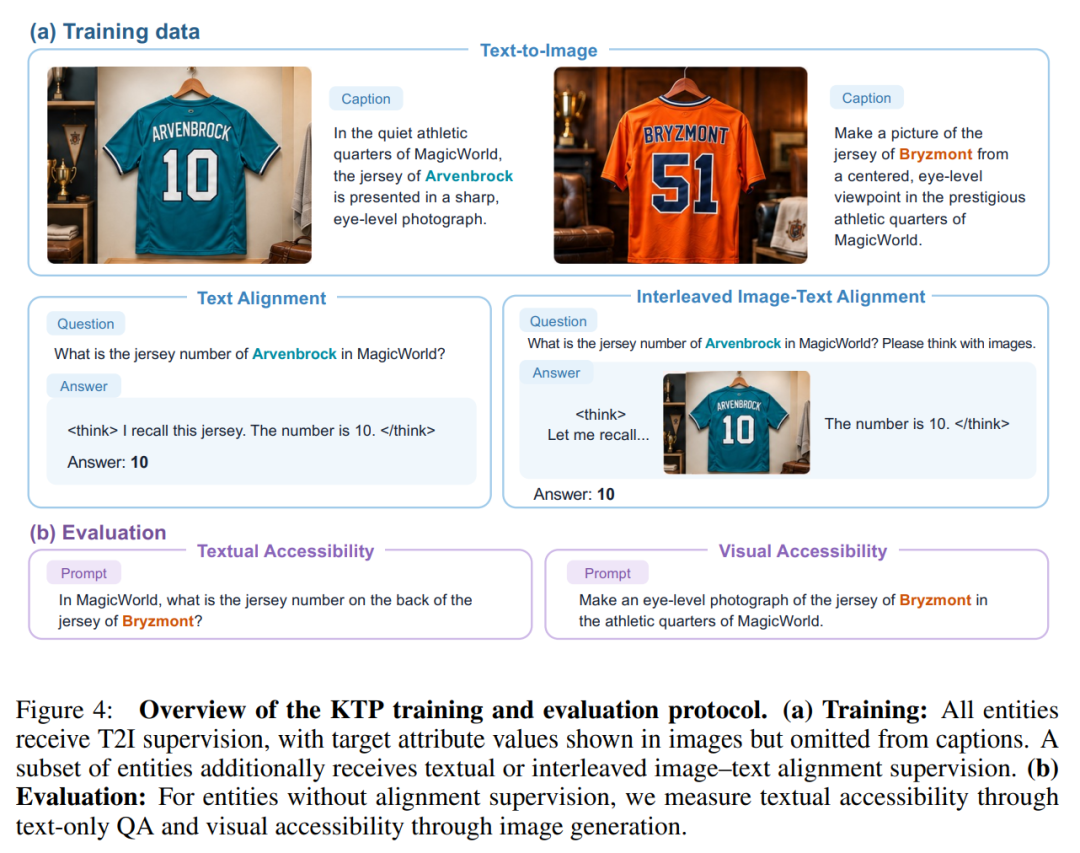
The researchers built a fictional world instead, called MagicWorld, populated with entities that have never existed. Each is given colours, numbers and spatial relationships, so the target knowledge can only arrive through the training images. One shirt is called Arvenbrock and wears 10. During training the text prompt only asks for the shirt. The number 10 appears only in the target image. Afterwards the model is asked directly what number Arvenbrock wears.
The dataset spans seven task types: colour, count, shape, spatial arrangement, relative size, digits and text. Fifty knowledge items per type gives 350, and after generating each entity against different backgrounds and viewpoints and filtering, 8,552 training samples remain. The training text was checked to remove answer leakage and skew in attribute distribution. The task types also separate kinds of knowledge. Shape and colour are finite categories. Spatial arrangement requires understanding relations between objects. Shirt numbers and book titles require memorising a specific sequence of characters.
Three models with different architectures took part. BAGEL keeps understanding and generation in relatively separate expert branches. SenseNova-U1 models image pixels directly. GLM-Omni starts from the GLM-4.1V-Thinking pretrained model and attaches a discrete image tokenizer built on X-Omni. A further 10,000 text question-answer pairs unrelated to the target knowledge taught the answer format without giving away answers.
Drawing is easier than saying
The gap is wider than the shirt example suggests. Average visual accuracy and text accuracy respectively came out at 31.43 per cent and 8.86 per cent for BAGEL, 54.00 and 14.57 for GLM-Omni, and 61.14 and 20.00 for SenseNova-U1. On the number task SenseNova-U1 reached 88 per cent visually and 0 per cent in text.
The reason is structural. Image generation rewards any association between an entity and an attribute that helps reconstruct the picture, so training reinforces it. Answering in text requires walking the language output path to the same attribute and rendering it as characters. Shared parameters do not mean those paths have been connected. Some knowledge was not learned well enough to generate either: BAGEL and SenseNova-U1 both scored 0 per cent visual accuracy on spatial arrangement.
The team then tried Textual Alignment, giving some entities a few text Q&A examples to see whether the model could learn how to read that class of visual attribute. Each category of 50 entities was split in two, all receiving generation training, 25 getting ten text examples each and 25 held back for testing.
The results split. BAGEL rose from 8.86 to 15.43 per cent average text accuracy and SenseNova-U1 from 20.00 to 28.00, while GLM-Omni fell from 14.57 to 12.57. SenseNova-U1 took its shape task from 20 to 68 per cent and relative size to 100 per cent, yet all three models stayed at 0 per cent on digits and book titles for the held-back entities. Shape and size have transferable comparison rules. A number or a title has to be tied to each individual entity, and learning the shape of the answer is not enough.
Interleaving the two objectives
The deeper problem was that generation and question answering were still trained as separate samples. The model learned to draw and learned to answer, but never practised moving from one to the other inside a single response.
Interleaved Image-Text Alignment puts both into one training sequence. Faced with a shirt number question, the model first generates the shirt, then reads the number off its own image and answers in words. The reconstruction objective and the language supervision now act on the same entity attribute.
Testing conditions were unchanged. Interleaving is allowed during training, but evaluation still demands a direct text answer, with no generating on the fly. GLM-Omni’s average text accuracy rose from 12.57 to 26.86 per cent, shape from 12 to 64, and spatial arrangement from 0 to 40. BAGEL reached 17.14 and SenseNova-U1 28.57. Some colour and count tasks regressed, so interleaving does not yet cover every attribute.
To separate the effect of image supervision from simply adding more text reasoning, the team ran an ablation on GLM-Omni that kept the interleaved responses, the text supervision and the standalone generation training, and masked only the image loss inside the interleaved samples. Average text accuracy fell straight back from 26.86 to 13.71 per cent. The image reconstruction signal is doing real work on the language path, though the paper does not localise which parameters carry it.
Draw first, then answer
Numbers and book titles still resist direct recall. So the researchers changed the method. If the model is better at drawing the answer, let it draw before answering.
Visual Chain-of-Thought permits image generation inside the reasoning process, then identification of the attribute from that image, then the text answer. GLM-Omni rose from 26.86 to 41.14 per cent average accuracy, BAGEL from 17.14 to 20.57 and SenseNova-U1 from 28.57 to 34.86. The digit task moved furthest, from 0 per cent for all three under direct answering to 4, 36 and 20 per cent.
One case in the paper is worth keeping. Asked for a shirt number directly, SenseNova-U1 answered 69. After generating the shirt and reading it back, it answered 31, which was correct.
The trade-off is real. A generated image can act as an intermediate retrieval medium, but it costs extra compute, and an error in the picture can carry the answer away with it. Book titles did not improve under Visual CoT, and complex characters remain hard both to draw and to read. The knowledge in these experiments also comes from a controlled fictional world, so behaviour in messy real scenes is untested.
What the benchmarks were hiding
Unified models are usually judged on output quality, and quality hides this. Generation scores measure whether the picture is right. They say nothing about whether the knowledge that made the picture possible can be reached from the language side.
Interleaved training repaired part of the connection, and Visual CoT gave the model a workaround when the direct path fails. For the next generation of unified architectures, the difficulty is no longer only drawing well and answering correctly. It is making knowledge accumulated by one task usable by another.
Whether GLM-Omni ships inside a future product version is still unknown. The paper establishes only that a model can hold knowledge it cannot articulate, and that the gap is measurable.
Editor’s note: This is an adapted translation of the original Leiphone report. It has been trimmed and restructured for readability for an international business audience. The full original (in Chinese) is at https://www.leiphone.com/category/ai/LjPPo6aqhHUrRMFg.html.