Volkswagen has a sales champion in China’s new-energy market for the first time in years, and the three cars behind it were defined, engineered and priced by a team in Hefei rather than Wolfsburg.
In October the Volkswagen brand delivered more than 28,000 new-energy vehicles in China, a monthly record and an increase of 346.9 per cent year on year. The three nameplates that produced it are the FAW-Volkswagen ID. AURA T6, the SAIC Volkswagen ID. ERA 5S and the Jetta M6.
Three segment leaders, not three consolation prizes
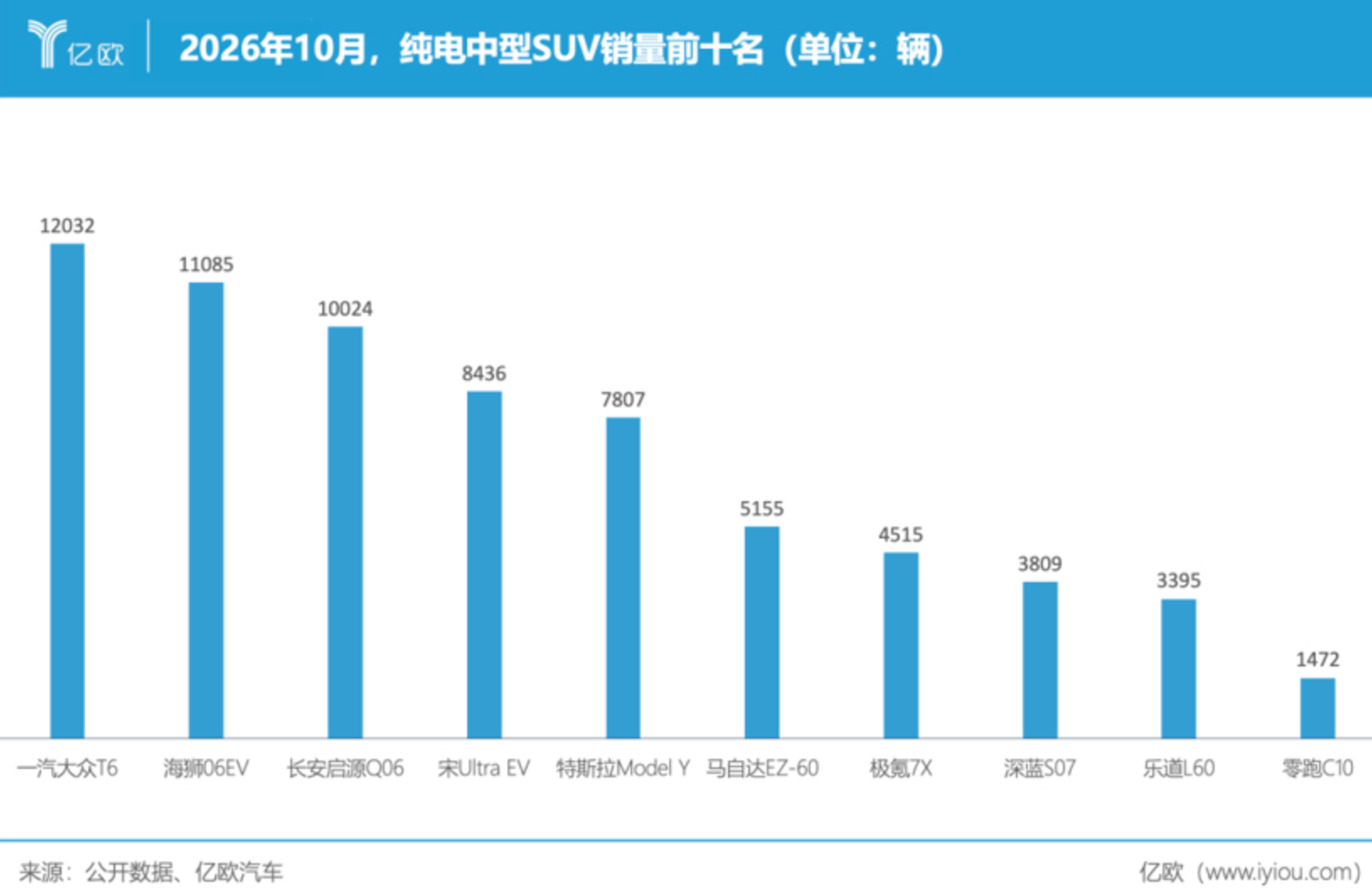
The T6, a mid-size electric SUV, sold 12,032 units in its first full month on sale and finished first in its segment. Mid-size electric SUVs are the single largest segment in China’s new-energy market, and the T6 also placed seventh across the wider electric SUV field.
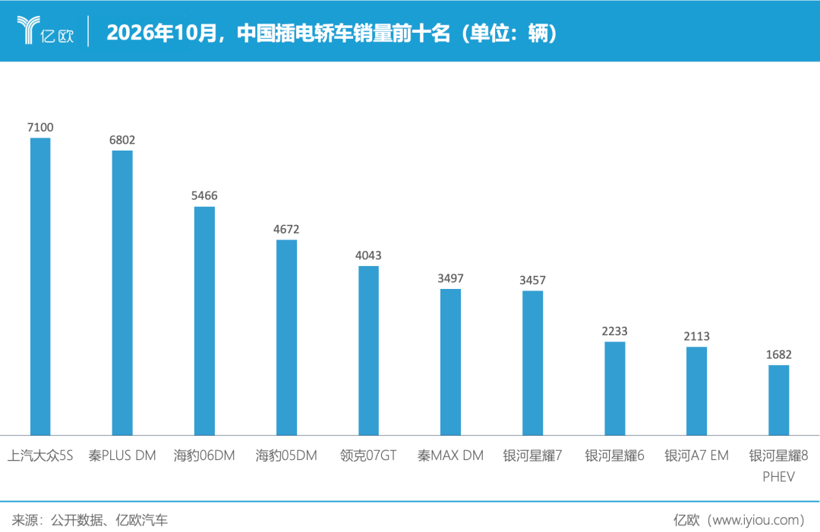
The ID. ERA 5S reached 7,100 units in its second full month and took first place among plug-in hybrid sedans, a category where BYD’s Qin PLUS DM, Seal 06 DM, Seal 05 DM and Qin MAX DM took second, third, fourth and sixth in October, with Geely holding the remaining five top-ten places.
The Jetta M6, an electric sedan launched on 22 October, passed 1,200 units in nine days.
Order books are deeper than deliveries. Brandstaetter said locked orders for the T6, the 5S and the M6 have reached 38,000, 31,000 and 12,000 respectively.
The bill came due in 2020
Volkswagen announced an investment programme of more than EUR 15 billion, about RMB 117.1 billion, in 2020 to embed itself in China’s smart electric vehicle supply chain. It then built Volkswagen Group Technology Solutions in Hefei, the group’s largest research centre outside Germany, and transferred product authority from Germany to China for the first time.
Under that structure, with CARIAD China alongside, launch cycles shortened by more than 30 per cent and development costs on some priority models fell by up to 50 per cent.
The technical result is the VEGA system, covering vehicle platforms, the electrical and electronic architecture and advanced driver assistance. The new CMP platform handles the A-segment mainstream and supports both battery-electric and plug-in hybrid cars. The next-generation CSP platform is aimed at full-size and flagship electric and range-extended models.
The CEA architecture is the part that matters most. Volkswagen’s previous MEB platform, launched in China in January 2021, was still built on a distributed functional-domain layout. While Volkswagen paused, Tesla and Chinese carmakers moved through centralised functional domains and zonal integration to a quasi-central computing layout with a body domain controller.
Volkswagen’s Chinese team skipped the intermediate steps. Under Han Sanchu, chief executive of CARIAD China, the team took MEB straight to a quasi-central computing, body-domain architecture. Han said the company’s in-house C-Brain toolchain now sits inside the whole CEA development chain, replacing a sequential V-model process with an AI-driven development loop.
A world model that arrived at birth
On driver assistance, Volkswagen’s joint venture with Horizon Robotics, CARIZON, produced the HS8 system, a full-scenario L2++ solution and the first driver assistance stack Volkswagen has developed itself in China.
Huang Chang, CARIZON’s chief technology officer, said the in-house GAIA 2.0 world model runs safety simulations equivalent to five million kilometres of real driving every day, drawing on 30 million real-world scenario clips. Against the previous generation, useful data utilisation rose 10-fold and long-tail scenario capture rose 50-fold. The target is 10 million simulated kilometres a day, ahead of Volkswagen’s plan to deliver L3 capability in China from the second half of 2027.
From “in China for China” to “in China for the world”
Volkswagen now describes its Chinese operation as a global product and technology hub. Brandstaetter said the company plans to export at least 300,000 vehicles a year from China by 2030.
Cars built in China by Volkswagen and Jetta already ship to the Middle East, Uzbekistan, Kazakhstan and sub-Saharan Africa. Mexico, Egypt and Vietnam are scheduled to be added before the end of 2026, with ASEAN, South America and more of Africa to follow.
The more consequential export is the engineering. CMP and CEA will underpin the group’s next generation of models for Global South markets, supporting local customisation across electric, combustion and hybrid powertrains. South America is due to be the first region to adopt China-developed technology in its local line-up before 2030, with South Africa to follow. Brandstaetter said CMP would be adapted into the group’s GMP platform for those markets.
Europe is the twist. Germany’s Manager Magazin reported that Schaefer wants CEA in roughly three quarters of the next generation of Volkswagen, Skoda and Cupra models, with the ID. Golf, ID. Passat and Skoda Enyaq among the candidates. Volkswagen Group China declined to comment.
In 2012, then Fiat chief executive Sergio Marchionne accused Volkswagen of using profits earned in China to wage a price and margin war in Europe. Fourteen years later the same charge may return, minus the Chinese cheque. The capability this time was built inside China and paid for once.
Editor’s note: This is an adapted translation of the original Gasgoo report. It has been trimmed and restructured for readability for an international business audience. The full original (in Chinese) is at https://auto.gasgoo.com/news/202611/13I70477861C109.shtml.