Electro-mechanical braking has not yet reached scale in China’s passenger car market, but it has already reached the options list of a RMB 150,000 car.
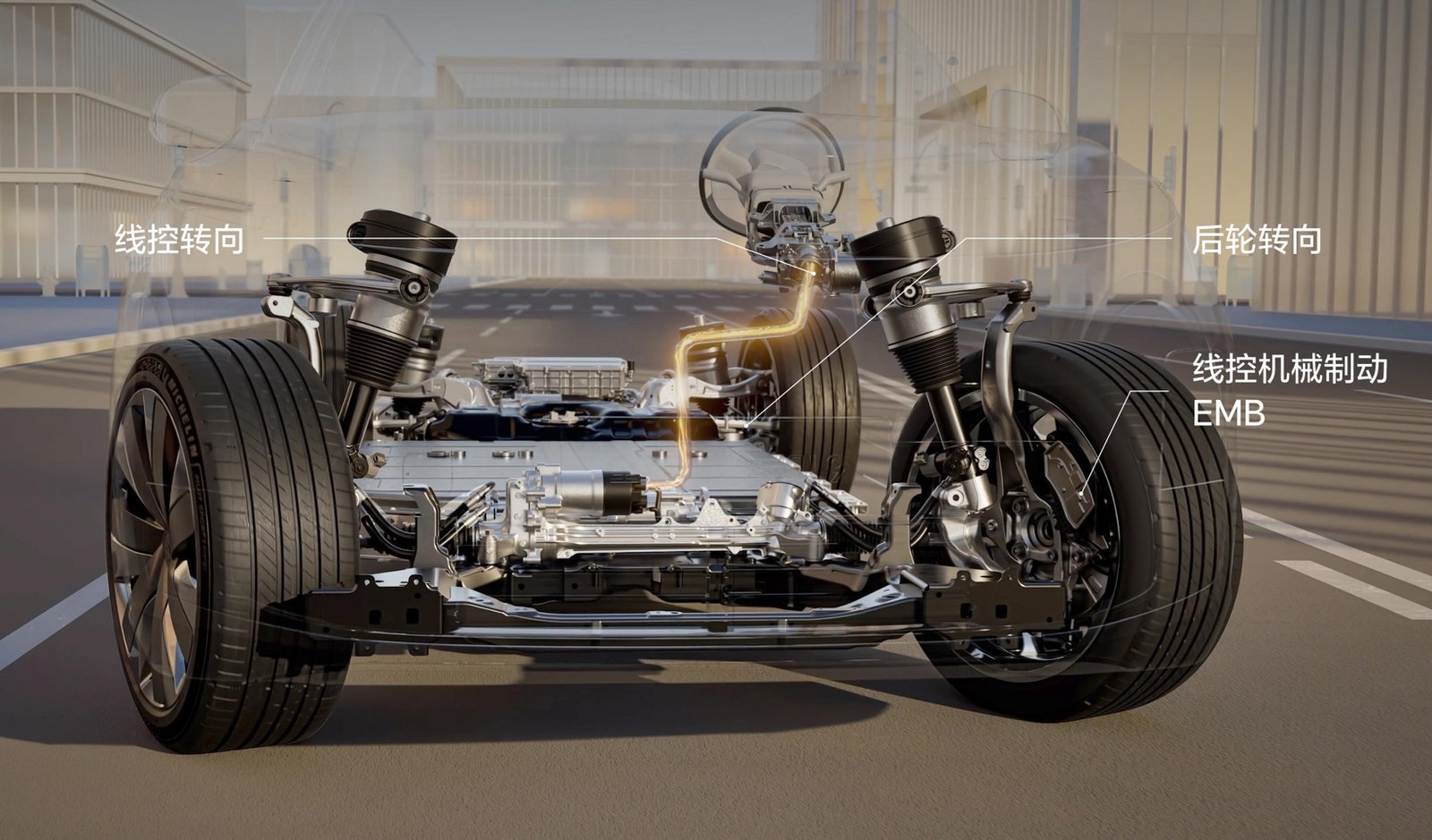
On 12 November, GAC Aion put the Ray7 on sale. The top trim, at RMB 158,800, carries Huawei’s DriveONE EMB system, which deletes the hydraulic circuit and drives each brake at the wheel with an electric motor and a mechanical transmission.
The sticker fell. The volume did not
EMB has been in development validation and nomination for years. 2026 is the first year it appeared on cars customers could actually buy. In April the Exeed EX7 launched with an EMB-equipped range-extender four-wheel-drive Ultra trim at RMB 236,900. In May the Li Auto L9 Livis arrived at a guide price of RMB 509,800.
Installations are concentrated at the top. Gasgoo Research data shows 15,160 EMB systems fitted to Chinese passenger cars between April and September 2026. Bethel supplied 15,089 of those, about 99.5 per cent, almost entirely through the L9 Livis.
A single model above RMB 500,000 is effectively the whole market. The Ray7 gives EMB a route into mainstream price brackets, but only on the top trim, so real volume depends on how many buyers choose that version.
The cost argument is being made in public
Yan Shifu, founder and chief executive of Coordinates Intelligent, has said his goal is to move EMB from an option on RMB 400,000 cars to standard equipment on RMB 200,000 cars. His company has quoted RMB 3,488 for four wheel-end actuators and argues EMB can still be profitable at the RMB 200,000 level.
“We are not selling Louis Vuitton,” he said. “We are selling an engineered safety foundation.”
The comparison that decides this is not component against component. A one-box electronic hydraulic system has years of mass production and cost optimisation behind it. EMB removes hydraulic parts and lines, which simplifies packaging and assembly, but adds motors, transmission, electronics, power supply, communication and safety design at each corner. The relevant number is the cost of the complete system needed to hit the same performance and safety targets.
Zhang Chenchen, chief technology officer of Jiongyi Electronics, told Gasgoo that Chinese suppliers can already hold EMB costs at levels comparable with hydraulic braking, and that packaging is now compact enough for the small wheel wells of economy sedans.
Cai Xudong, founder and chief executive of Huashen Ruili, cautioned that brake systems industrialise on their own schedule. Maturity is decided over the full life cycle, including engineering validation, reliability and consistency, and the ability to deliver at volume over years.
Xue Chunyu, vice-president of braking at Jingxi Zhixing, expects the motor, drive mechanism and manufacturing cost outside the caliper to fall 40 to 50 per cent over the next five to seven years through structural optimisation, part integration, process improvement and localisation.
Capacity is being built before the orders
Component suppliers cannot wait for volume before building lines, because nomination to production takes years of development, vehicle matching, validation and production preparation. Brakes add the strictest consistency and quality requirements of any chassis part.
Bethel has completed automated EMB lines with disclosed annual capacity of 1.2 million units, enough for roughly 300,000 vehicles. Small-batch deliveries began in March and the 10,000th part came off the line on 8 May. Guotai Haitong Securities reported after a September briefing that Bethel held three to four formal nominations with more than ten in discussion, and expects about 100,000 EMB units in 2027.
Coordinates has disclosed capacity planning at the 400,000-set level. Yan expects at least 20 EMB models to reach the market in 2027 and sees annual shipments of 200,000 sets as a plausible inflection point. Jingxi Zhixing is planning 480,000 units a year with production from the first half of 2027.
Huashen Ruili came at the market from unmanned logistics vehicles instead. It began EMB development in 2022, ran three consecutive winters of vehicle testing and calibration, started its first flexible line in 2025 and now delivers EMB-equipped unmanned logistics vehicles in volume. It has since won a passenger car nomination from a leading carmaker and expects scaled passenger car production in 2027.
The regulation does the selling
China’s GB 44721-2026, the safety requirements for automated driving systems in intelligent connected vehicles, takes effect on 1 July 2027. As L3 models move toward commercial deployment, braking actuation, fault response and system safety assurance become more prominent, and independent four-wheel control gives designers room that a hydraulic circuit does not.
Electronic hydraulic braking is upgrading redundancy and control capability to meet the same bar, so the contest between the two architectures is not settled. What is settled is the timetable. Almost every supplier in this market has put 2027 in its plan.
Editor’s note: This is an adapted translation of the original Gasgoo report. It has been trimmed and restructured for readability for an international business audience. The full original (in Chinese) is at https://auto.gasgoo.com/news/202611/13I70477768C103.shtml.