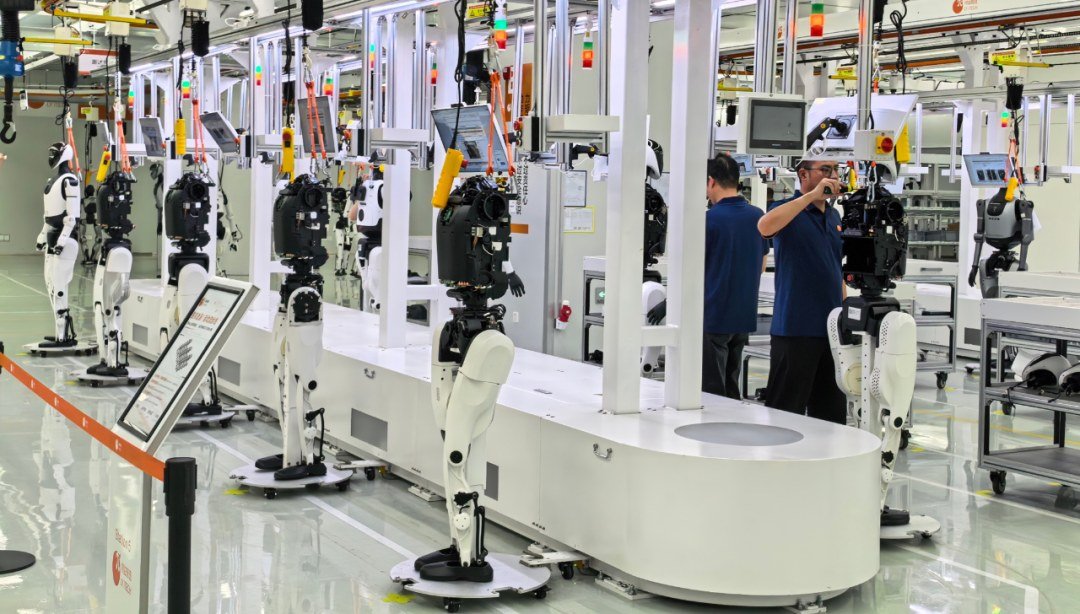
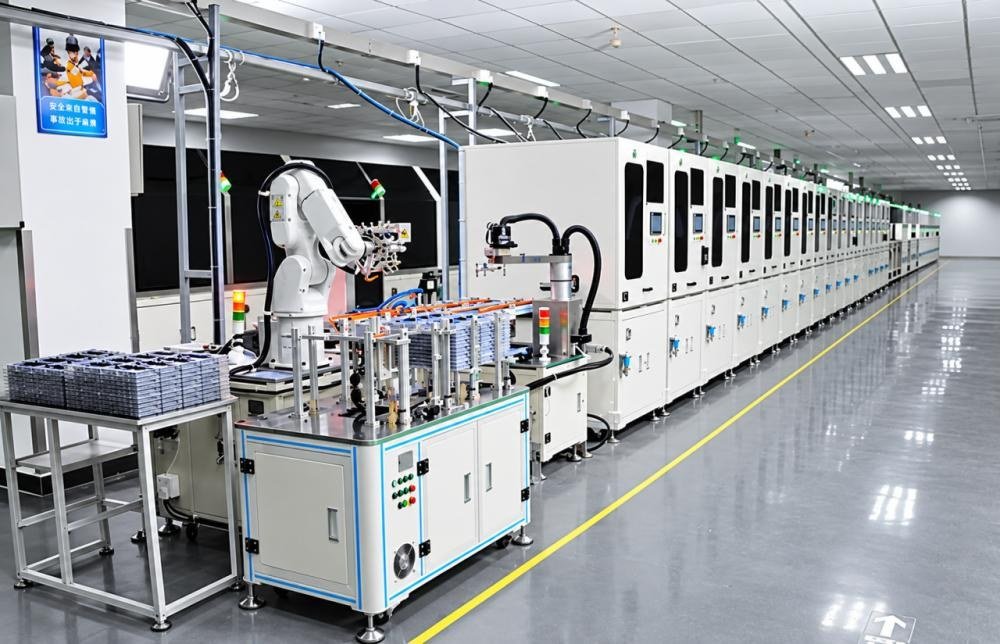
Lingyi iTech confirmed on 13 November, during an investor relations session, that robot assembly lines across Beijing, Chengdu, Zhengzhou, Dongguan and overseas bases have entered production, covering core components, joint modules and complete machines. On the same day Changying Precision said its complete-unit assembly business has begun deliveries, with a Shenzhen Bao’an industrial park live since late last year and capacity reserved in Yibin and Dongguan.
Both companies spent years in consumer electronics precision manufacturing. Releasing capacity signals on one day means humanoid manufacturing as a platform is moving from plan to plant, and the separation between the brand that defines a robot and the factory that builds it has arrived earlier than expected.
Who is ordering matters more than what is being built
Lingyi’s build is the heavier one. Its Beijing Yizhuang embodied intelligence super factory is planned for 10,000 units in 2026 and 500,000 a year by 2030. By the end of 2025 it had assembled more than 5,000 humanoid units for customers including Beijing Humanoid Robot Innovation Centre, AgiBot and Magic Atom, more than twenty brands in total, plus a North American AI company.
Changying entered through North American customers and has developed more than 1,000 part numbers, covering dexterous hand transmission parts, planetary roller screws and torso structural parts.
Both walk the same road: transplant consumer electronics precision manufacturing and package components, modules and complete machines into an outsourced service. The phone industry already ran that playbook. What is new is the demand structure revealed by one clause from Changying, which said current orders mainly serve customer data collection and model training.
If assembly orders come from teams that need robots in order to collect data and train models, the buyers are not brands selling to end customers. The destinations are training grounds, laboratories and data collection stations rather than shops, factories or homes. The line is running, but it serves iteration rather than ramp.
The dividing line exists, but neither side has settled
The split between brand and contractor is real in direction and thin in practice. Phone manufacturing split cleanly because brands knew what they wanted: a fixed product, millions of units, a launch date. Humanoid brands are still iterating hardware fast. Unitree’s H2-X, AgiBot’s Expedition and UBTech’s Walker each change joint layout, degrees of freedom and structure between generations. What Lingyi and Changying sell at this stage is not capacity but engineering, the ability to turn a drawing into something manufacturable and to align component tolerances with assembly rhythm.
Who defines the machine
If assembly can be outsourced, what is left of a hardware moat? In the short term, definition rights. Whoever decides how many joints a robot has and how precise its hand must be is still the brand. Lingyi and Changying turn someone else’s definition into deliverable hardware. That division held in phones and probably holds here, on condition that brands converge on a definition. Many have not, and flexible lines are absorbing that uncertainty for them.
Longer term the moat migrates toward data and models. If assembly is levelled by manufacturing platforms, hardware stops being scarce and differentiation moves to whose robots collect more valuable data and whose models work in real settings. Changying’s order book, read through that frame, says the buyers of assembly today are largely data and model players, which puts the platform upstream of R&D rather than downstream of retail.
Three signals are worth watching. When terminal production orders overtake R&D orders in these books. Whether any brand publicly outsources a full product while keeping only design and software. And whether Luxshare, Foxconn and BYD Electronics start undercutting each other, which would mark the shift from scarce capability to surplus capacity.
Assembly lines are turning. Sitting downstream of them, for now, are training grounds rather than shelves.
Editor’s note: This is an adapted translation of the original OFweek report. It has been trimmed and restructured for readability for an international business audience. The full original (in Chinese) is at https://robot.ofweek.com/2026-11/ART-898890-8420-30712076.html.