Three weeks after releasing Gemini 4 Carbon, Google shipped another model. Gemini 4 Neon, named for the tenth element in the periodic table, went on sale the same day across Google AI Studio, the Gemini app, enterprise APIs and the company’s coding environment Antigravity. No waiting list this time.
A family sorted by chemistry
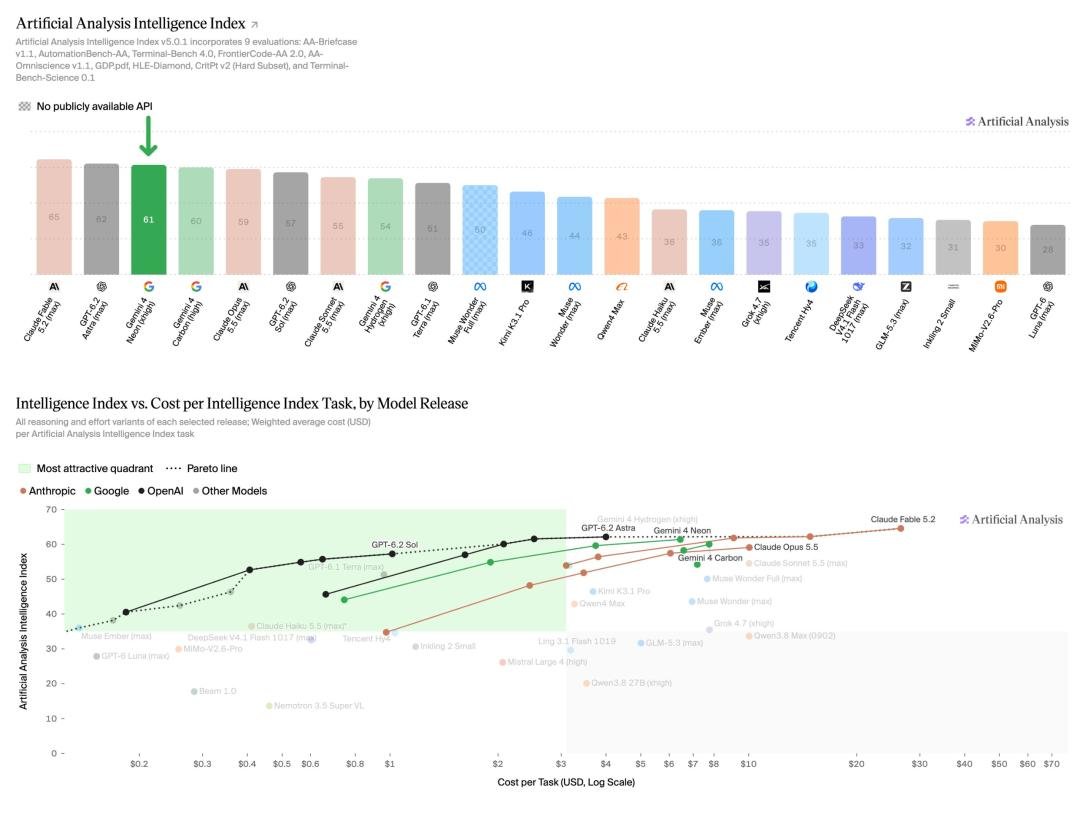
Google has finally published the family map. Hydrogen targets everyday coding and light agent workflows, scoring 54 on the Artificial Analysis index at USD 1.50 per million input tokens and USD 7.50 output. Carbon handles the longest-horizon projects and deep research, at 60 on the index and USD 4 in, USD 20 out, with a promotional USD 2 and USD 10 until 30 November. It is aimed mainly at higher-tier Ultra subscribers.
Neon sits in the middle, built for software engineering, knowledge work and scientific reasoning, and available to Pro and Ultra users. Because it adds an extra xhigh thinking level that Carbon lacks, Neon scores 61, one point above its bigger sibling, while its USD 3 input and USD 15 output price is roughly a quarter below Carbon’s standard rate. It ships with a one-million-token context window and cached input as low as USD 0.15.
The naming has become its own joke. Google DeepMind researcher Yao Shunyu noted on X that element code names are a clever way to keep outsiders guessing which tier a model belongs to.
Benchmarks aimed at two rivals
Google put Neon on the same chart as Claude Opus 5.5 and GPT-6.2 Sol. The results are mixed at the edges. Opus keeps a narrow lead in terminal and frontier-code tasks, and GPT-6.2 Sol edges ahead on dense chart reading. Switch to composite intelligence, where Neon scores 61 against 59 and 57, and its advantage is clear. On agent coding it reaches 65.4 per cent on CursorBench and 39.0 per cent on SWE-sweep inside Antigravity. In GraphWalks, which tests retrieval across 256,000 to one million tokens, Neon scored 95.2 per cent against 66.8 for Opus and 80.1 for GPT-6.2 Sol.
Google also released Project Genie and the Genie 4 world model to eligible Ultra users, letting them generate and walk into interactive 3D worlds in a browser. In its safety report, the company said Neon’s cheating rate on Terminal-Bench 4.0 was held at 0.0 per cent and its shortcut rate on internal coding tests fell to a record 2.45 per cent.
The price is the weapon
In a head-to-head test by blogger JAZII, with both models at maximum reasoning, Neon finished in 20 minutes for USD 3.50 while Opus 5.5 took 18 minutes and USD 7.20. The verdict was that Opus remains the higher ceiling, but Neon delivers the most refined output in the Gemini 4 family at well over half the cost per task. Enterprise search firm Glean put it at three times Carbon’s speed and 60 per cent of its cost for comparable quality, with per-task spend 50 to 80 per cent below leading competitors.
The timing is not subtle. Anthropic is in the middle of an initial public offering. OpenAI and Google have taken turns dropping low-priced mainstream models into the developer and enterprise workflows that matter most to the company going public. For developers, a price war among frontier labs is simply cheaper access to capable models, one task at a time.
Editor’s note: This is an adapted translation of the original 36Kr report. It has been trimmed and restructured for readability for an international business audience. The full original (in Chinese) is at https://m.36kr.com/p/4075907868955785.