Between 14 and 20 November, companies in robotics, embodied intelligence and related supply chains in China and abroad disclosed twelve funding and investment events. The list shows where capital is concentrating in the physical AI boom.
Genesis AI: USD 500 million Series A
On 17 November Genesis AI announced a USD 500 million Series A, about RMB 3.3 billion, at a post-money valuation of USD 3.5 billion, roughly RMB 23.3 billion. The round was co-led by Premji Invest, Khosla Ventures and Eclipse, with participation from Durable Capital Partners, France’s Bpifrance, HSG, NVIDIA’s NVentures, AMD Ventures, Zoom Ventures, Samsung Next and Ericsson Ventures.
Founded in December 2024, Genesis AI works on general-purpose robotics and dexterous manipulation. Its products include a dexterous hand and data-collection glove, a general robot called Eno, a robot brain model named GENE, and a simulation platform called Genesis World. The money will go to data collection and large-model training, expanding the range and complexity of robot tasks, accelerating human-level physical manipulation, hiring engineers, and scaling deployment of Eno in customer scenarios. The company plans to enter manufacturing, logistics and laboratories first, then extend into hospitality, healthcare, consumer and outdoor settings.
Blue Dot Touch: past RMB 1 billion in six months
On 17 November force-sensor maker Blue Dot Touch announced a Series D3 round worth several hundred million yuan, taking its cumulative funding over the past six months beyond RMB 1 billion. Fourteen institutions joined, including Hongtai Fund, ZGC Science City, Hillhouse-backed investors, Zhejiang Venture Capital and several government funds.
The company makes robot force sensors with 0.1 per cent full-scale accuracy, response above 10 kilohertz and 500 per cent overload resistance. Its technology traces to the civil use of aerospace-grade sensing, and it says the full production chain is domestic. AgiBot, Galaxy General, Xiaomi, UBTech, Noetix and Star Era are among the makers using its products in volume, with several single customers ordering at ten-thousand-unit scale. It has built a plant of more than 10,000 square metres in Jiangmen, Guangdong, with an automated line designed for one million joint force sensors and 200,000 six-axis sensors a year.
Baichuan Data: RMB 50 million for physical AI data
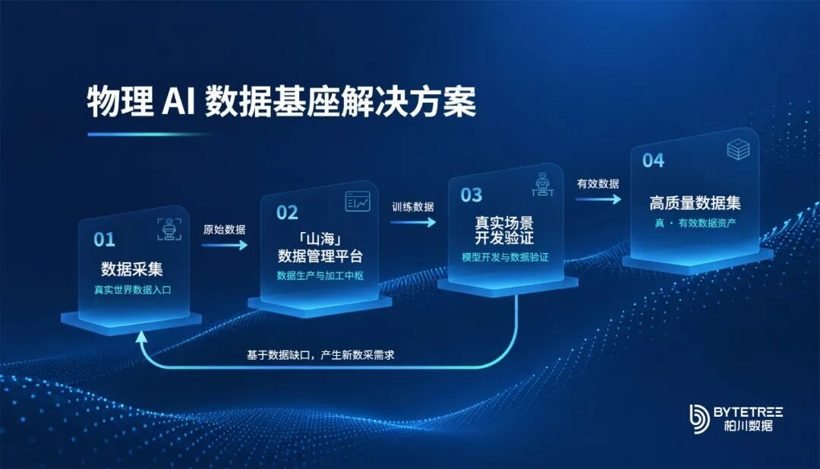
On 18 November Baichuan Data, also called ByteTree, raised RMB 50 million in a Pre-A round. Investors included Yuanhe Houwang and Yifeng Capital, along with two embodied AI companies including Star Era. The money will go to physical AI data pipelines, embodied AI algorithms, high-quality datasets, and robots for special scenarios.
Founded in 2021, the company built its business on data services for autonomous driving, serving nearly a hundred carmakers and driving-assistance firms. In the second half of 2025 it moved into embodied AI. Within a year it had served nearly twenty embodied AI companies, including several valued above RMB 20 billion. It runs two training grounds with more than 200 humanoid robots and hundreds of body-free data collection rigs, giving an annual capacity of 350,000 hours of usable embodied data. It has delivered more than 200,000 hours so far and expects that to pass one million hours in 2027.
Eagle X: flapping-wing robots from Shenzhen
On 17 November Shenzhen-based Eagle Wing Intelligent Technology, which builds bionic flapping-wing robots, completed a Pre-B round worth tens of millions of yuan. The round was led by SenseTime’s Guoxiang Capital and will fund next-generation flapping-wing robots, its Vortrix fluid simulation engine, supply chain and production lines, and overseas expansion. Earlier backers include Qiming Venture and Yuanhe Origin. Founded in March 2025, the company debuted its consumer product Eagle X at IFA 2026 in September and is developing a next model.
The twelve deals point to a pattern. Big rounds still go to general-purpose platforms, but a growing share of capital is flowing to the components and data that those platforms need: force sensors, spatial chips and training data. For investors, those are easier to underwrite than a general robot that has yet to leave the lab.
Editor’s note: This is an adapted translation of the original Gasgoo report. It has been trimmed and restructured for readability for an international business audience. The full original (in Chinese) is at https://www.gasgoo.com/robot/news/70478622-%E8%9E%8D%E8%B5%84%E5%91%A8%E6%8A%A5-genesis/.