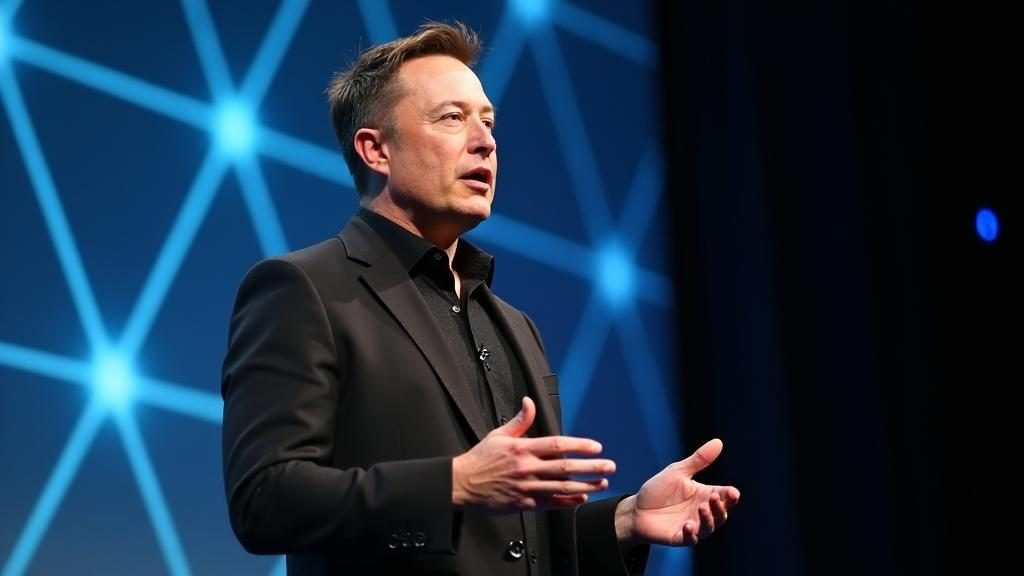
Elon Musk said on 19 November at the Austin Tomorrow X summit that Tesla would arrange a new demonstration of its Optimus humanoid within the next two months. He also said the robot would be prioritised for heavy industrial scenarios, with mining and smelting named as key targets.
The comments are a shift from a month earlier. At the third-quarter earnings call on 21 October, Musk said a demonstration video would take roughly one or two months and stressed that the robot in the video would not be pre-programmed. The time window has rolled forward, and the scenario has changed. Heavy industry was not mentioned in October. In November, mining and smelting became the stated landing point.
Why heavy industry first
Most Chinese robot makers are trying to teach their machines to fold laundry or greet customers in showrooms. Tesla is pointing Optimus at dirty, dangerous work. That looks like a rational compromise given current technical limits. Home environments demand extremely high safety, where any mistake can become an ethical problem. Mining and smelting are already defined by high risk and unstructured conditions, where the return on investment is easier to justify. If a robot keeps working without a major accident, that counts as a win.
There is also a closed commercial loop. Tesla and SpaceX operate their own smelters and mines, which serve as ready-made test sites. The company does not need a long customer pilot cycle. Internal orders provide the work, and the data feeds straight back into model training.
The reasoning layer
Musk also mentioned that SpaceX is developing Grok 4.8, which he linked to the mining use case. In heavy industry, a vision-language-action model alone is unlikely to handle long-tail events. An uneven ore face or an overheated furnace demands physical reasoning about grip angle, load limits and recovery motions. A stronger reasoning base is what lets a general model anticipate physical consequences before acting.
The domestic funding climate in China has also shifted. Official media and private investors have begun saying embodied AI funding must move from technical imagination to delivery certainty, with framework orders and slide decks no longer enough. A rolling demonstration date can lift sentiment briefly. What matters is whether the hardware can sustain hours of continuous heavy work and whether a maintenance network exists for a mine site.
Heavy industry is both a test and a route to general-purpose robotics. A demo video can be polished with teleoperation. A mine shift cannot. Timelines move. Physical constraints do not.
Editor’s note: This is an adapted translation of the original OFweek report. It has been trimmed and restructured for readability for an international business audience. The full original (in Chinese) is at https://robot.ofweek.com/2026-11/ART-8321202-8460-30712609.html.