SynapX, the Beijing-based embodied AI company also known as Zhangyu Dongli, has raised several hundred million yuan in a new funding round. New investors include Midea, the appliance and industrial group. The full investor list has not yet been finalised, according to Gasgoo’s embodied intelligence desk.
Money for production, not demonstrations
Proceeds from the round will be used to build a high-end manufacturing line for dexterous hands and to fund research into embodied models. The company was explicit about the allocation: the capital is going into production facilities and the supply chain, rather than demo videos or benchmark rankings.
Four rounds in twelve months
This is SynapX’s fourth raise this year. The company completed a first round of nearly USD 50 million just two months after it was founded, with Horizon, Hillhouse Ventures, Xiaomi’s strategic investment unit, Shunwei Capital and Linear Capital participating. In April it secured a strategic investment worth several hundred million yuan led by Singapore’s K3. June brought a further USD 50 million, led by Jinqiu Fund, ChipLink Capital and Huangpu River Capital, with JAFCO Asia and Houxue Capital also taking part. At that point the company disclosed nearly RMB 1 billion raised across three months. With the new round, total funding has reached the RMB 1 billion scale.
Brain, hand, data
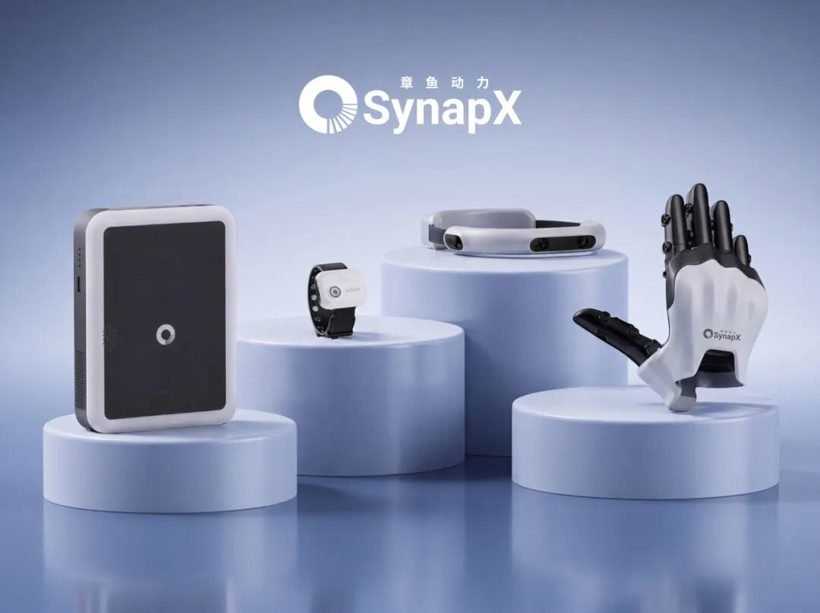
SynapX positions itself as a general productivity platform for physical AI. Its stated advantage is a closed-loop flywheel linking model, hand and data, built on co-design across hardware and software. At the 2026 World Robot Conference it unveiled a three-part system: the SYNWorld embodied world model, the OctoH-Hand high-degree-of-freedom biomimetic dexterous hand, and OctoSense, a next-generation data capture platform. The company claims OctoSense achieves zero-shot cross-subject generalisation from electromyographic signals, aligning human operation data with real machines with minimal loss.
A commercial signal
Early in October, SynapX said it had won a mass-production order from a leading overseas embodied technology customer. The round gives it manufacturing capacity to pursue that demand, and gives Midea an early position in a component market that remains unsettled.
Editor’s note: This is an adapted translation of the original Gasgoo report. It has been trimmed and restructured for readability for an international business audience.