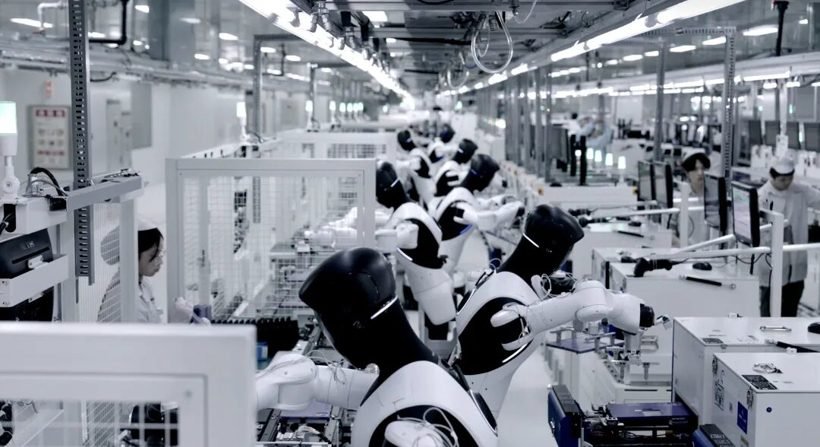
AgiBot Innovation and Lens Technology have reached a strategic partnership under which dozens of AgiBot G2 robots will be deployed on mobile phone test lines. The machines will handle automatic loading and unloading at test stations and interaction with test equipment, covering MMI, ANT, CAM and CAMCV stages. The two companies describe the project as a standardised template for testing in the consumer electronics industry.
Why general robots here
Loading and equipment interaction in phone testing are repetitive and relatively fixed, so multiple automation options already exist. The difficulty is that phone models change quickly, forcing changes to lines, test fixtures and process flows. General-purpose robots are being asked to hold flexibility through repetition and frequent changeovers.
The G2 is an industrial-grade interactive embodied robot with high-performance joint actuators, multiple sensor types, an AI computing platform and an omnidirectional mobile chassis. Its cross-wrist force-controlled arm has seven degrees of freedom on each side and high-precision joint torque sensors across the whole arm, using joint impedance control to sense external force and respond compliantly. A three-degree-of-freedom waist approximates human bending, turning and side-sway. Dual hot-swappable batteries and an optional charging station allow continuous operation.
The record in previous factories
Before the Lens project, G2 units had entered factories including Junsheng Electronics and Longcheer Technology. At a Junsheng safety plant in late 2025, the robot achieved integration of hand, eye, body and network. According to Junpu Intelligent, system success was about 99 per cent and visual grasping success 100 per cent. Average takt was 15.28 seconds, with a best of 12.97 seconds, against the line’s original average of 18 seconds.
Longcheer pushed the test further. In December 2025, G2 units entered the Nanchang plant for stress testing of loading and unloading functions and adaptation to the production environment, then joined a real line for the MMIT test process. By May, eight units had been integrated into a full tablet quality inspection segment, working to factory takt alongside line workers. Between 23 and 28 June, those eight robots took part in a six-day live broadcast of the production line, handling loading, equipment interaction and sorting of good and defective units across multimedia interface, audio, radiated spurious emission and coupling tests. AgiBot reported 64,828 completed line tasks, cumulative output of 17,625 units and an overall task success rate of 99.99 per cent.
What the figures do not settle
A single-station trial answers one set of questions. Six continuous days on a real line test multi-machine coordination and process handoffs as well. But a 99.99 per cent task success rate does not replace the full set of industrial metrics. Public material does not fully answer whether robots held takt continuously, how long recovery took after a fault, or how many engineers were required to keep the line running.
The Lens plan expands both the number of robots and the variety of phone test stages, but the announcement mainly describes deployment targets and construction goals. Long-term operating data has not been published. Across Junsheng, Longcheer and now Lens, AgiBot is trying to reuse the same machine body across different products, processes and customers. Whether the path works depends on how much of what one factory learned can be applied directly in the next.
Editor’s note: This is an adapted translation of the original Gasgoo report. It has been trimmed and restructured for readability for an international business audience.