Unitree disclosed its first quarterly report since going public on the evening of 28 October. For the first three quarters of 2026, revenue reached RMB 1.817 billion, already above the full-year 2025 figure of RMB 1.699 billion. Gross margin fell noticeably, the research expense ratio jumped, and recurring profit declined. On the surface this is growth without profit. In substance it is a deliberate shift: hardware margins earned over the past two years are being spent on embodied models and computing capacity.

Revenue is still scaling, just not exploding
Nine-month revenue rose 55.7 per cent year on year to RMB 1.817 billion. Third-quarter revenue was RMB 665 million, up 69.9 per cent. The growth rate has slowed from 332.7 per cent in 2025, but that reflects a higher base rather than a reversal. Revenue was RMB 159 million in 2023, RMB 393 million in 2024 and RMB 1.699 billion in 2025.
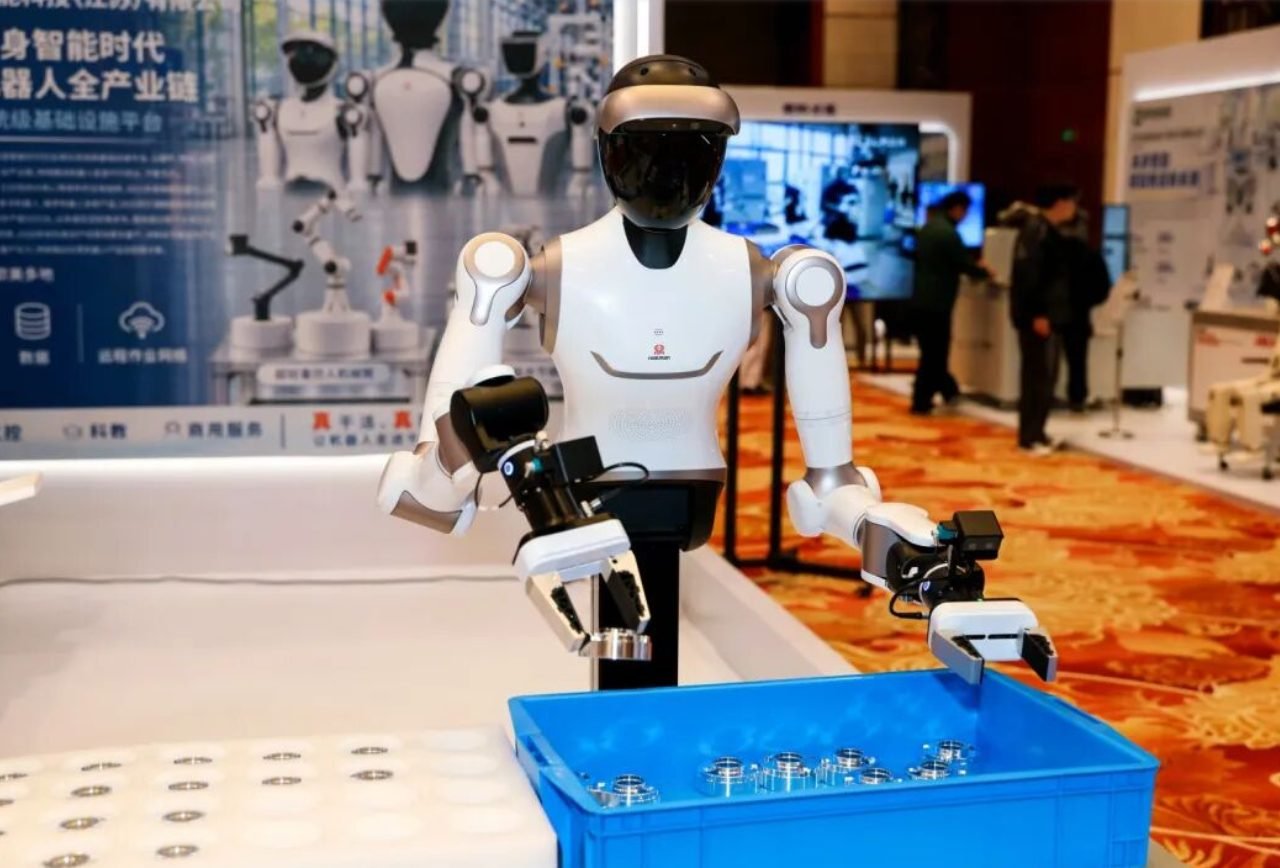
The company attributes growth to product innovation and business expansion. In September it launched the G1+ humanoid with an upgraded joint motor system, multi-sensor fusion and an external power interface. On 21 October it unveiled the H2-X, a full-size high-dynamic humanoid with 31 degrees of freedom and a claimed eight-hour runtime. Demonstration footage showed backflips, a landing from a four-metre platform and vehicle-lifting manoeuvres aimed at security and rescue work.
One change matters for readers of the numbers. The quarterly report no longer breaks out revenue by product line. In 2025, humanoids generated RMB 868 million, or 51.1 per cent of revenue, overtaking the RMB 698 million from quadruped robots.
The margin peak may have passed
Gross margin was 54.0 per cent for the nine months and 50.6 per cent in the third quarter, down from 60.4 per cent for 2025 as a whole. The historical path was 44.7 per cent in 2023, 57.2 per cent in 2024 and 60.4 per cent in 2025, driven by a rising share of high-margin humanoid products. The company cites yield fluctuations during humanoid ramp-up, price cuts on some models, higher computing and component costs, and a likely increase in lower-margin industrial orders. In plain terms, the era of lifting margin simply by selling a richer product mix is ending.
Profit falls as research spending surges
Attributable net profit for the nine months was RMB 387 million, up 270.5 per cent, but recurring attributable profit was RMB 349 million, down about 18.8 per cent. Third-quarter attributable profit was RMB 113 million, down 17.4 per cent, and recurring profit was RMB 105 million, also down 17.4 per cent. The gap reflects a low 2025 comparison base created by a large share-based payment charge.
Research spending reached RMB 263 million in the nine months, up 191.5 per cent. The expense ratio jumped from a stable 8.8 to 9 per cent range in 2023 to 2025 to 14.47 per cent, and 19.1 per cent in the third quarter. Unitree says the increase came mainly from embodied AI research, especially model development and compute, plus team expansion. Its model sequence runs from the open-sourced world model UnifoLM-WMA-0 in September 2025 to the VLA-0 model in January 2026 and the 6-billion-parameter WLA-1.0 released in September 2026, trained on roughly 2,500 hours of real-machine data.
A volatile listing
Unitree listed on the Shanghai Stock Exchange’s STAR Market on 19 August 2026 at RMB 150.80. The shares opened at RMB 1,100, more than 629 per cent above the issue price, and market capitalisation briefly passed RMB 440 billion. By 15 October the stock had touched around RMB 404, more than 60 per cent below its peak, wiping out roughly RMB 280 billion in value. It then rebounded nearly 70 per cent to around RMB 670 ahead of the report, with capitalisation near RMB 270 billion and a trailing price-to-earnings ratio of about 465 times.
Founder Wang Xingxing has said the key competition will be how well models align with physical robots and how effectively data loops are built. For the next few quarters, two questions matter more than any single profit figure: whether revenue shifts from research and education orders towards industrial and commercial deployment, and whether model investment converts into visible product capability and pricing power.
Editor’s note: This is an adapted translation of the original Leiphone report. It has been trimmed and restructured for readability for an international business audience.