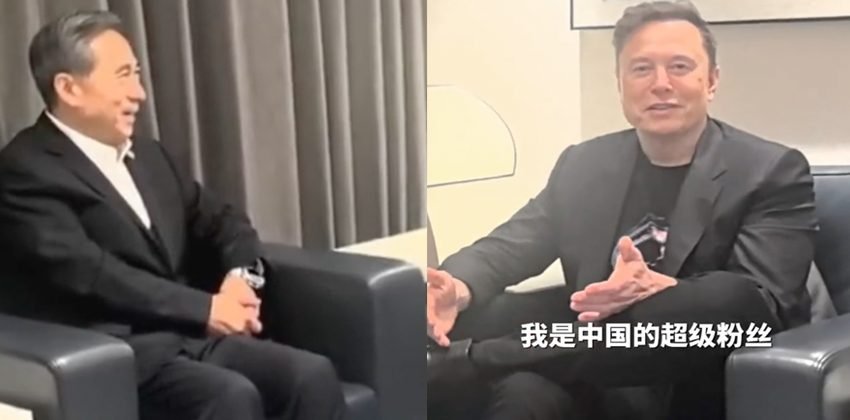
Elon Musk met Ren Hongbin, chairman of the China Council for the Promotion of International Trade, in Shenzhen on 19 November. During the meeting he described himself as a strong admirer of China and said Tesla would continue to increase its production in the Chinese market.
The numbers behind the commitment
According to the China Passenger Car Association, Tesla China’s wholesale sales in the first ten months of this year reached 810,900 vehicles, up 21.4 per cent year on year. Publicly reported figures put the annual capacity of Tesla’s Shanghai factory at more than 950,000 vehicles.
Three more points from New York
Because he was in Shenzhen, Musk joined the 2026 DealBook Summit at New York’s Lincoln Center by video link. There he made three further disclosures. First, Tesla plans a Model Y without a steering wheel or pedals, able to carry six to seven people. Second, asked about a potential combination of SpaceX and Tesla, he said that if it happened things might be better, because it would help joint development of advanced AI and robotics technology, while stressing that the final decision belongs to shareholders. Third, he said he would visit the Tesla Shanghai factory during this trip.
Within 24 hours of landing in Shenzhen, he had covered four substantive points. On the question most closely watched by the industry, the approval and rollout timetable for the full version of FSD in China, no further official information had emerged at the time of publication. At Tesla’s third-quarter earnings call in October, executives said Chinese approval had not landed and offered no new schedule.
A first public visit
According to public reports, this was Musk’s first public visit to Shenzhen. He arrived on 18 November with a US delegation for events connected to the 2026 APEC leaders’ week held in the city. After arriving, he wrote on social media that he hoped the so-called Thucydides trap could be avoided, a term used in international relations theory for the risk of conflict when a rising power challenges an established one.
He also spoke about the trip while participating online in the DealBook Summit. He said he was struck each time by China’s scale and grandeur, that he encourages people to visit and see for themselves, and that Shenzhen was a huge city with striking buildings and, in his view, China’s largest advanced technology centre. He said relations between the two countries were quite good and expressed the hope that they would remain so. He added that one reason for the visit was to stop by the Shanghai factory and thank the team for its work over the years.
For the Chinese auto industry, the immediate signal is a production commitment backed by existing capacity. The longer-term one is the possibility that Tesla’s AI and robotics ambitions are evaluated against its Chinese manufacturing base, even as the software approval timeline stays open.
Editor’s note: This is an adapted translation of the original Chedongxi report. It has been trimmed and restructured for readability for an international business audience.