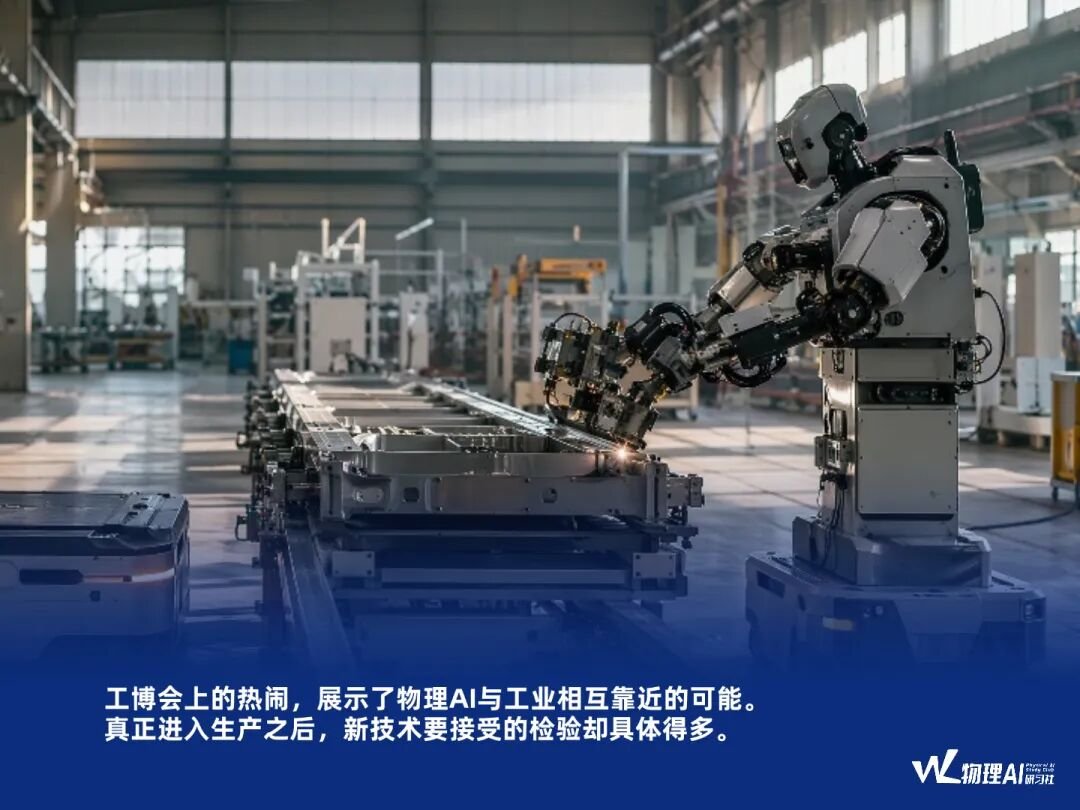
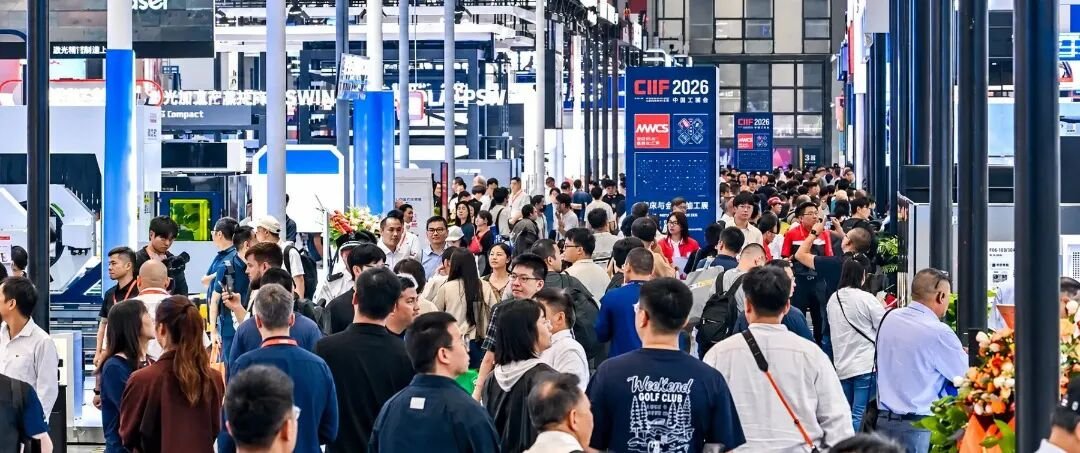
Industrial production is moving towards physical AI, and the 26th China International Industry Fair, which opened at the National Exhibition and Convention Centre in Shanghai on 12 October, made the shift visible. The pairing of factory and physical AI has become the focal point of industrial deployment.
Han Chen, president of ABB Robotics China, was direct about where the fit is. Small batch, many varieties and high-frequency changeover are the production conditions where physical AI is especially suitable, he said at the show.
That framing matters because it points at the application layer rather than the model layer. Factories have tasks that existing automation cannot handle economically, and they also have a genuine opportunity to put new capability into volume use. Physical AI needs real production environments just as much, to test what the technology can do and to find a real market anchor. The approach can come from cooperation between physical AI players and manufacturers, or from iterating on the equipment and software already installed on the line.
It is not as simple as the narrative suggests. The promise of perceiving the physical world, understanding it and making decisions inside it is attractive enough to pull in industrial buyers. But industry has hard thresholds on efficiency, cost control, safety and stability. It is not a test bed that grants forgiveness on the strength of a demo and a vision.
Nobody needs another robot. They need one process fixed
Factories are not short of robots and they are not short of automation. What they lack is new solutions, and a solution is concrete: it corresponds to a specific process requirement.
Take loading in multi-variety, low-volume production. Part models and their orientation may change from batch to batch. If every change requires re-programming the automation equipment and refitting tooling, the investment is too high, and factories naturally keep people on the task to judge, sort and arrange. If the perception and manipulation capability that physical AI represents can absorb those changes and cut manual handling and changeover debugging, it has a reason to enter the process.
Precision insertion works the same way. The workpiece position deviates, and after contact the motion has to adjust to resistance. A single pre-set trajectory may not complete the task economically.
None of this means mature automation cannot do the job. Vision and force control have been used on industrial robots for years. What physical AI has to prove is that under multi-variety, low-volume and frequent changeover conditions it can take on work that was previously hard to justify economically, with less deployment cost, less tooling adjustment and less on-site intervention.
The supplier carries the adaptation cost
Running one process proves that a workflow holds under one set of production conditions. Change the line and the materials, equipment and process requirements change with it. The question then is how much resource a company must commit again, and that is where a technology becomes a sustainable business.
Reuse here is far more complicated than a model completing more tasks. A model may recognise new materials while the equipment still needs reconfiguring. A robot may carry over a manipulation skill while takt time and quality requirements must be revalidated. Generalisation reduces part of the adaptation work, but the customer is buying a complete solution and the remaining engineering still has to be staffed and paid for.
This touches the core expectation factories bring to physical AI, which is help in absorbing change more cheaply. If each change requires the technology provider to reorganise substantial development and debugging, the adaptation cost has simply moved onto the supplier. Early research budgets can carry that. Before a business scales, the provider has to find a way to stop repeating the work.
ABB has made one concrete attempt. It recently added the AI Robot Trainer to its Fashion Inductor apparel logistics sorting module, packaging a pretrained vision model for garment sorting together with deployment tools. Integrators can retrain on top of it as goods, packaging and layout change, and debug through a digital twin. Common capability carries forward, site differences get adjusted, and the work of building from scratch on each deployment falls sharply.
That points to the more practical starting point for scaling physical AI: expand gradually between similar production tasks. A manipulation skill validated on one line can plausibly serve other similar tasks, though changes in materials, tooling and equipment interfaces will need extra adaptation. The job is to carry over as much existing capability as possible while cutting the development and debugging that adaptation demands.
Whether reuse holds is measured by one number. How much work does the last site’s accumulated experience save on the next delivery?
Editor’s note: This is an adapted translation of the original OFweek report. It has been trimmed and restructured for readability for an international business audience. The full original (in Chinese) is at https://robot.ofweek.com/2026-10/ART-8321202-8420-30708322.html.