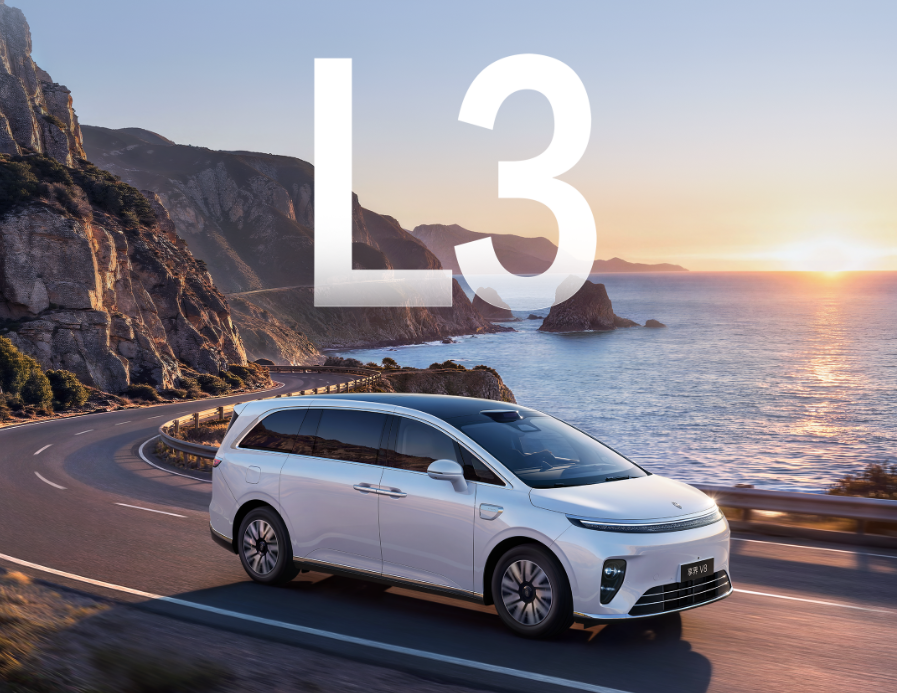
Maextro said on 17 November that its first MPV, the V8, had begun what it described as the first nationwide cross-city Level 3 autonomous highway test at 120 km/h. The test extends the scope from a single city to an intercity route, and is the first time an MPV has undergone cross-city L3 testing.
Eight layers of redundancy
The road test is built on eight redundant systems covering perception, computing, braking, steering, power supply, communication, positioning and interaction. The car carries Huawei’s Qiankun ADS 5. Ultra and Ultra+ versions use an 896-line dual-optical-path imaging lidar, and the total sensor count is 38, arranged to an L3 autonomous driving architecture.
The test supports L3 activation on motorway sections at up to 120 km/h. The system can perform navigation-based, efficiency and safety lane changes, and can be used in light to moderate rain, snow and at night. Before the road test, Maextro completed extensive simulation and closed-course testing against typical scenarios such as a stationary vehicle blocking a lane and a slowly moving vehicle ahead.
A rulebook arriving in real time
Since the start of 2026, L3 access and road-use rules have been taking shape. The Ministry of Industry and Information Technology and the Ministry of Public Security have been pushing forward the approval and legal road use of production L3 vehicles. The GA/T 2388-2026 traffic standard came into force in July, covering L3 testing and demonstration applications across all scenarios. The V8 cross-city test is being carried out within that framework.
The vehicle is jointly developed by BAIC and Huawei and is scheduled to go on sale on 20 November, with presales starting at RMB 329,800.
Editor’s note: This is an adapted translation of the original Gasgoo report. It has been trimmed and restructured for readability for an international business audience. The full original (in Chinese) is at https://auto.gasgoo.com/news/202611/17I70478233C109.shtml.