Warehouse automation has spent twenty years getting very good at moving things that are already the same shape. The pallet, the tote and the carton are solved problems. The contents of the bin are not.
That is the line the robotics industry crossed at CeMAT Asia 2026. The machines on display were not stacking boxes. They were reaching into shelving, picking individual products with soft packaging, odd geometry or awkward poses, and placing them into outbound totes.
Zero retrofit, one centimetre at a time
Zinovate built its demonstration around a single constraint: do not change the warehouse. Its Armstrong Pro uses an all-wheel omnidirectional chassis that can move sideways and rotate in place, with a working height covering 0 to 2.4 metres, and two arms for the pick itself.
The argument is economic. Retrofitting a live warehouse means stopping it, adjusting racking, replanning aisles, standardising totes and adding location markers. Every one of those steps costs money and disrupts throughput, which is hard to approve in a facility handling thousands of SKUs.
Zinovate’s founder Sun Junkai uses a pharma warehouse project to describe the cost of the alternative. After the robot entered, the team found that one extra centimetre on the chest of the machine blocked the arm’s path to the shelf. The chassis and body were redesigned and the electronics relaid. Getting from arrival to stable operation took about nine months.
Performance followed the same curve. At entry the robot ran at roughly 80 to 90 per cent of a human operator. Once stable, it reached parity on the picking tasks in scope.
Three tiers instead of one clever robot
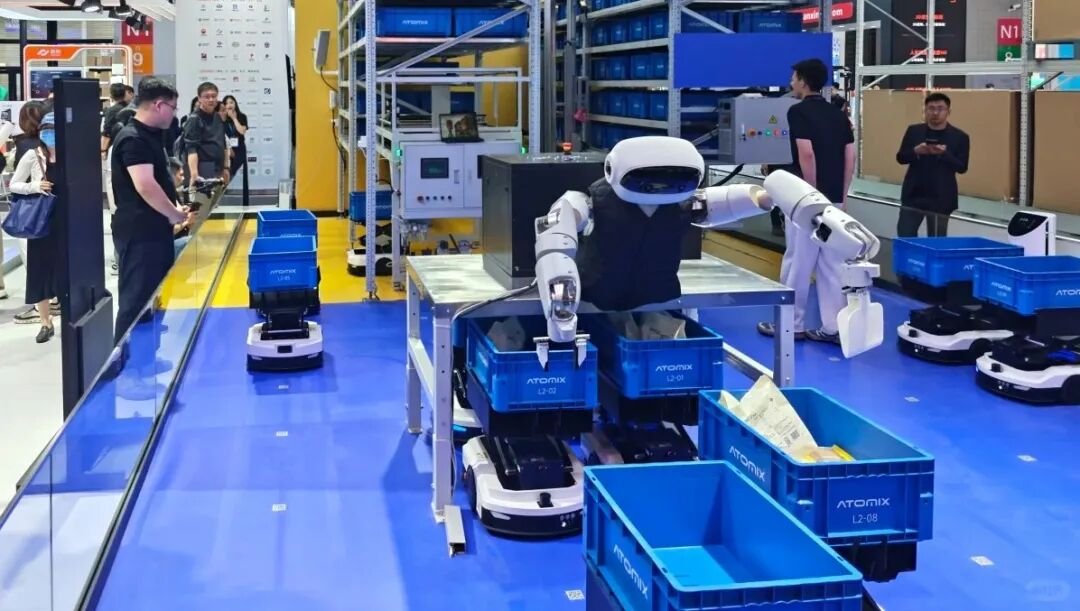
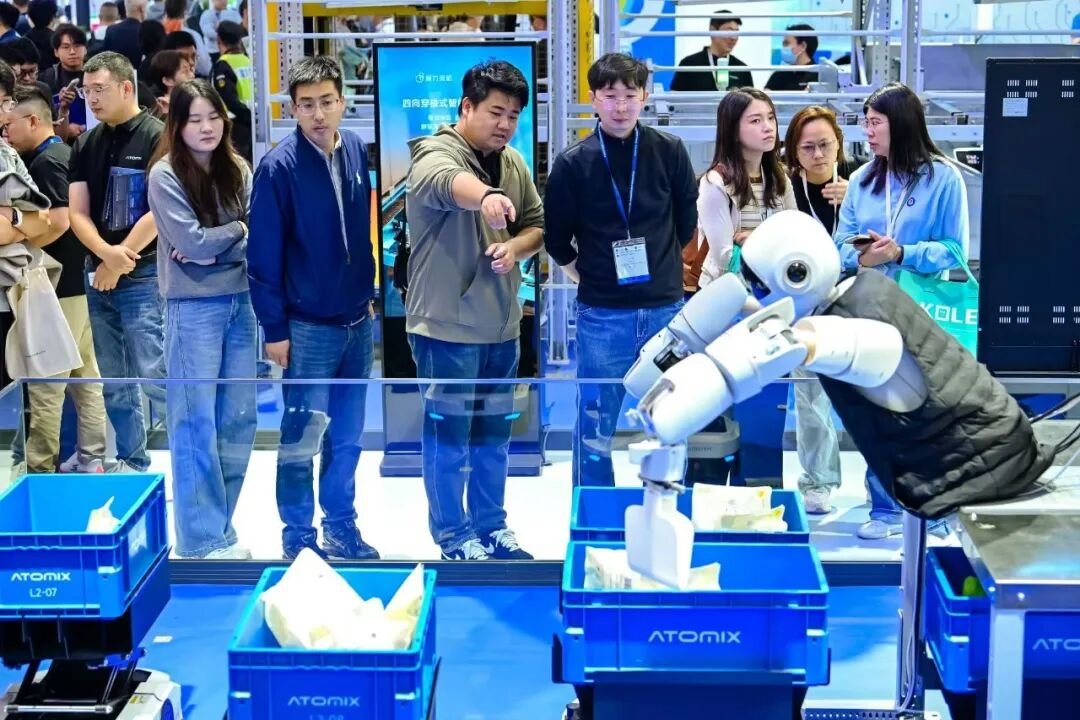
Origin Intelligence, which merged with ATOMIX in June 2026, took the opposite approach to the same problem. Instead of building one machine that can do everything, it split warehouse work into three levels and assigned each to the cheapest capable device.
L1 is a dedicated coordinate robot for standard, easily picked goods: high cycle rate, low cost. L2 is a dual-arm embodied robot for soft bags, irregular packaging and awkward poses, where dedicated machinery fails. L3 keeps humans for exceptions and long-tail tasks, and doubles as the backup for the automated tiers.
An AI layer decomposes the order and routes each line item to the right tier in real time. The company says its Ferrata multi-agent system has been tested in a real customer warehouse covering more than 100,000 SKUs with daily order peaks in the tens of thousands.
The design logic is to optimise at order level rather than machine level. A warehouse does not need every device to be universal. It needs an order to pass through the system without being stopped by one item that no machine can handle.
The 24/7 argument is not about night shifts
Geek+ showed its Gino 1 robot picking daily chemicals and bottled drinks, switching between products and handling tote transfer, and used the show to launch a plan for fully autonomous 24/7 warehouses.
Running through the night is the obvious benefit, and it is not the important one. The structural gain is that picking stops being tied to the opening hours of human stations, so work can be spread across more of the day. Most warehouses have a few sharp peaks and long troughs. If a flexible picking robot can clear orders that are already released during the trough, the peak gets shorter.
Geek+ platform vice president Tan Wenzhe says pilots are running in three or four warehouses, with customers including Korea’s largest e-commerce company, a global beauty group and a German electrical manufacturer. Existing conveyors, sorters and outbound systems then receive a steadier flow instead of a spike.
What actually gets faster
Warehouse automation has been sold on single-machine speed: cartons per hour, picks per minute, how much faster an arm is than a person. Those numbers still matter, and they are the least interesting part of the change.
A warehouse is a queue. If one item in an order cannot be picked, the conveyor downstream waits, the order stalls and the dispatch slot is missed. A machine that can handle soft bags and bottles does not just add capacity at one station. It removes the blockages that make the rest of the equipment idle.
Which is the real claim being made at CeMAT this year: not that robots are fast, but that the slowest item in the order is no longer a human hand.
Editor’s note: This is an adapted translation of the original OFweek report. It has been trimmed and restructured for readability for an international business audience. The full original (in Chinese) is at https://robot.ofweek.com/2026-11/ART-8321202-8420-30711042.html.