A veteran semiconductor supply-chain consultant who has tracked the industry for decades let a truth slip at a closed-door roundtable: crack open the PCB of a top-tier NVIDIA AI accelerator that speculators have pushed to $40,000 a chip, and you will find a handful of unremarkable components whose origin you cannot escape, Shizuishan, in China’s Ningxia region.
When foreign media repeated the remark, more than a few Silicon Valley engineers did a double take. The golden nugget everyone is fighting over still has its lifeline tied to a “local specialty” hauled from the foot of the Helan Mountains. The contrast punctures the embarrassment of “de-risking” better than any industry report.
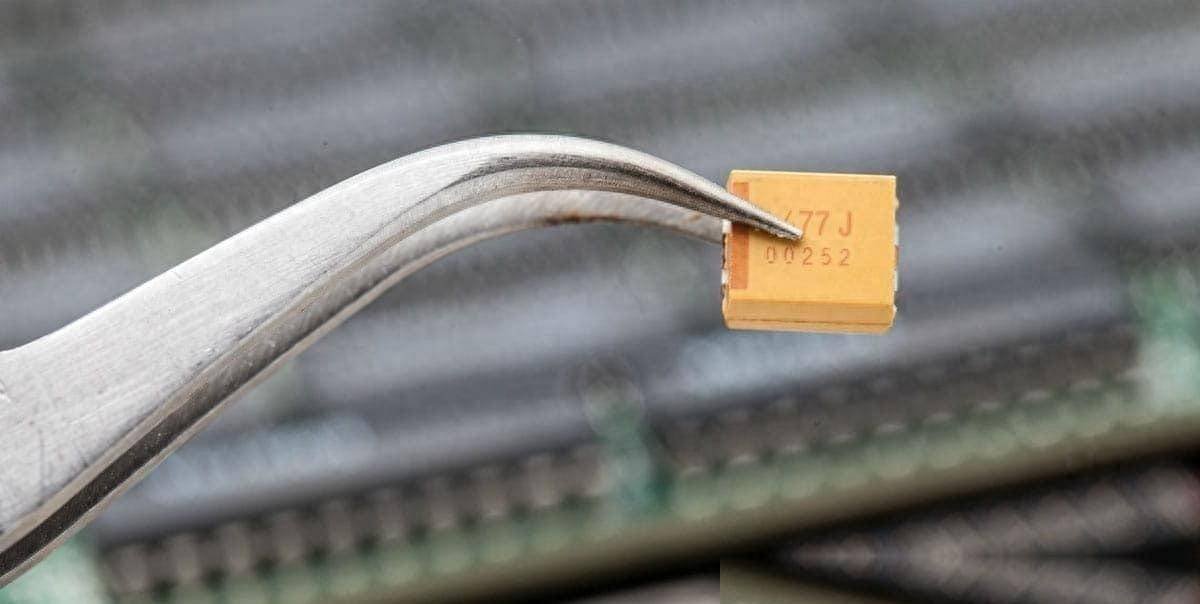
Your first instinct might be to object: an AI chip is defined by 3nm and 2nm EUV lithography. What does it have to do with the northwest? The answer sits in the row of black blocks along the edge of the GPU board, polymer tantalum capacitors.
The component that sits next to the GPU
Tantalum capacitors look modest, small and dull-coloured, but their job is to stabilise voltage and deliver sudden surges of current to the compute core. The two critical raw materials are capacitor-grade high-purity ultrafine tantalum powder and tantalum wire thinner than a human hair, and the bulk of global capacity sits in the hands of one old state-owned enterprise in Ningxia.
Why exactly does a tantalum cap end up next to an AI chip? Anyone who has run large-model training knows a single H100 or B200 can spike its load current from tens of amps to several hundred in an instant; a microsecond voltage collapse can bring the entire training run down. Aluminium electrolytics are slow and dry out in heat. MLCC ceramics are fast but crack under mechanical stress and short. Tantalum sits in the sweet spot: extremely low ESR, high energy density, stable from minus 55 to plus 175 degrees Celsius. AI servers, phased-array radar, satellite payloads, pacemakers, anywhere failure is not an option, lean on it.
The catch is that turning metallic tantalum into capacitor-grade material is a craft somewhere between metallurgy and magic. The industry measures powder by specific capacitance; ordinary grades sit around 1,000 microfarad-volt per gram, while ultra-high grades for high-end AI and military gear push to 150,000 or even 200,000. Hitting that means nano-scale particles, five-nines purity, and a sintering process that survives 1,500 degrees without breaking the wire.
Why Ningxia, of all places
The global tantalum market is tiny, around 2,000 tonnes a year of consumption, but a tight oligopoly. GAM, a US-Australian joint venture, Taniobis, formerly Germany’s H.C. Starck and now under Japan’s JX Metals, and Ningxia Orient Tantalum Industry split the high-end powder and wire market between them. On tantalum wire specifically, Ningxia Orient holds 50 to 60 per cent of the global share year after year; on ultra-high-capacitance powder, Ningxia alone takes roughly a third. Peel back the purchase orders of KEMET, AVX, Vishay and Kyocera and the address at the bottom is the same.
The plant’s lineage runs back to 1964, when a tantalum-niobium research group from the Beijing General Research Institute for Nonferrous Metals was relocated wholesale during the Third Front campaign and set up Factory 905 at the foot of the Helan Mountains, today’s Ningxia Orient. Its original mission: supply critical rare-metal inputs for the atomic and missile programmes. By the 1980s, with military orders collapsing, the team bet everything on capacitor-grade high-capacitance powder, going head-to-head with decades-ahead US, German and Japanese giants.
China’s tantalum powder specific capacitance rose from two or three thousand in the early 1980s to thirty-odd thousand by the 1990s, then past 150,000 this century, steadily overtaking Germany’s H.C. Starck and the US’s GAM. The 2000 dot-com boom multiplied tantalum prices tenfold and turned a military plant into a hidden champion. Since then, AI, 5G base stations and EVs have each taken a bigger bite of tantalum demand. In 2026, global GPU shipments are more than triple what they were two years ago, and Ningxia’s lines are running flat out.
A moat built on midstream refining
The geopolitical maths is the interesting part. Most tantalum ore sits in Congo, Rwanda and Ethiopia; China’s own deposits are low-grade and small, so more than 80 per cent of raw material is imported. Washington’s think-tank playbook says: choke the African mines and you cut the chain. Reality disagrees. Turning crude ore into potassium fluorotantalate and then into five-nines nano powder is the dirty, labour-intensive, capital-burning, environmentally punishing midstream step that only China has truly scaled.
Upstream resources abroad, midstream capacity locked in, that combination is the real moat. And it exposes a fatal gap in the containment strategy: the side being contained holds the upstream link the containee cannot do without. The result is an awkward mutual deterrence. Taiwan’s position is the most delicate: TSMC’s advanced packaging for NVIDIA still sources tantalum caps routed through Japan and Korea, whose powder and wire trace back to Ningxia. Island media now debate “critical-material resilience,” but even the government’s own research units will not write an optimistic conclusion: building replacement capacity in two or three years is a daydream.
Washington is not idle. The Critical Minerals Supply Chain Resilience Act passed at the end of 2025 earmarked over $4 billion in subsidies for rare-metal refining, with tantalum projects approved in Texas and Tennessee. But insiders know the truth: equipment and buildings can be bought; process parameters, worker feel and yield curves cannot. GAM’s US line has run for over thirty years and still cannot match Ningxia Orient’s latest generation. Expecting a Ningxia replacement on the new continent in three to five years is policy slogans outrunning engineering reality.
The unglamorous bottom card
This single material says more than its niche suggests. It is a live lesson in industrial depth: modern high tech is never carried by one star chip, but by tens of thousands of unglamorous intermediates strung into a chain. Break one link and the brightest bead becomes scrap.
Washington has spent years engineering decoupling, only to find that the deeper you dig into the supply chain, the more Chinese names you unearth. That is not luck; it is the accumulated estate of generations of workers and engineers. So the American expert’s mixed feelings make sense. Silicon Valley puts a $40,000 price tag on an AI chip, pushes lithography to the 2nm edge, stacks training clusters to 100,000 cards, a spectacle anyone would applaud. But the moment all that civilisation is racked and powered on, whether it actually runs still depends on whether a few electric furnaces at the foot of the Helan Mountains fired on schedule, and whether a few spools of wire finer than hair shipped on time. That is the least dignified, and most real, bottom card of the AI age.
Source (Chinese original): Sohu IT
Translated and adapted from Sohu IT (it.sohu.com).