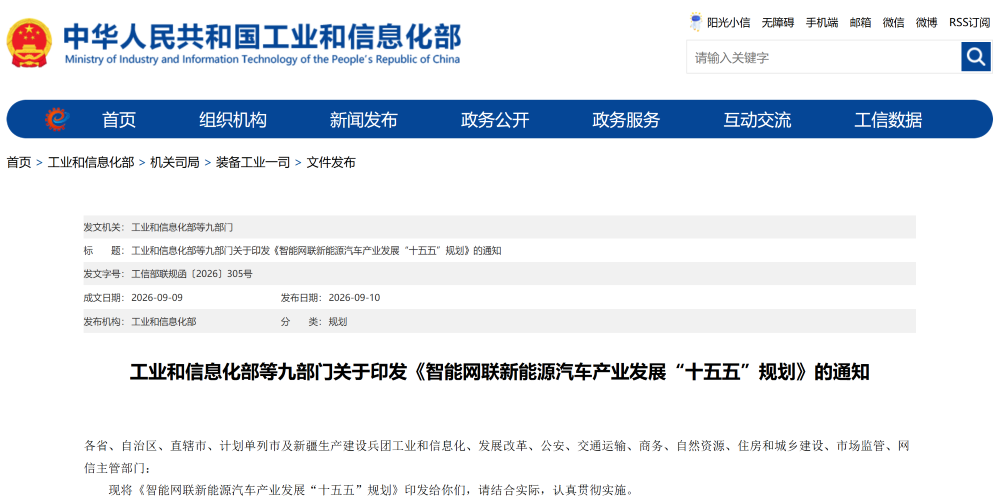
China’s intelligent connected new-energy vehicle industry now has a specific plan for the 15th Five-Year Plan period. MIIT and eight other departments issued the plan for the industry’s development, a document that sets the sector’s direction through 2030.
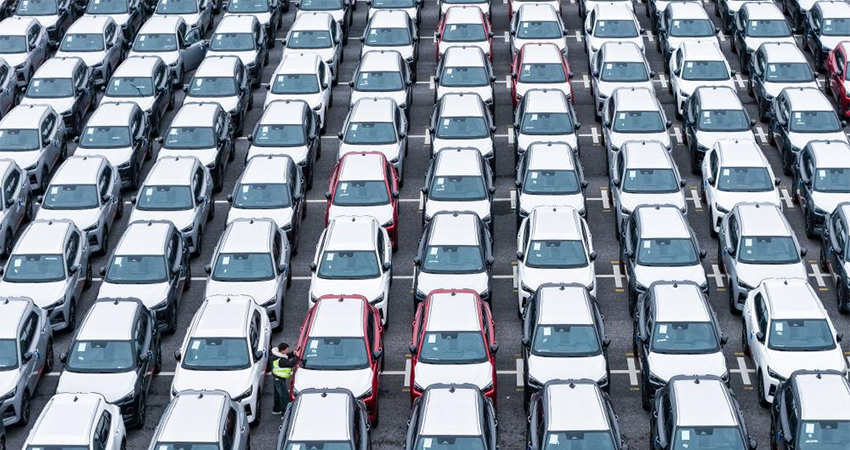
The plan calls intelligent connected new-energy vehicles the main direction of the industry’s transformation, a representative of new productive forces and a core part of building a modern industrial system. Its headline targets for 2030 are that China’s full-industry-chain advantage is further consolidated and the country joins the ranks of world automotive powers, that new-energy passenger cars and commercial vehicles reach 70 per cent and 40 per cent of new vehicle sales in their segments, and that cars with autonomous driving functions are deployed at scale.
On key technologies it sets average passenger-car fuel consumption at 3.3 litres per 100 kilometres and average pure-electric passenger-car energy consumption at about 11.5 kilowatt-hours per 100 kilometres, with highly automated driving on highways, urban expressways and some city roads. The industrial structure should keep improving, with labour productivity per worker up 15 per cent on 2025 and several vehicle makers in the global top ten by sales plus suppliers in the global top hundred.
Internationally, it wants stronger global operations for Chinese firms, higher brand reputation and a bigger voice in international standards and regulations. On economic and social impact, it targets carbon peaking before 2030 and says vehicles with autonomous driving systems should be substantially safer than human drivers.
The plan sets five priority tasks with 17 specific actions and seven supporting programmes. The first is raising technological innovation capacity, built on three measures. It calls for core technology breakthroughs in energy and powertrain, intelligent chassis and intelligent connectivity, supported by a dedicated programme covering batteries with better safety, charging rate, cold-weather use and cycle life, low and zero-carbon combustion engines, high-temperature and long-life fuel-cell stacks, integrated drive-brake-steering-suspension chassis with in-wheel motors and steer-by-wire, a dedicated automotive AI model, vehicle-road-cloud cooperative autonomy and high-value autonomous driving scenario libraries.
It also targets the whole vehicle, calling for a new electronic and electrical architecture, better integrated powertrain and chassis design, lighter weight, lower drag and lower rolling resistance, plus work on amphibious vehicles. Under foundational materials, software and chips, it lists ultra-high-strength steel, aluminium, magnesium, fibre-reinforced composites, special rubber and engineering plastics, an in-vehicle operating system kernel, middleware and functional software, simulation tools for structure, fluids and dynamics, and faster iteration of computing, control, storage and communication chips and high-end sensors.
The second measure is supply-chain resilience and safety, with rolling high-quality development actions to close gaps in key materials, operating systems, industrial software, automotive chips and components, using first-batch material and first-edition software policies, and coordinating the mining and recycling of lithium, cobalt and nickel. The third is a more effective innovation system, supporting cross-sector innovation consortia led by leading firms, national laboratories and manufacturing innovation centres, faster build-out of pilot and public-service platforms, and venture funds that invest early, small, long-term and in hard technology.
The second priority task upgrades the industrial system. It pushes digital and intelligent transformation across the whole chain, embedding AI in research, production, supply, sales and service, building a new vehicle-component collaboration model, expanding smart factories and upgrading industrial control systems. A dedicated “AI plus cars” programme covers foundation models and agents, pilot AI bases and shared compute, plus deeper on-vehicle AI in energy management, motion control, multi-modal interaction, proactive service and fault prediction, with cockpit-driving integration and links between cars, robots, smart homes and wearables. It also calls for trusted data spaces for manufacturing, autonomous driving, digital supply chains and safety assessment, and about 50 typical application scenarios.
On green development, it wants a digital identity system for traction batteries and better recycling, plus participation in international carbon standards. On world-class enterprises, it continues the “upward development of Chinese auto brands” campaign, cultivates leading component firms and supports regions building world-class intelligent connected NEV manufacturing clusters. On the aftermarket, it targets repair information disclosure, a repair technology standards system, lower repair costs, and new consumption in insurance, remote maintenance, roadside assistance, software subscriptions, modification, leasing, motorsport and RV camping.
The third task covers cross-sector integration. On information and communication, it wants deeper 5G and 5G-Advanced coverage in key cities and some highways, C-V2X roadside equipment, higher penetration of vehicle-side 5G and C-V2X, direct-to-satellite and BeiDou integration, coordinated compute scheduling and IPv6 adoption. On transport and cities, it wants nationwide digital upgrading of traffic lights, signs and markings, scaled roadside sensing, and deeper integration of autonomous driving with logistics and mobility. On energy, it wants better charging and battery-swap infrastructure, high-power charging, rural charging, vehicle-to-grid at scale, coordination with green power and green hydrogen, and wider use of new-energy heavy trucks.
A dedicated application programme pushes autonomous driving across passenger cars, buses, trunk logistics, urban delivery and special operations, orderly market access and road operation for intelligent connected vehicles, pilot functional driverless vehicles, vehicle-road-cloud integration in top-tier cities and some national highways, and cross-region low-carbon corridors for new-energy heavy trucks.
The fourth task is industry governance. On standards, it aims to deepen participation in the UN World Forum for Harmonisation of Vehicle Regulations, or UN/WP.29, and to enter the global front rank of newly led international standards, with new standard systems for automotive chips, software, data governance, automotive AI, solid-state batteries and low-carbon development. It plans safety standards for functional safety, expected functional safety, cyber security, data security and road safety, plus fast-tracked standards for autonomous driving and automated parking systems, and frontier standards for cockpit-driving integration, solid-state batteries, distributed drive, fully active suspension and integrated driving units.
On access and use management, it will revise rules covering vehicle production access, road traffic safety, road transport, surveying and insurance, improve access requirements for combined driver assistance and autonomous driving systems, and strengthen software and hardware upgrade filing. On capacity, it will strictly enforce investment rules, tighten conditions for new standalone new-energy vehicle projects, push mergers and cross-region consolidation, and let low-efficiency capacity exit in an orderly way. On market order, it will strengthen antitrust, anti-unfair-competition and price enforcement, correct improper local intervention, and curb excessive local subsidies, tax breaks, land discounts and resource handouts used to attract investment.
The fifth task is global cooperation. It wants top-level design for internationalisation, deeper cooperation through trade, investment and technology, participation in international trade rules, and a new international science organisation for intelligent connected NEV innovation. It encourages banks to provide convenient local and foreign currency settlement, innovation in currency-hedging products and stronger export credit insurance, better fit between China-Europe freight trains and NEV exports, and cross-brand overseas spare-part warehouses to cut logistics costs, with compliance guidance for firms going abroad. It also promotes cross-border data flows with pilot cooperation, mutual regulatory recognition and integrated compute, algorithm and data centres, and deepens inbound investment by giving foreign firms national treatment and equal standing in government procurement.
The plan closes with implementation measures: the inter-ministerial coordination mechanism, tax incentives for new-energy vehicles, reform pilots for auto circulation and consumption, trade-in programmes, NEV sales in rural areas, bus and battery renewal, deeper reform of NEV insurance, management of cross-region used-car circulation, and new academic programmes for intelligent electric vehicles backed by an industry talent catalogue.
Editor’s note: This is an adapted translation of the original Chedongxi report. It has been trimmed and restructured for readability for an international business audience.